Stream Deck Radio Controller Built With Cheap Yellow Display

Stream decks are pretty useful in all kinds of contexts, but commercial models can feel a bit pricy for what is effectively a bunch of buttons. [WhiskeyTangoHotel] has whipped up one of their own on the cheap using some readily available parts.

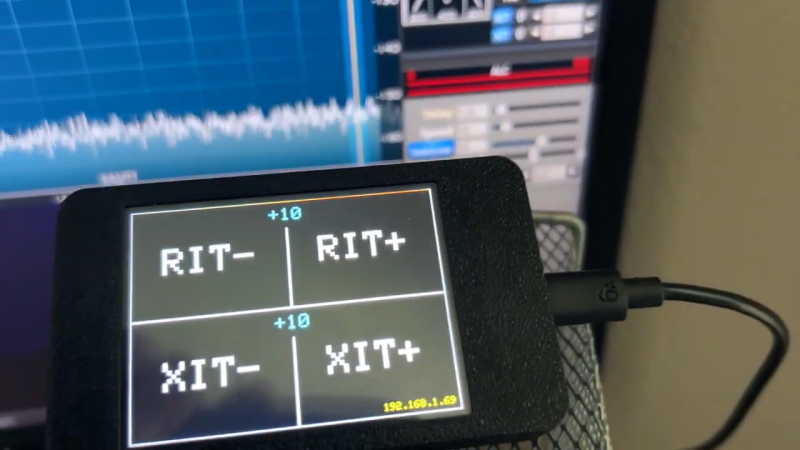
The build came about due to the use of Stream Decks as a common way to control the Flex-6400 software-defined radio. [WhiskeyTangoHotel] figured that using a full-priced Elgato Stream Deck was overkill for this purpose, and that a cheaper interface could be put together for less. Enter the Cheap Yellow Display—a combination of the ESP32 microcontroller with a 2.8-inch touchscreen LCD. It was simple enough to code the device such that it had four big touch buttons to control RIT-, RIT+, XIT-, and XIT+ on the Flex-6400. Plus, with the ESP32 having WiFi onboard, it’s able to control the radio wirelessly—you just need to feed the unit 5 volts, and you’re up and running.

Continue reading “Stream Deck Radio Controller Built With Cheap Yellow Display”
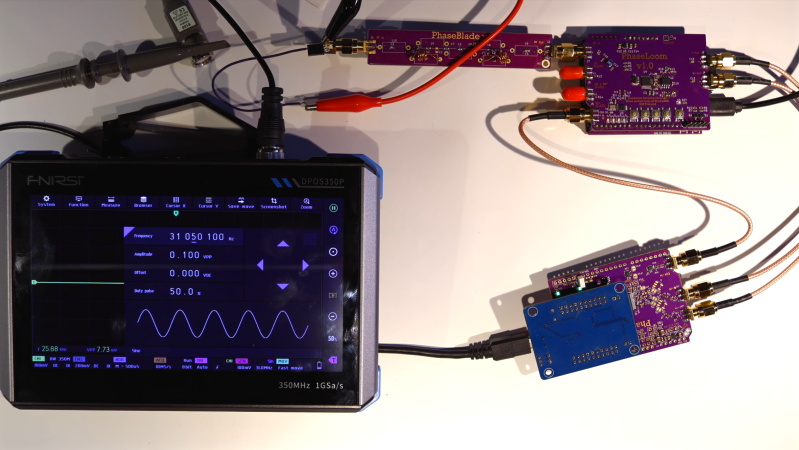
An oscilloscope display is seen in lower left corner. In the rest of the image, two purple circuit boards are connected by SMA RF cables. A wire antenna is connected to one board.

Building A $50 SDR With 20 MHz Bandwidth

Although the RTL-SDR is cheap, accessible, and capable enough for many projects, it does have some important limitations. In particular, its bandwidth is limited to about 3.2 MHz, and the price of SDRs tends to scale rapidly with bandwidth. [Anders Nielsen], however, is building a modular SDR with a target price of $50 USD, and has already reached a bandwidth of almost 20 MHz.

If this project looks familiar, it’s because we’ve covered an earlier iteration. At the time, [Anders] had built the PhaseLoom, which filters an incoming signal, mixes it down to baseband, and converts it to I/Q signals. The next stage is the PhaseLatch, a board housing a 20-MHz, 10-bit ADC, which samples the in-phase and quadrature signals and passes them on to a Cypress FX2LP microcontroller development board. [Anders] had previously connected the ADC to a 6502 microprocessor instead of the FX2LP, but this makes it a practical SDR. The FX2LP was a particularly good choice for this project because of its USB 2.0 interface, large buffers for streaming data, and parallel interface. It simply reads the data from the SDR and dumps it to the computer.

Continue reading “Building A $50 SDR With 20 MHz Bandwidth”

Analog Video From An 8-Bit Microcontroller

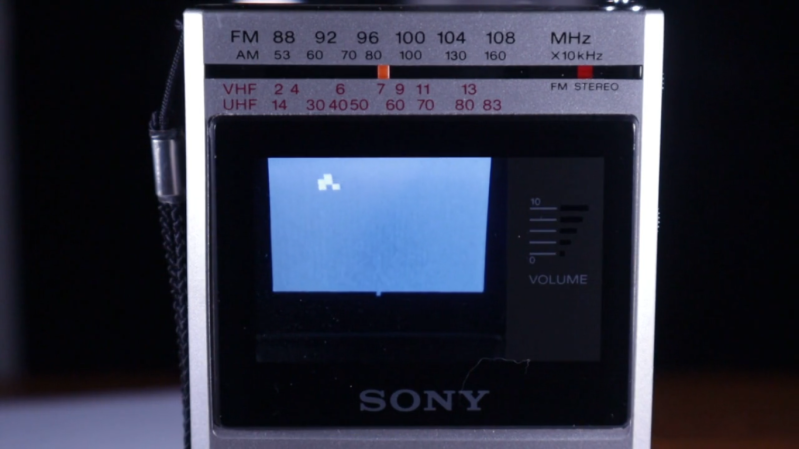
Although the CRT has largely disappeared from our everyday lives, there was a decades-long timeframe when this was effectively the only display available. It’s an analog display for an analog world, and now that almost everything electronic is digital, these amazing pieces of technology are largely relegated to retro gaming and a few other niche uses. [Maurycy] has a unique CRT that’s small enough to fit in a handheld television, but since there aren’t analog TV stations anymore, he decided to build his own with nothing but an 8-bit microcontroller and a few other small parts.

Continue reading “Analog Video From An 8-Bit Microcontroller”

Open Source Radar Has Up To 20 KM Range

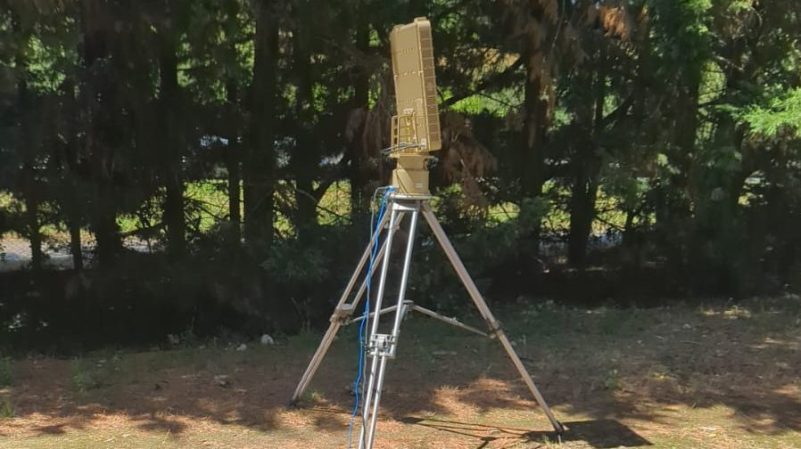
Phased-array radars are great for all sorts of things, whether you’re doing advanced radio research or piloting a fifth-generation combat aircraft. They’re also typically very expensive. [Nawfal] hopes to make the technology more affordable with an open-source radar design of their own.

The design is called the AERIS-10, and is available in two versions. Operating at 10.5 GHz, it can be built to operate at ranges between 3 or 20 kilometers depending on the desired spec. The former uses an 8 x 16 patch antenna array, while the latter extends this to a 32 x 16 array. Either way, each design is capable of fully-electronic beam steering in azimuth and can be hacked to enable elevation too—one of the most attractive features of phased array radars. The hardware is based around an STM32 microcontroller, an FPGA, and a bunch of specialist clock generators, frequency synthesizers, phase shifters, and ADCs to do all the heavy lifting involved in radar.

Radar is something you probably don’t spend a lot of time thinking about unless you’re involved in maritime, air defence, or weather fields. All of which seem to be very much in the news lately! Still, we feature a good few projects on the topic around these parts. If you’ve got your own radar hacks brewing up in the lab, don’t hesitate to let us know. 

A Radio Power Amplifier For Not A Lot

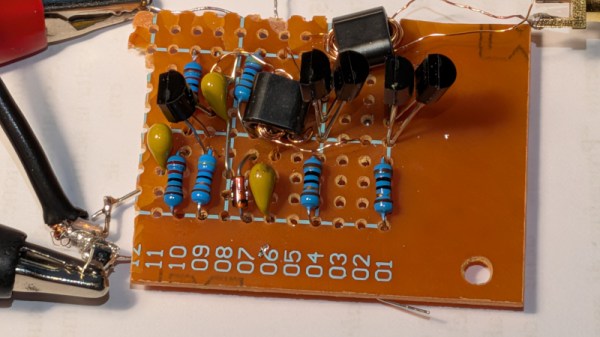
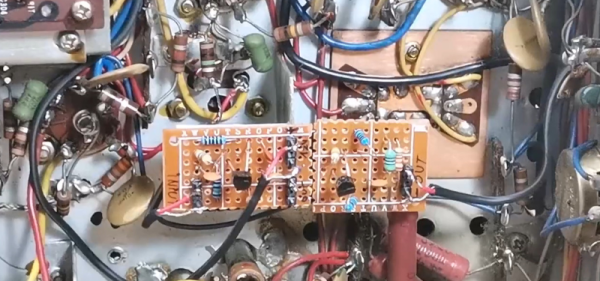
When building a radio transmitter, unless it’s a very small one indeed, there’s a need for an amplifier before the antenna. This is usually referred to as the power amplifier, or PA. How big your PA is depends on your idea of power, but at the lower end of the power scale a PA can be quite modest. QRP, as lowe power radio is referred to, has a transmit power in the miliwatts or single figure watts. [Guido] is here with a QRP PA that delivers about a watt from 1 to 30 MHz, is made from readily available parts, and costs very little.

Inspired by a circuit from [Harry Lythall], the prototype is built on a piece of stripboard. It’s getting away with using those cheap transistors without heatsinking because it’s a class C design. In other words, it’s in no way linear; instead it’s efficient, but creates harmonics and can’t be used for all modes of transmission. This PA will need a low-pass filter to avoid spraying the airwaves with spurious emissions, and on the bands it’s designed for, is for CW, or Morse, only.

We like it though, as it’s proof that building radios can still be done without a large bank balance. Meanwhile if the world of QRP interests you, it’s something we have explored in the past.

Simple D-STAR Transceiver Uses Inexpensive Hardware

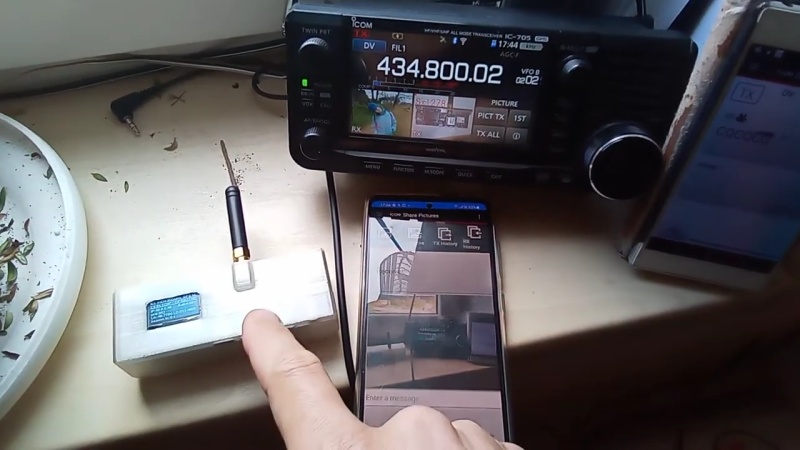
[Yeckel] recently put the finishing touches on an ambitious implementation of a simple D-STAR (Digital Smart Technologies for Amateur Radio) transceiver using some very accessible and affordable hardware. The project is D-StarBeacon, and [Yeckel] shows it working on a LilyGO TTGO T-Beam, an ESP32-based development board that includes a SX1278 radio module and GPS receiver. It even serves a web interface for easy configuration.

What is D-STAR? It’s a protocol used by radio operators for voice that also allows transmitting low-speed data, such as short text messages or GPS coordinates. While voice is out of scope for [Yeckel]’s project (more on that in a moment) it can do all the rest, including send images. That makes beacon-type functions possible on inexpensive hardware, instead of requiring a full-blown radio.

As mentioned, voice is a big part of D-STAR. While [Yeckel] was able to access the voice data, attempts to decode it were unsuccessful. A valiant effort, but we suppose voice decoding isn’t terribly relevant to beacon-type operations like transmitting APRS (Automatic Packet Reporting System).

So far as [Yeckel] is aware, D-StarBeacon is currently the only open-source implementation of a D-STAR radio available on the internet, which is pretty interesting. We’ve seen projects that touch indirectly on D-STAR, but nothing like this.

Watch it go through its paces in the video embedded below. Since the T-Beam is just a microcontroller development board, the user interface comes from an Android app on a mobile phone, which is why you see a phone in the video.

Continue reading “Simple D-STAR Transceiver Uses Inexpensive Hardware”

Adding A Panadapter To A Classic Receiver

There was a time when only the richest ham radio operators could have a radio with a panadapter. Back in the day, this was basically a spectrum analyzer that monitored a broad slice of the receiver’s intermediate frequency so you could see signals on either side of the receiver’s actual frequency. Today, with SDR technology and computers, this is an easy thing for receivers to implement. But what if you want to refit a classic radio? It isn’t that hard, and [Mirko Pavleski] shares his notes on how he tackled the project. You can also check it out in the video below.

The plan is simple. A FET amplifier taps the radio’s IF stage before the first IF filter. This provides good isolation and buffering. Then, an emitter follower stage provides a matched output to the SDR through a low-pass filter. The SDR remains tuned to the IF frequency, of course. The rest is essentially software and procedures.

Continue reading “Adding A Panadapter To A Classic Receiver”