Decoding JS1YMG: First Ham Radio Station On The Moon After SLIM Mission

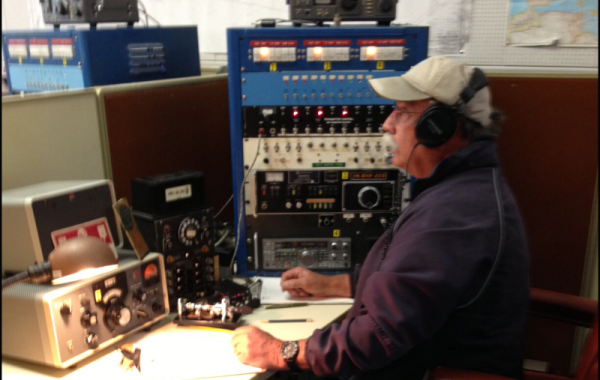
When Japan’s SLIM lunar lander made a rather unconventional touch-down on the lunar surface, it had already disgorged two small lunar excursion vehicles from its innards: LEV-1 and LEV-2. Of these, the LEV-1 is not only capable of direct to Earth transmission, but it also has been assigned its own amateur radio license: JS1YMG, which makes it the first Ham radio station on the Moon. LEV-1 receives data from LEV-2, which is transmitted to Earth using its 1 Watt UHF circular polarization antenna as Morse code at 437.410 MHz. Although the data format hasn’t been published, [Daniel Estévez] (EA4GPZ) has been sleuthing around to figure it out.

Using captures from the 25 meter radiotelescope at Dwingeloo in the Netherlands, [Daniel] set to work deciphering what he knew to be telemetry data following a CCSDS standard. After some mix-and-matching he found that the encoding matched PCM/PSK/PM with a symbol rate of 64 baud and 2048 kHz subcarrier. The residual carrier is modulated in amplitude with Morse code, but initially this Morse code made no sense.

Continue reading “Decoding JS1YMG: First Ham Radio Station On The Moon After SLIM Mission”

HF In Small Spaces

Generally, the biggest problem a new ham radio operator will come across when starting out on the high frequency (HF) bands is finding physical space for the antennas. For a quick example, a dipole antenna for the 20 m band will need around 10 m of wire, and the lower frequencies like 80 m need about four times as much linear space. But if you’re willing to trade a large space requirement for a high voltage hazard instead, a magnetic loop antenna might be just the ticket.

Loop antennas like these are typically used only for receiving, but in a pinch they can be used to transmit as well. To tune the antennas, which are much shorter than a standard vertical or dipole, a capacitor is soldered onto the ends, which electrically lengthens the antenna. [OM0ET] is using two loops of coax cable for the antenna, with each end soldered to one half of a dual variable capacitor which allows this antenna to tune from the 30 m bands to the 10 m bands, although he is using it mostly for WSPR on 20 m. His project also includes the use of an openWSPR module, meaning that he doesn’t have to dedicate an entire computer to run this mode.

The main downsides of antennas like these is that they are not omnidirectional, are not particularly good at transmitting, and develop a significantly high voltage across the capacitor as this similar mag loop antenna project demonstrated. But for those with extreme limitations on space or who, like [OM0ET] want a simple, small setup for running low-power applications like WSPR they can really excel. In fact, WSPR is a great mode for getting on the air at an absolute minimum of cost.

Continue reading “HF In Small Spaces”

No Dish? Try A Portable Weave Helix Antenna

When you think of satellite communications, you probably think of a dish. But that’s not the only option — a new device from the American University of Beruit and Stanford created a portable antenna made of woven materials that packs easily, weighs little, and can reconfigure for ground-to-space or ground-to-ground communications. The antenna reminded us of a finger trap and you can see it for yourself in the video below.

Because of the antenna’s construction, it can fold up and also adjust to different lengths for different purposes. The antenna collapses to a ring that is five inches across and 1 inch tall. The weight? Under two ounces. The actual paper in Nature Communications is available to read online.

Stretched out to about a foot, the antenna is omnidirectional. The size, of course, also changes the resonant frequency. Tuning is no problem, though, since you can easily change the size as needed. The antenna may also find use on satellites where it’s low weight, and compact storage would be a definite advantage.

The antenna’s weave is actually two separate helixes, one conductive and the other insulating. The antenna normally operates in a vertical configuration. It looks like it might be simple to make some version of this without anything exotic. Let us know if you try!

Helical antennas aren’t new, but this is an unusual construction. They are popular as satellite antennas because of their polarization characteristics among other things.

Continue reading “No Dish? Try A Portable Weave Helix Antenna”

FM Radio Is Discriminating

AM radios were easy to understand. The strength of the signal goes up and down, and the audio follows. FM radio is a little more difficult. [AllAmericanFiveRadio] has an old tube FM set and takes us on a tour of how the FM discriminator works. You can see the video below.

The first step is to look at the IF signal on the scope. It is hard to see, but the frequency is changing, and that’s the basis of modulation that the discriminator has to resolve.

Continue reading “FM Radio Is Discriminating”

Simulating A Time-Keeping Radio Signal

As far as timekeeping goes, there’s nothing more accurate and precise than an atomic clock. Unfortunately, we can’t all have blocks of cesium in our basements, so various agencies around the world have maintained radio stations which, combined with an on-site atomic clock, send out timekeeping signals over the air. In the United States, this is the WWVB station located in Colorado which is generally receivable anywhere in the US but can be hard to hear on the East Coast. That’s why [JonMackey], who lives in northern New Hampshire, built this WWVB simulator.

Normally, clocks built to synchronize with the WWVB station include a small radio antenna to receive the 60 kHz signal and the 1-bit-per-second data transmission which is then decoded and used to update the time shown on the clock. Most of these clocks have internal (but much less precise) timekeeping circuitry to keep themselves going if they lose this signal, but [JonMackey] can go several days without his clocks hearing it. To make up for that he built a small transmitter that generates the proper timekeeping code for his clocks. The system is based on an STM32 which receives its time from GPS and broadcasts it on the correct frequency so that these clocks can get updates.

The small radio transmitter is built using one of the pins on the STM32 using PWM to get its frequency exactly at 60 kHz, which then can have the data modulated onto it. The radiating area is much less than a meter, so this isn’t likely to upset any neighbors, NIST, or the FCC, and the clocks need to be right beside it to update. Part of the reason why range is so limited is that very low frequency (VLF) radios typically require enormous antennas to be useful, so if you want to listen to more than timekeeping standards you’ll need a little bit of gear.

How To Operate A 500KW Transmitter

Crosley was a famous name in radio for more than one reason. The National VOA Museum of Broadcasting has a video telling [Powel Crosley Jr.’s] story, and the story behind the 500 kW WLW transmitter. WLW was an AM broadcast station often called the nation’s channel since its signal covered most of the United States. The first Crosley station was identified at 8CR, running 20 watts from [Crosley’s] living room. Quite a modest start!  By 1922, he had moved to his family business location along with 500 watts of output. Over the years, WLW got more powerful until it was finally a 500 kW giant.

Continue reading “How To Operate A 500KW Transmitter”

Pico-Sized Ham Radio

There are plenty of hobbies around with huge price tags, and ham radio can certainly be one of them. Experienced hams might have radios that cost thousands of dollars, with huge, steerable antennas on masts that can be similarly priced. But there’s also a side to the hobby that throws all of this out of the window in favor of the simplest, lowest-cost radios and antennas that still can get the job done. Software-defined radio (SDR) turned this practice up to 11 as well, and this radio module uses almost nothing more than a microcontroller to get on the air.

The design uses the capabilities of the Raspberry Pi Pico to handle almost all of the radio’s capabilities. The RF oscillator is driven by one of the Pico’s programmable I/O (PIO) pins, which takes some load off of the processor. For AM and SSB, where amplitude needs to be controlled as well, a PWM signal is generated on another PIO which is then mixed with the RF oscillator using an analog multiplexer. The design also includes a microphone with a preamplifier which can be fed into a third PIO; alternatively it can receive audio from a computer via the USB interface. More processor resources are needed when generating phase-modulated signals like RF, but the Pico is still quite capable of doing all of these tasks without jitter larger than a clock cycle.

Of course this only outputs a signal with a few milliwatts of power, so for making any useful radio contacts with this circuit an amplifier is almost certainly needed. With the heavy lifting done by the Pico, though, the amplifier doesn’t need to be complicated or expensive. While the design is simple and low-cost, it’s not the simplest radio possible. This transmitter sends out radio waves using only a single transistor but you will be limited to Morse code only.

Continue reading “Pico-Sized Ham Radio”