A Slim 7400 Logic VGA Board For All Your Retro Needs

Over the years we’ve seen a number of hackers generate VGA with 74xx logic chips, but they’ve generally not been the most practical of builds. Often put together as part of a competition or purely for the challenge, these circuits are usually implemented in a mass of jumper wires and often take up multiple breadboards. Not exactly something you can toss in a drawer when you’re done with it.

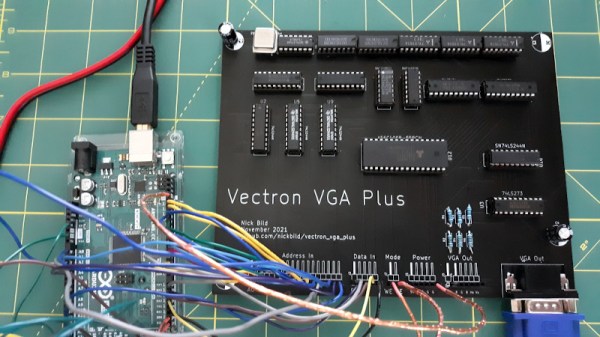
But the Vectron VGA Plus, created by prolific hacker [Nick Bild], manages to improve on things considerably. Designed specifically to be smaller and simpler than its predecessors, the custom PCB contains far fewer chips than we’re used to seeing for this kind of thing. At the same time it provides a handy header row along the bottom that allows the user to connect whatever they’re working on, from microcontrollers to retro computers.
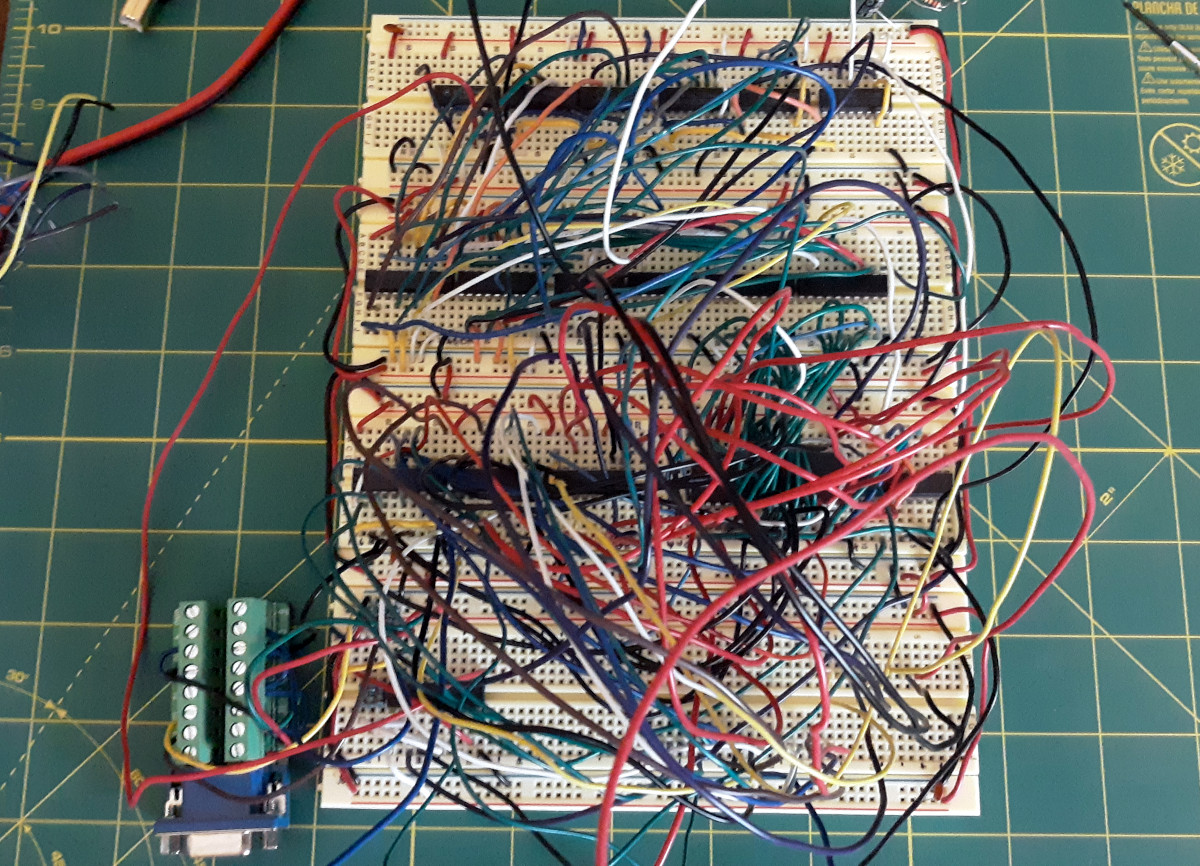
When your breadboard looks like this, it’s time for a PCB.

It looks like the PCB could still be shrunk down considerably if you’re really looking to maximize desk space, but we imagine for his purposes, [Nick] felt this was more than compact enough. Especially when you look at what the same circuit looked like during the breadboard phase. Yikes.

So, what did it take to simplify this 640 x 480 VGA interface? The short answer is adding more RAM. Wherever possible, dedicated hardware was replaced with software operations that could be performed by the externally connected device. [Nick] has provided some sample code for the Arduino that lets the microcontroller push data into the board’s memory and take control.

We can trace the origins of this project back a few years, to when [Nick] was working on adding an LCD to his homebrew 6502 computer. A few months later he put together the earlier version of this board, the Vectron VGA, before switching gears and handing VGA generation duty over to a FPGA. We’re excited to see the next evolution of this project, and given the track record of this particular hacker, we shouldn’t have to wait long before it hits our inbox.
MAC TIP Diagnoses Your Old Zip And Jaz Drives

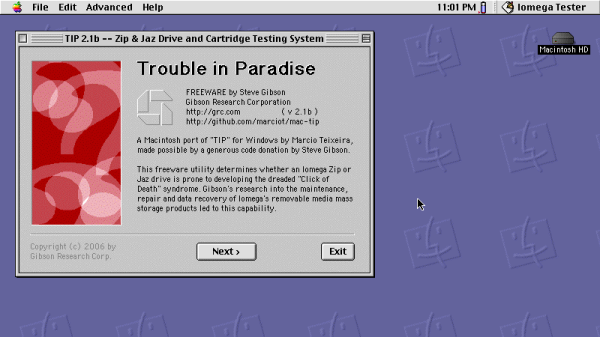
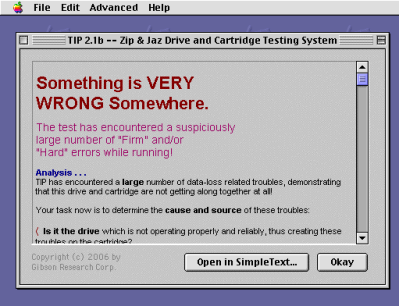
Trouble In Paradise (TIP) was a popular Windows-only tool for troubleshooting  Iomega Jaz and Zip drives way back when. The drives have fallen out of favor with PC, but the drives are still highly prized amongst classic Mac collectors, who use the SCSI versions as boot disks for the vintage machines. Thus, [Marcio Luis Teixeira] set about porting the TIP tool to the platform.

Macintosh utilities used to have so much personality about them.

It all came about because running the original TIP recovery tool became difficult in the modern era. One must dig up a old Windows 98 machine and SCSI adapters in order to use it with Macintosh-compatible Zip or Jaz drives. This inspired [Marcio] to reach out to the developer, [Steve Gibson], who provided the original x86 assembly code for the tool.

[Marcio] then ported this line-by-line into C and compiled it with a retro Macintosh compiler to get TIP up and running on the classic Mac platform. Now, it’s possible to check and test Zip and Jaz drives and media on your old Mac without having to mess around with a vintage Windows machine.

It took plenty of effort, and the generous donation of code from [Steve Gibson], and all involved should be applauded for their work. It’s not every day we see such an impressive port, but they come along every now and then.

Meanwhile, if you’ve been tinkering on your own projects with Iomega’s classic removable storage, don’t hesitate to let us know! Video after the break.

Continue reading “MAC TIP Diagnoses Your Old Zip And Jaz Drives” →

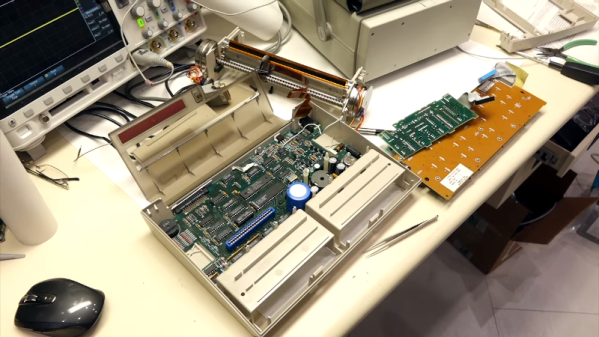
Almost-Modern TeleType Is Silent

If you’ve ever used a real TeleType machine or seen a movie with a newsroom, you know that one TeleType makes a lot of noise and several make even more.[CuriousMarc] acquired the silent replacement, a real wonder of its day, the TI Silent 703. The $2,600 machine was portable if you think hauling a 25-pound suitcase around is portable. In 1971, it was definitely a step up.

The machine used a thermal printer, could have a built-in acoustic coupler for talking over the phone. You could also get a dual tape drive that acted like a mostly silent paper tape reader and punch.

Continue reading “Almost-Modern TeleType Is Silent” →

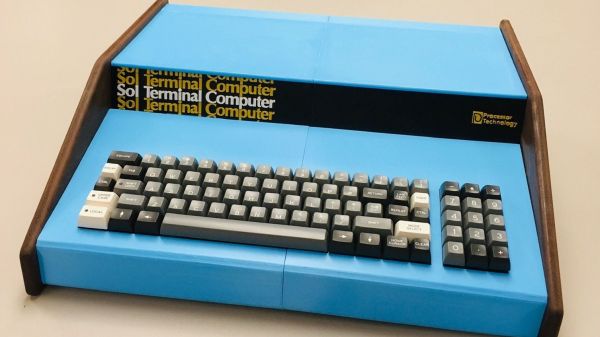
Sol-20 reproduction

Retro Reproduction Captures The Style Of The Sol-20

In the early years of the computer revolution, a machine like the Sol-20 really stood out. Where most hobbyist machines had front panels that bristled with toggle switches and LEDs, the Sol-20 was a sleek, all-in-one that looked like an electric typewriter in a walnut-trimmed box. Unfortunately, it was also quite expensive, so not that many were sold. This makes them hard enough to find 40 years later that building his own reproduction Sol-20 is about the only way for [Michael Gardi] to have one of his own.

In a lot of ways, the Sol-20 anticipated many of the design elements that would come into play later. Like the Apple and Commodore machines that were coming down the pike, the Sol-20 was intended to be plug and play. [Mike] celebrates that design with a full-size reproduction of the original, concentrating on its unique aesthetic aspects. The reproduction mimics the striking blue case, with its acrylic front panel and walnut sides. The keyboard is also an exact match for the original, in looks if not in function — the capacitive mechanism proved too difficult to replicate, so he opted for a kit using Cherry switches and custom keycaps. [Mike] also used his proven technique for 3D-printing the memorable Sol-20 logo for the front panel, in the correct font and color.

Under the hood, a Raspberry Pi runs an 8080 emulator, which supports a range of virtual devices, including a cassette tape drive and the video output. For fun, [Mike] also imagined what a CRT display for the Sol-20 would have looked like, and added that to his build. It’s a great-looking machine that never was, and we appreciate the attention to detail. We’ve seen that before — his 2/3-scale VT-100 terminal comes to mind, as does his reproduction of a 1960s computer trainer.

Building The DIY HP41C: A Field Report

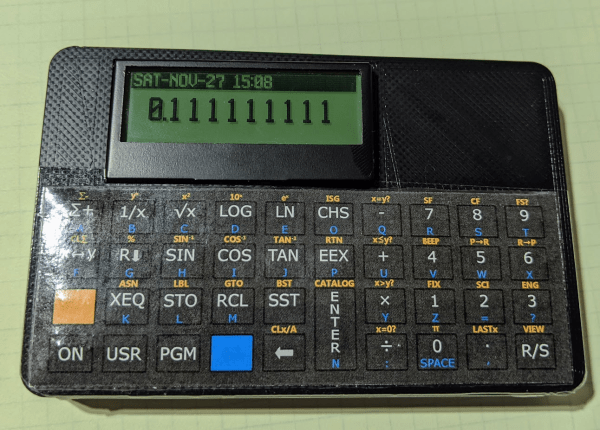
I have a confession to make. I write about a lot of projects for Hackaday, but there are very few I read about and then go actually build a copy of it. I don’t have a lot of time and I’m usually too busy building my own stuff. But once in a while, something strikes my fancy and I’ll either raid the junk box or buy the kit. The most recent case of that was the PX-41C, a replica of the classic HP-41C.

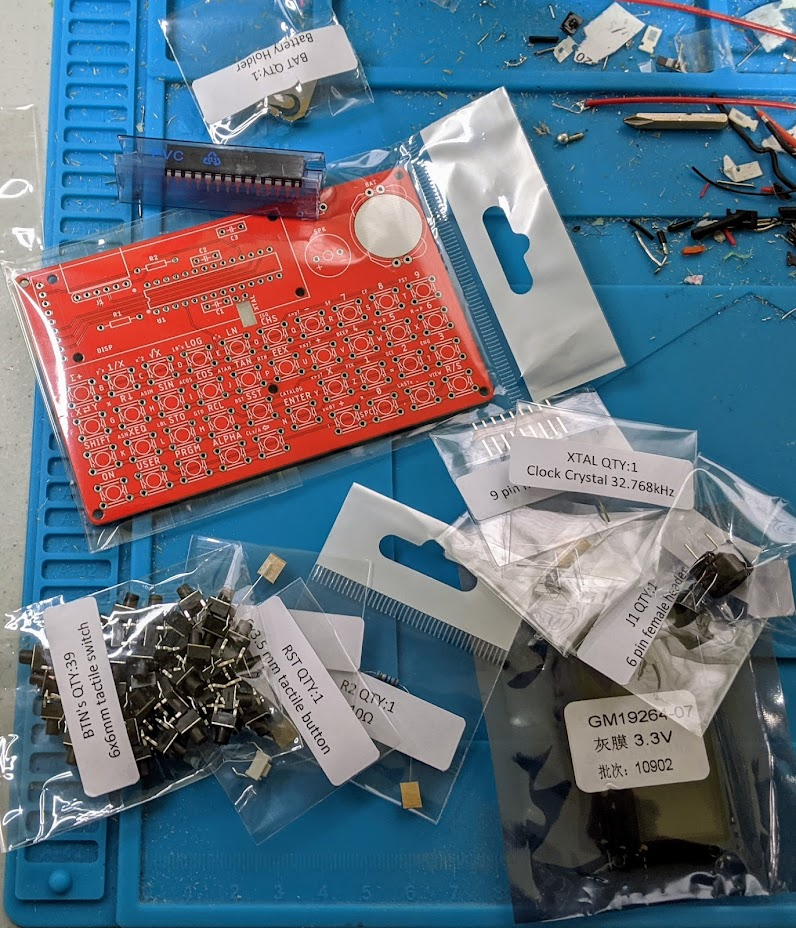
Nicely bagged parts.

The HP-41C is a somewhat legendary reverse-polish notation calculator. I still have my original HP-41C from 1979 (a very low serial number). It is still a workhorse but at 43 years old or so, I don’t like to leave it hanging around or near anything that might damage it. It has enough wear from the daily use it received 40 years ago. Sure, I have great emulation on my phone and I use that too, but the PX-41C kit looked fun, and with all through-hole parts it would be a quick build. The black Friday sale on Tindie sealed the deal for me.

Start-Up

The kit arrived on the Saturday after Thanksgiving, I decided to tackle it while waiting for some 3D prints. The components were all nicely bagged and marked. Tearing into the bags was a bit frustrating, but not hard and it did keep everything separate. There was a bill of materials, but — I thought — no instructions. Turns out the last part of the bill of materials is a link to some instructions. They aren’t much and I didn’t realize they were until after completing the board, but it isn’t hard to figure out. All the parts are marked on the silkscreen and you can probably figure it out — with a few caveats.

Continue reading “Building The DIY HP41C: A Field Report” →

Asus Motherboard gets CPU Upgrade Past its Specs

Clever Motherboard Hack Brings Late 90’s Motherboard Into The Early 2000’s

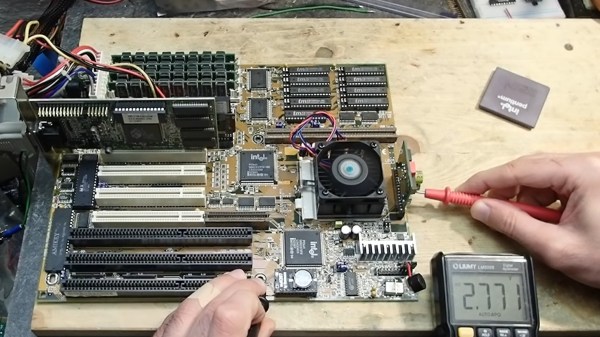
Some people look at specifications as a requirement, and others look at them as a challenge. You’re reading this on Hackaday, so you know where [Necroware] falls. In the video below the break, you’ll see how he takes a common mid-to-late 90’s motherboard and takes it well past its spec sheet.

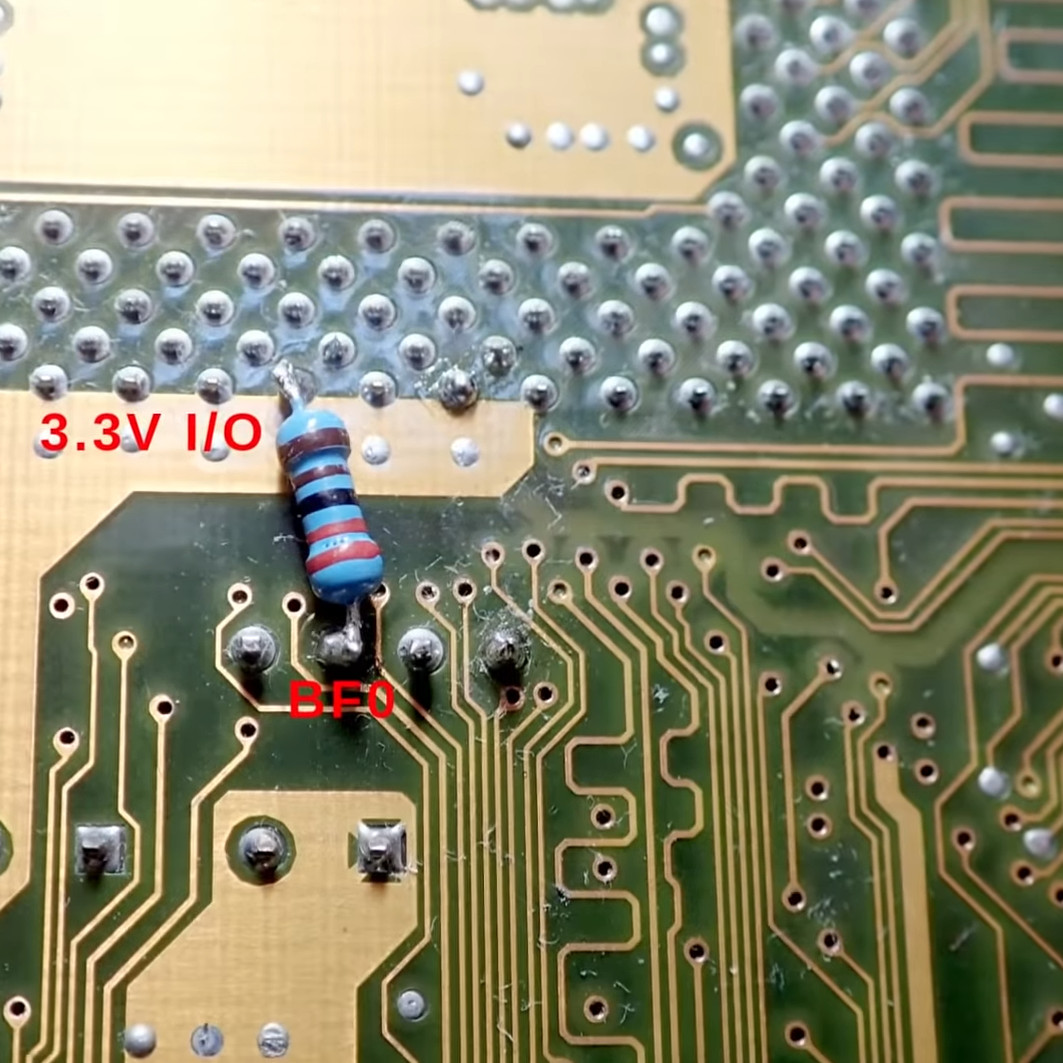
A pull up resistor enables faster clock multipliers
[Necroware] does what all soldering iron ads think people do with soldering irons
Having already started with replacing the Real Time Clock with his own creation, [Necroware] looked for other opportunities to make the Asus P/I-P55TP4XEG more capable than Asus did. And, he succeeded. Realizing that the motherboard has the ability to have an external voltage regulator board, [Necroware] made one so that the Socket 7 board could supply more than a single voltage to the CPU- the very thing keeping him from upgrading from a Pentium 133 to a Pentium MMX 200.

While the upgrade was partially successful, a deep dive into the Socket 7 and Super Socket 7 documentation helped him realize the need for a pullup resistor on a strategic clocking pin. Then, [Necroware] went full Turbo and smashed this author’s favorite single core CPU of all time into the socket: the AMD K6-2 450, a CPU well beyond the original capabilities of the board.

It really goes to show that, of course, It’s All About The Pentiums. Thanks to [BaldPower] for the doing the needful and dropping this great hack into the Tip Line!

Continue reading “Clever Motherboard Hack Brings Late 90’s Motherboard Into The Early 2000’s” →

Listening To The Sounds Of An 1960s Military Computer

Restoring vintage computers is the favorite task of many hardware hackers. Retrocomputing probably makes you think of home computer brands like Commodore, Amiga, or Apple but [Erik Baigar] is deeply into collecting early military computers from the UK-based Elliott company. Earlier this year he made a detailed video that shows how he successfully brought an Elliott 920M from the 1960s back to life.

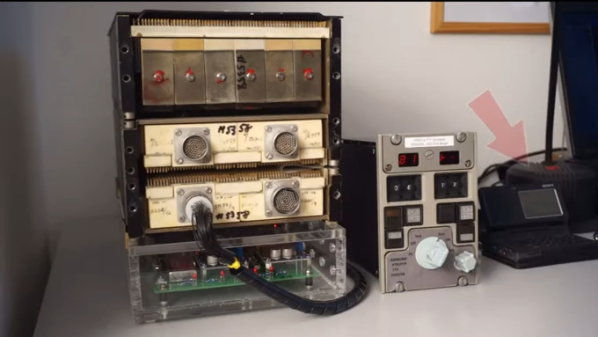
It is quite amazing that the Elliott company already managed to fit their 1960s computer into a shoebox-sized footprint. As computers had not yet settled on the common 8bit word size back then the Elliott 900 series are rather exotic 18bit or 12bit machines. The 920M was used as a guidance computer for European space rockets in the 1960s and ’70s but also for navigational purposes in fighter jets until as late as 2010.

Opening up the innards of this machine reveals some exotic quirks of early electronics manufacturing. The logic modules contain multilayer PCBs where components were welded instead of soldered onto thin sheets of mylar foil that were then potted in Araldite.

To get the computer running [Erik Baigar] first had to recreate the custom connectors using a milling machine. He then used an Arduino to simulate a paper tape reader and load programs into the machine. An interesting hack is when he makes the memory reading and writing audible by simply placing a radio next to the machine. [Erik Baigar] finishes off his demonstration of the computer by running some classic BASIC games like tic-tac-toe and a maze creator.

If you would like to code your own BASIC programs on more modern hardware you should check out this BASIC interpreter for the Raspberry Pi Pico.

Video after the break.

Continue reading “Listening To The Sounds Of An 1960s Military Computer” →