Arctic Adventures With A Data General Nova II — The Equipment

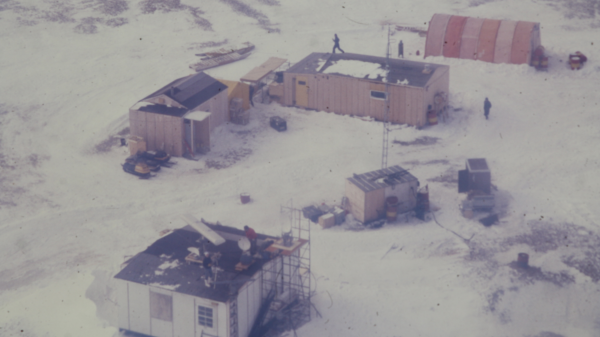
As I walked into the huge high bay that was to be my part-time office for the next couple of years, I was greeted by all manner of abandoned equipment haphazardly scattered around the room. As I later learned, this place was a graveyard for old research projects, cast aside to be later gutted for parts or forgotten entirely. This was my first day on the job as a co-op student at the Georgia Tech Engineering Experiment Station (EES, since renamed to GTRI). The engineer who gave me the orientation tour that day pointed to a dusty electronic rack in one corner of the room. Steve said my job would be to bring that old minicomputer back to life. Once running, I would operate it as directed by the radar researchers and scientists in our group. Thus began a journey that resulted in an Arctic adventure two years later.

The Equipment

The computer in question was a Data General (DG) mini computer. DG was founded by former Digital Equipment Corporation (DEC) employees in the 1960s. They introduced the 16-bit Nova computer in 1969 to compete with DEC’s PDP-8. I was gawking at a fully-equipped Nova 2 system which had been introduced in 1975. This machine and its accessories occupied two full racks, with an adjacent printer and a table with a terminal and pen plotter. There was little to no documentation. Just to turn it on, I had to pester engineers until I found one who could teach me the necessary front-panel switch incantation to boot it up. Continue reading “Arctic Adventures With A Data General Nova II — The Equipment”
Sega’s AI Computer Embraces The Artificial Intelligence Revolution

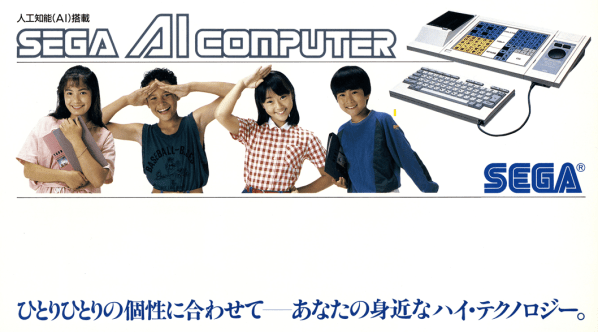
Recently a little-known Sega computer system called the Sega AI Computer was discovered for sale in Japan, including a lot of the accompanying software. Although this may not really raise eyebrows, what’s interesting is that this was Sega’s 1986 attempt to cash in on Artificial Intelligence (AI) hype, with a home computer that could handle natural language. Based on the available software and documentation, it looked to be mostly targeted at younger children, with plans to launch it in the US later on, but ultimately it was quietly shelved by the end of the 1980s.

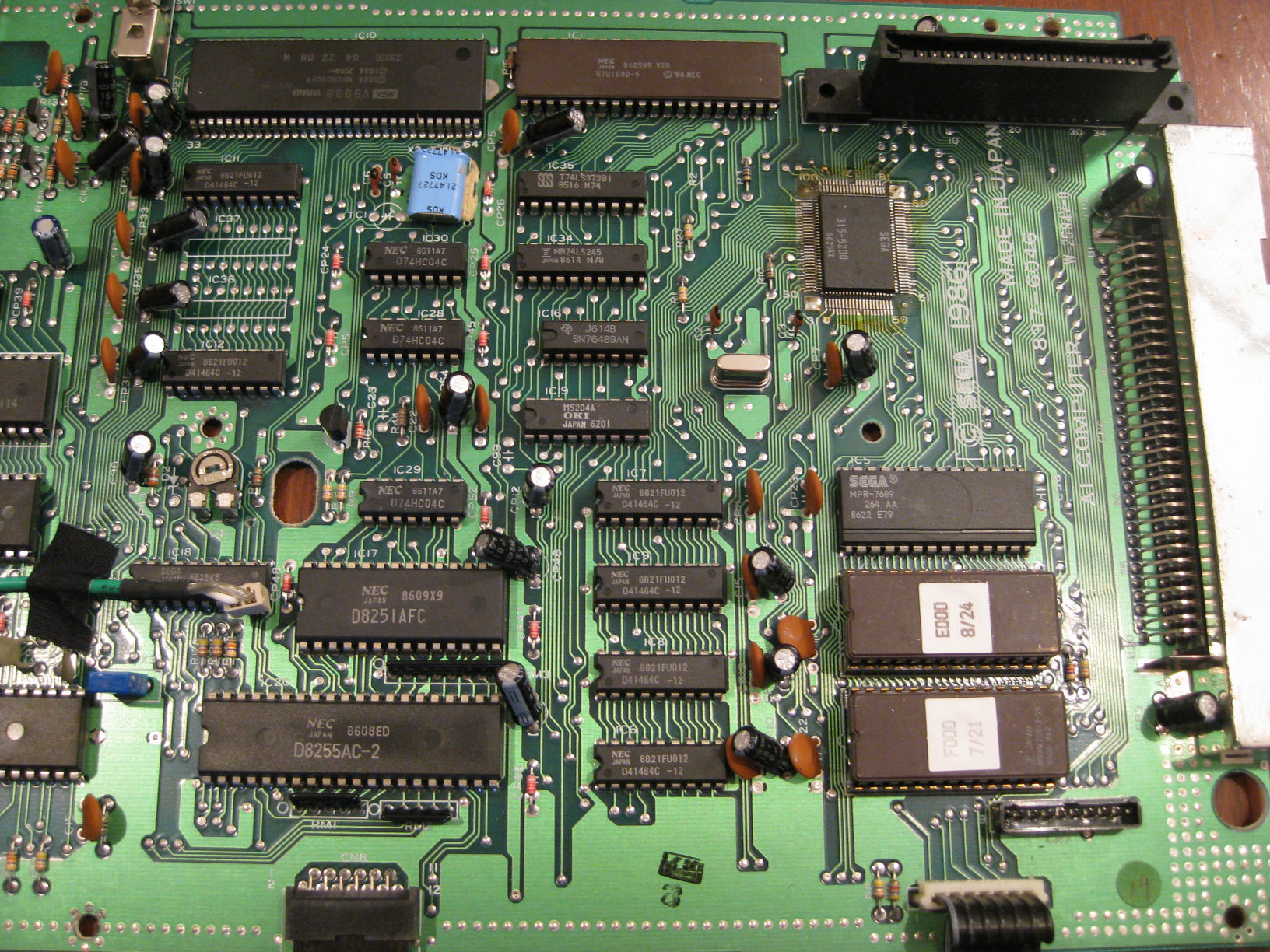
Part of the Sega AI Computer's mainboard, with the V20 MPU and ROMs.
Part of the Sega AI Computer’s mainboard, with the V20 MPU and ROMs.

The computer system itself is based around the NEC v20 8088-compatible MPU with 128 kB of RAM and a total of 512 kB of ROM, across multiple chips. The latter contains not only the character set, but also a speech table for the text to speech functionality and the Prolog-based operating system ROM. It is this Prolog-based environment which enables the ‘AI’ functionality. For example, the ‘diary’ application will ask the user a few questions about their day, and writes a grammatically correct diary entry for that day based on the responses.

On the system’s touch panel overlays can be used through cartridge or tape-based application to make it easy for children to interact with the system, or a full-sized keyboard can be used instead. All together, 14 tapes and 26 cartridges (‘my cards’) had their contents dumped, along with the contents of every single ROM in the system. The manual and any further documentation and advertising material that came with the system were scanned in, which you can peruse while you boot up your very own Sega AI Computer in MAME. Mind that the MAME system is still a work in progress, so bugs are to be expected. Even so, this is a rare glimpse at one of those aspirational systems that never made it out of the 1980s.

A Vintage Monitor Lives Again With A New Heart

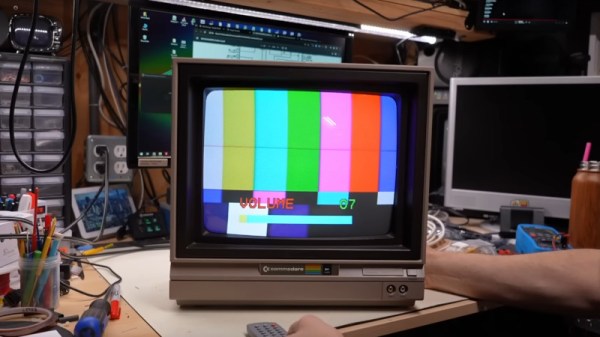
Aside from keeping decades-old consumer-grade computing hardware working, a major problem for many retrocomputing enthusiasts lies in doing the same for vintage monitors. Whether your screen is a domestic TV or a dedicated monitor, the heat and voltage stress of driving a CRT made these devices significantly less reliable than many of their modern-day counterparts. [Adrian’s Digital Basement] has a worn-out and broken Commodore 1701 monitor, which he’s brought back to life with a modern circuit board and a CRT transplant.

Following on from a previous project, he’s using a replacement board sold as a repair option for CRT TVs on AliExpress. The Commodore monitor has its board on a metal chassis which takes the replacement with a bit of modification. He doesn’t say where the new CRT came from, but we’re guessing it was a late model TV as CRTs made over the last few decades are more interchangeable than might be expected. There’s a moment of mild dodginess as he makes a voltage doubler to run the 220 V board from 120 V with a pair of large electrolytic capacitors hot glued in place, but otherwise it’s a success.

At the end of it all after some testing and set-up he has a Commodore monitor with a new heart and multi-standard support. Is it really a Commodore monitor though, or should it have been repaired? It’s a difficult one to answer, but we’d suggest that CRT monitor repair is less easy today than it used to be because many of the parts are now difficult to find. If it saves at least some of the original from the dumpster it’s better than doing nothing. We wonder how long these upgrades will remain possible as even with Chinese plants making these boards and a handful of CRT TVs still appearing on AliBaba it’s clear that CRTs are at the very end of their life.

Continue reading “A Vintage Monitor Lives Again With A New Heart”

Bringing An IBM Butterfly Laptop Back From The Dead

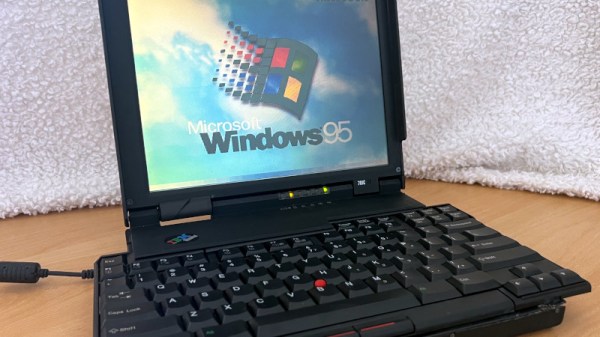
Among all the laptops produced over the last few decades, there is one which rises above the rest and which has retained an appeal long after its meager computing resources became obsolete. It’s the IBM 701c, the famous “Butterfly” laptop, whose fold-out keyboard still gives it star  quality, and [John Graham-Cumming] has documented the restoration of one from the tattered remains of two scrap examples.

The two laptops in question were someone else’s never-started project, and were in a sorry state. The flexible cables were in poor condition, and the 1990s Ni-MH batteries had leaked and damaged both circuits and case. We were unaware that NiMH leakage could damage plastic, but the parts of these machines were significantly damaged.

One had a working mainboard, the other a working modem card. One keyboard was in pretty bad shape, the other was complete. Of the pair there was a double super twisted nematic (DSTN) display and a more contemporary thin film transistor (TFT) panel. Be thankful if you have never had to use a DSTN laptop, as they were truly awful. From this pile of parts a working machine could be made, and with a new CMOS battery, that cable repair, and a repaint, he was ready. Or at least, as he says, ready for 1995.

This isn’t the first 701c restoration we’ve seen, and within reason, it’s even possible to give them a retro processor upgrade.

Crusty: The Story Of The Mac SE That Could

Retrocomputing often involves careful restorations, rare components, and white gloves.  This story involves none of those. This is the story of two people who sought to answer one of the greatest questions in the universe: What does it take to kill a Mac SE?

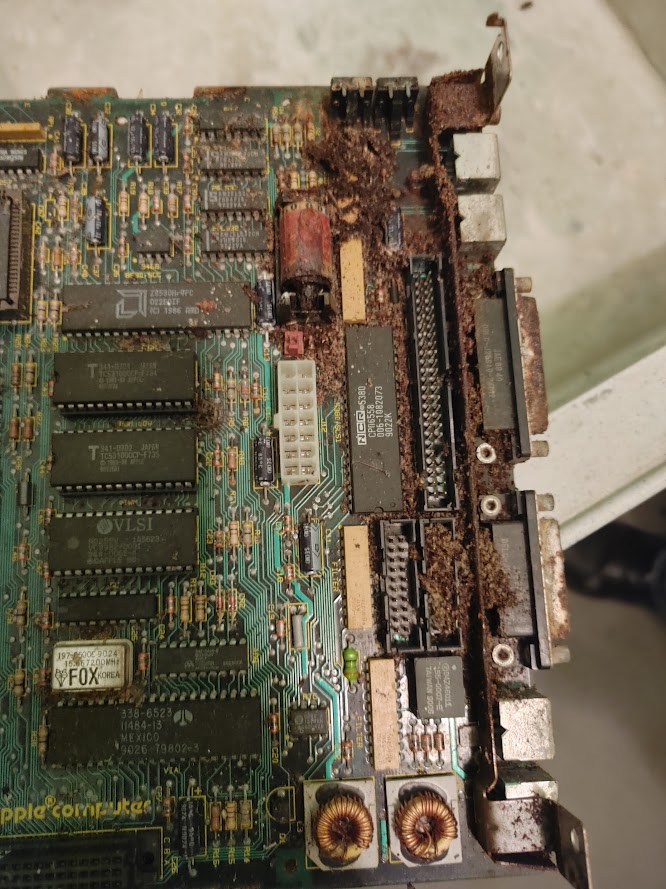
Crusty’s mainboard as found

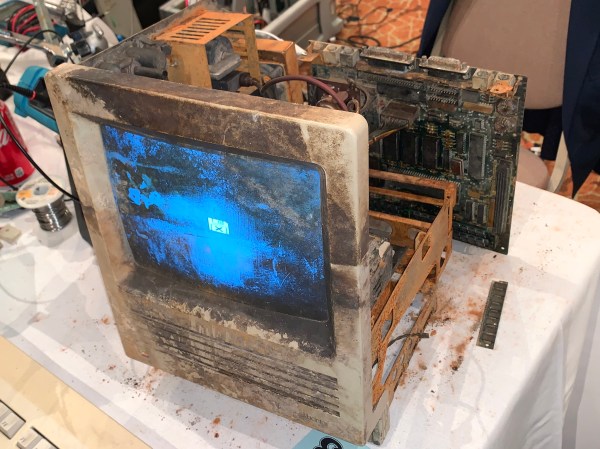
The star of the show here is Crusty, a Mac SE that was found on the loading dock of a scrap company. It sat out in the weather for at least 6 months, complete with the original leaking lithium battery.

Enter [RadRacer203], who is friends with the owner of this particular scrap company. [RadRacer203] and picked up Crusty, along with a few other classic Macs. He brought these machines to VCF East 2021, where our other hero comes in. [CJ] is something of a magician with CRTs and analog electronics. Trained under [Sark] himself, [CJ] has mastered the 5-finger exploding capacitor technique.

The battery had eaten through the mainboard and even into the chassis. But after a thorough cleaning, the damn thing booted up. Crusty was born.

This Mac was a survivor. Much like Top Gear and their plucky Toyota Hilux, [RadRacer203] and [CJ] devised a plan to put Crusty to the test.

Click through the break for more!

Continue reading “Crusty: The Story Of The Mac SE That Could”

Writing And Running Atari 2600 Games In Your Browser

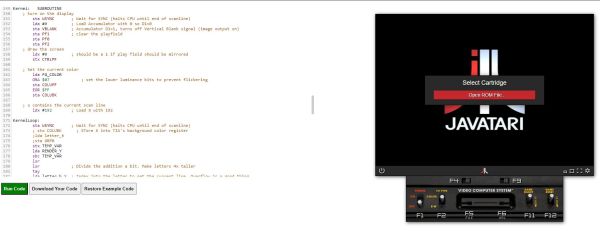
Here in 2024, writing new games for the venerable Atari 2600 game console is easier than ever, with plenty of emulators and toolchains to convert your code into ready-to-load ROMs. Yet what is easier than diving straight into 6502 assembly code without even having to download or set up a toolchain? That’s where [Henry Schmale]’s fully in-browser Atari IDE and associated emulator (using the Javatari project) comes into play.

As [Henry] explains in a blog post, the main goal was to get a project working in Emscripten, the LLVM-based toolchain to create WebAssembly binaries with. The target of this became DASM, the macro assembler for a range of 8-bit MPUs, including the 6502. In the blog post [Henry] describes the general procedure for how he compiled and integrated DASM, as part of creating the earlier linked Atari 2600.

In this IDE a number of example programs are provided, which can be selected, assembled and run in the integrated Javatari instance. Beyond this you can write your own custom 6502 ASM, of course, but at this point you may be interested in taking things further with the versatile Stella emulator that can even run on platforms which you’d be hard-pressed to get a browser running on, never mind Chromium.

Fixing A PDP-11/03 Power Supply Is Easy When You Understand It

After we last saw [David Lovett] of [Usagi Electric], he was knee-deep in trying to fix a DEC PDP-11/03 power supply, which fortunately led to a fixed PSU and a very happy PDP-11/23 system installed in the enclosure, as he covers in today’s video. Previously, we had covered his debugging attempt of this very much dead power supply, which had led [David] down many fruitless rabbitholes. By the time he was taking various components off the board to try and induce certain results, he threw in the towel and went back to the drawing board, assisted with many community comments.

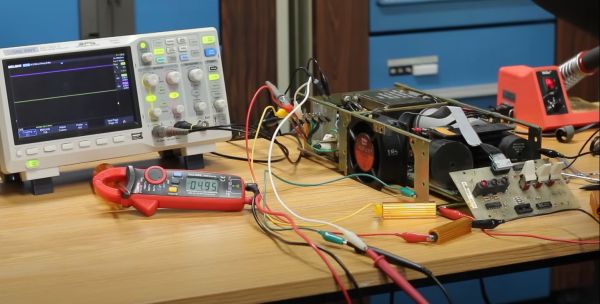
The 5V rail on a DEC PDP-11/03 power supply. (Credit: David Lovett)

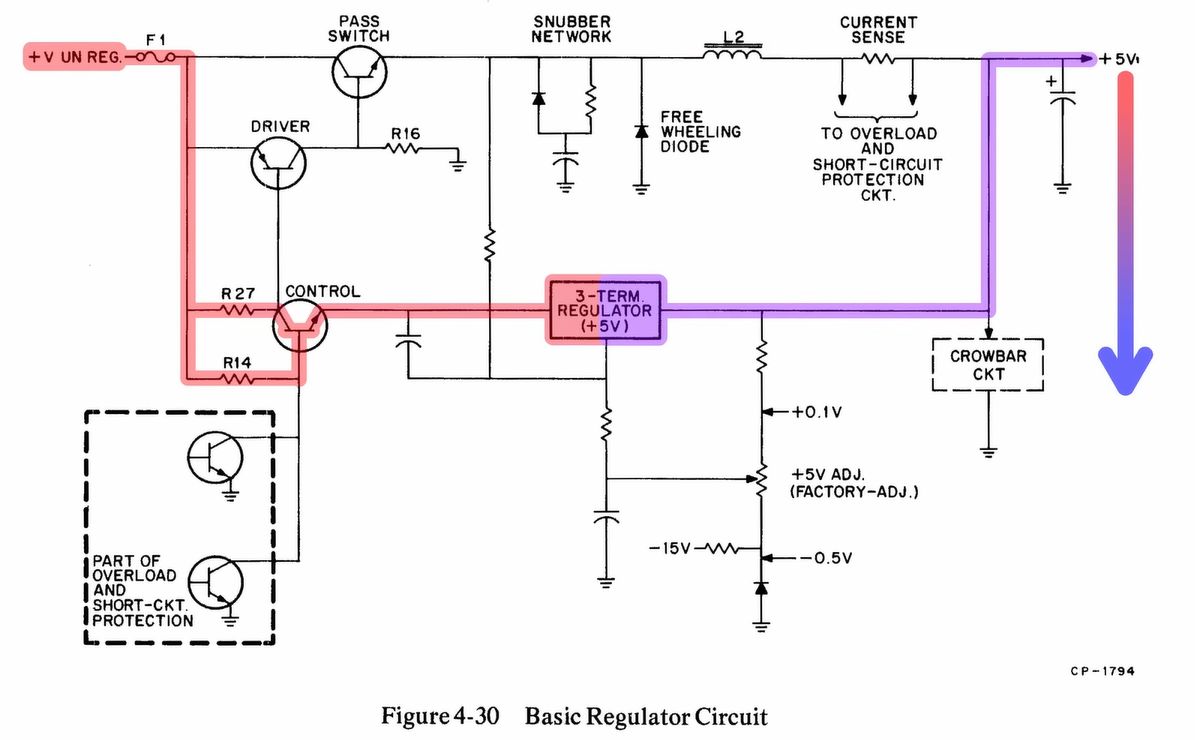
Much of the confusion came down to not really understanding how this PDP-11/03 PSU design works, which isn’t that crazy in hindsight, considering how quaint it is. Although [David] originally focused on the +5V rail, a small detail that was in the schematics is that the 5V rail is based around a 7805 that has its ground referenced to the -15V rail.

It is this 7805 that provides a linearly regulated 5V rail up till its current limit, at which point the control transistor gets biased sufficiently to start conducting, which eventually triggers the driver transistor that is responsible for driving the pass switch transistor. This then charges L2 from the unregulated supply, which is used effectively as a switching mode power supply until the current across the 7805 drops sufficiently that it becomes the primary 5V rail source again. This repeats at a kHz rate, making it more or less an SMPS as we know it today, but heavily reliant on the -15V rail as can be observed in the schematic. Continue reading “Fixing A PDP-11/03 Power Supply Is Easy When You Understand It”