Submersible Robots Hunt Lice With Lasers

De-lousing is a trying agricultural process. It becomes a major problem in pens which contain the hundreds of thousands of salmon farmed by Norwegians — the world’s largest salmon exporter — an environment which allows the parasite to flourish. To tackle the problem, the Stingray, developed by [Stingray Marine Solutions],  is an autonomous drone capable of destroying the lice with a laser in the order of tens of thousands per day.

Introduced in Norway back in 2014 — and some areas in Scotland in 2016 — the Stingray floats in the salmon pen, alert and waiting. If the lice-recognition software (never thought you’d hear that term, huh?) detects a parasite for more than two frames in the video feed, it immediately annihilates it with a 530 nanometre-wide, 100 millisecond laser pulse from up to two metres away. Don’t worry — the salmon’s scales are reflective enough to leave it unharmed, while the pest is fried to a crisp.  In action, it’s reminiscent of a point-defense laser on a spaceship.

Continue reading “Submersible Robots Hunt Lice With Lasers”

PUFFER: A Smartphone-Sized Planetary Explorer

Is there room on Mars and Europa for cute robots? [NASA] — collaborating with [UC Berkley] and [Distant Focus Corporation] — have the answer: PUFFER, a robot inspired by origami.

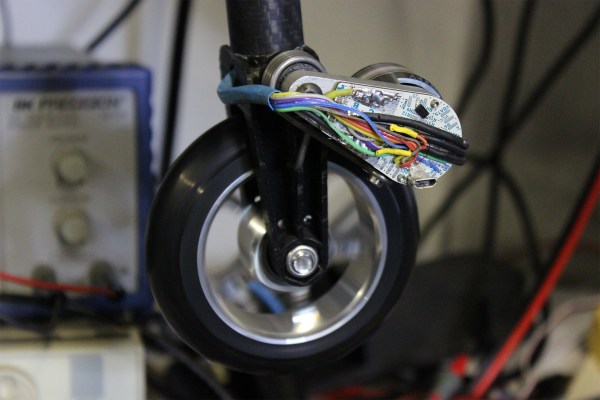
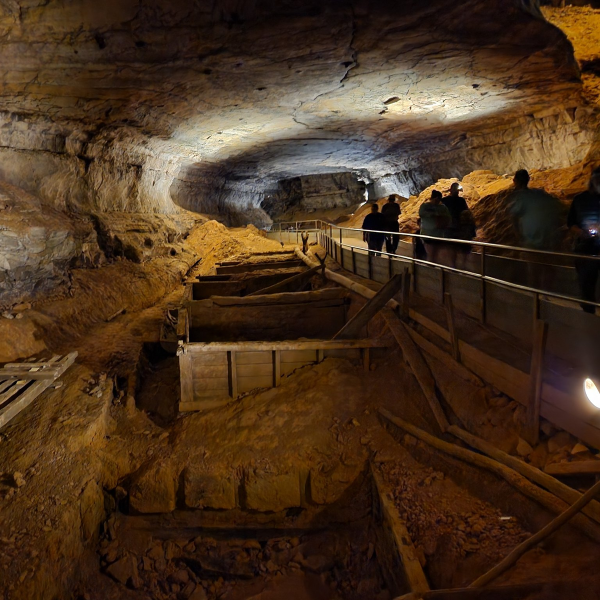
PUFFER — which stands for Pop-Up Flat-Folding Explorer Robot — is able to sense objects and adjust its profile accordingly by ‘folding’ itself into a smaller size to fit itself into nooks and crannies. It was designed so multiple PUFFERs could reside inside a larger craft and then be deployed to scout otherwise inaccessible terrain. Caves, lava tubes and shaded rock overhangs that could shelter organic material are prime candidates for exploration. The groups of PUFFERs will send the collected info back to the mother ship to be relayed to mother Earth.

We’ve embedded the video of the bot folding it’s wheels down to pass a low-bridge. You can get a view of the wider scope of functionality for the collection of demos on the project page.

Continue reading “PUFFER: A Smartphone-Sized Planetary Explorer”

LEGO Liquid Handler And Big Biology

A career as a lab biologist can take many forms, but the general public seems to see it as a lone, lab-coated researcher sitting at a bench, setting up a series of in vitro experiments by hand in small tubes or streaking out a little yeast on an agar plate. That’s not inaccurate at all – all of us lab rats have done time with a manual pipettor while trying to keep track of which tube in the ice bucket gets which solution. It’s tedious stuff.

But because biology experiments generally scale well, and because more data often leads to better conclusions, life science processes can quickly grow beyond what can be handled manually. I’ve seen this time and again in my 25 years in science, from my crude grad school attempts to miniaturize my assays and automate data collection to the multi-million dollar robotic systems I built in my career in the pharmaceutical industry. Biology can get pretty big in a hurry. Continue reading “LEGO Liquid Handler And Big Biology”

Quadruped Robot Can Crawl Under Cars And Jump-Kick-Open Doors

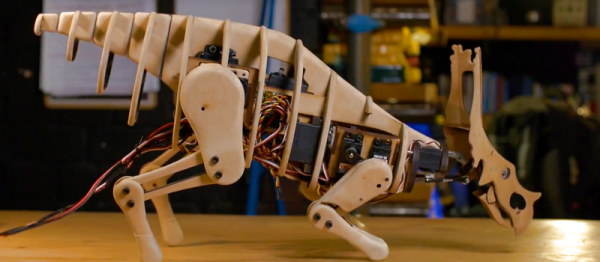
The wheel is a revolutionary invention — as they say — but going back to basics sometimes opens new pathways. Robots that traverse terrain on legs are on the rise, most notably the Boston Dynamics Big Dog series of robots — and [Ghost Robotics]’ Minitaur quadruped aims to keep pace.

One of [Ghost Robotics] founders, [Gavin Knneally] states that co-ordination is one of the main problems to overcome when developing quadruped robots; being designed to clamber across especially harsh terrain, Minitaur’s staccato steps carry it up steep hills, stairs, across ice, and more. Its legs also allow it to adjust its height — the video shows it trot up to a car, hunker down, then begin to waddle underneath with ease.

Continue reading “Quadruped Robot Can Crawl Under Cars And Jump-Kick-Open Doors”

Robot Arm From Recyclables

A robot assistant would make the lives of many much easier. Luckily, it’s possible to make one of your own with few fancy materials. The [circuito.io] team demonstrates this by building a robot arm out of recyclables!

With the exception of the electronics — an Arduino, a trio of servo motors, and a joystick — the arm is made almost completely out of salvaged recyclables: scrap wood, a plastic bottle, bits of plastic string and a spring. Oh, and — demonstrating yet another use for those multi-talented tubers — a potato acts as a counterweight.

Instead of using screws or glue, these hackers used string made from a plastic bottle as a form of heat shrink wrap to bind the parts of the arm together. The gripper has only one pivoting claw for greater strength, and the spring snaps it open once released. Behold: your tea-bag dunking assistant.

Continue reading “Robot Arm From Recyclables”

Line Follower Has Lots Of Recycled Parts, But Zero Brains

Line Followers are a tried-and-true type of robot; both hardware and software need to be doing their job in harmony in order to be successful at a clearly defined physical task. But robots don’t always have microcontrollers and software, as [Mati_DIY]’s zero programming analog line follower demonstrates.

For readers used to seeing a Raspberry Pi or Arduino in almost everything, an analog robot whose “programming” exists only as a harmony between its discrete parts can be an eye-opener as well as an accessible project. A video of the robot in action is embedded below.

[Mati_DIY]’s design uses two CNY70 reflective sensors (which are essentially infrared emitter/phototransistor pairs) and an LM358 dual op-amp. Together, the sensors act as two near-sighted eyes. By using the output of each sensor to drive a motor via a transistor, the presence or absence of the black line is directly and immediately reflected by the motion of the attached motor. The more black the sensor sees, the more the motor turns. Electrically, that’s all that happens; but by attaching the right sensor to the left motor and the left sensor to the right motor, you get a robot that always tries to keep the black line centered under the sensors. Playing with the spacing of the motors and sensors further tweaks the performance.

Continue reading “Line Follower Has Lots Of Recycled Parts, But Zero Brains”

BionicANTs from FESTO

Robot Ants Wear Circuitry As Exoskeleton

[FESTO] keeps coming up with new tricks that make us both envious and inspired. Take their bionicANTs for example. Watching a group of them cooperate to move objects around looks so real that you’re instantly reminded of the pests crawling across your floor, but looking at them up close they’re a treasure trove of ideas for your next robot project.

Ant exoskeleton as circuit board

The exoskeleton is 3D printed but they then use the outer surface of that exoskeleton as a circuit board for much of the circuitry. The wiring is “painted on” using a 3D MID (Molded Interconnect Device) process. While FESTO didn’t give specifics about their process, a little research shows that 3D MID involves the 3D printed object being made of a special non-conductive metal material, a laser then “drawing” the traces in the material, and then dipping the object in various baths to apply copper, nickel and gold layers. We mortal hackers may not have the equipment for doing this ourselves in our workshops but seeing the beautiful result should be inspiration enough to get creative with our copper tape on the outer surfaces of our 3D printed, CNC’d, or hand-carved parts.

We also like how they took a the mouse sensor from under a regular computer mouse and attached it to the ant’s underside, pointing down for precision dead reckoning. For the legs they used three piezo bending transducers. However, these give a deflection of only 1.5mm in both directions, not enough for walking. They increase this to over 10mm with the addition of a plastic hinge, another idea to keep in mind when building that next tiny robot. And there are more ideas to be taken advantage of in their ants, which you can see being built in the video below.

Continue reading “Robot Ants Wear Circuitry As Exoskeleton”