Stewart Platform Walker Gains Feeling In Legs From Resistors

Stewy is a very interesting robot, with some slightly odd kinematics. Its head is a Stewart platform, which is a common-enough 6-DOF actuated plate normally used with a fixed base. By connecting legs to the same servos running the Stewart platform, [JD] turned it into an adorable hexapod walker. The walker had a problem, though: it can’t feel its feet, and [JD] thinks that would make it much more mobile on uneven surfaces. So he got some resistors to turn the cheap servos in its legs into force-sensing actuators.

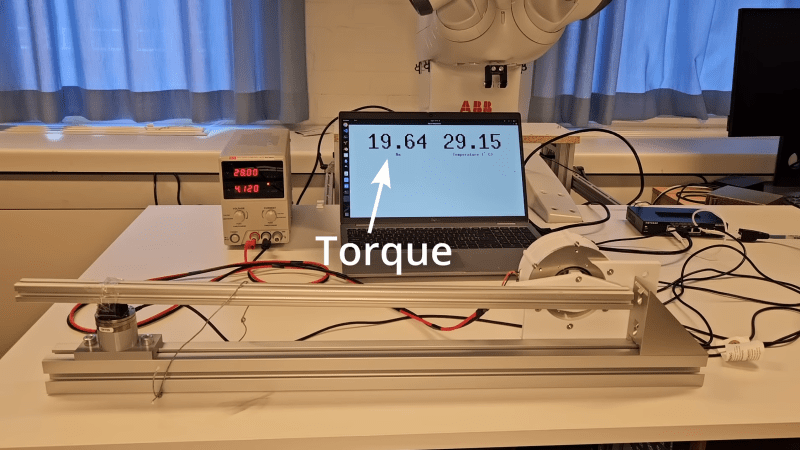
Well, almost. He’s not actually putting strain gauges or anything like that into the legs; he’s just measuring the voltage drop across a resistor in series with the servos. Since the motors draw more current the more torque they’re putting out, he has a very quick and easy way to sense the current and thus the torque using good old Ohm’s law and an analog input on the microcontroller driving the robot. It’s a simple hack, but the data he’s getting is surprisingly good for how much work it is to add to a robot, as you can see in the video — at least once he slowed down the servos a touch.

Perhaps this isn’t a ground-breaking innovation, but [JD] does a very good idea explaining it. Of course if you want to use resistors to sense force directly, force-sensitive resistors are a thing that we’ve seen in everything from Twister-mat MIDI controllers to self-leveling 3D printers.

Continue reading “Stewart Platform Walker Gains Feeling In Legs From Resistors”

Tiny Desktop Robot Has Radar

One thing our futuristic world is largely lacking in is droids and robot companions and the like. [solitary dev] is helping to rectify that problem by building a little robot called TongDou.

As [solitary dev] tells it, TongDou is a “tiny open-source desktop gremlin.” An ESP32-S3 serves as TongDou’s brain, buried inside a tasteful brass chassis. An OLED display is TongDou’s face, and he uses a pair of wheels driven by gearmotors for locomotion. A speaker plays back pre-recorded voice lines, while a 24 GHz radar and an IMU enables TongDou to keep track of the space it’s moving through. They are publishing the design files on GitHub so other makers can build their own if so desired.

[solitary dev] hopes to develop TongDou into something to make a “workspace feel less dead.” It’s not dissimilar from the way studios used to use robots to liven up otherwise hackneyed movies and TV shows, and we could absolutely use some of that whimsy in the real world. We’ve featured other fun desktop companions before, too.

Continue reading “Tiny Desktop Robot Has Radar”

Custom Beach Robot Handles The Hard Work

A day at the beach can involve hauling a surprising amount of gear, from coolers, towels, blankets, chairs, and umbrellas, and if children are involved the amount of beach stuff needed seems to go nonlinear very quickly. Some turn to beach carts with large, low-pressure pneumatic tires, but even that seemed like too much work for [John] who built this remote controlled cart for his summertime needs.

The cart is based around an old cargo rack from an e-bike. To mount all of the robotic components, a sheet of plywood was cut and attached to the underside. Two motors are used to drive the rear wheels independently, allowing for differential steering rather than adding the complexity of a steering system. Some safety features are built in to this design as well, including lights for night driving, a start button controlling a relay for the motors and electronics, and a time-of-flight sensor to stop the robot if it encounters an obstacle.

The ESP32 at the center of the build ties all of the electronics together, and a smartphone app lets the user remotely pilot the rover. It’s not autonomous (yet) but a fair alternative to dragging all of one’s beach gear through the sand without any assistance. You could also minimize your excursions through the sand by timing your visits at high tide, but [John] is out on the Great Lakes so this may be of marginal utility here.

Continue reading “Custom Beach Robot Handles The Hard Work”

Open Source Vacuum Avoids Cloud

As more and more of the technology that we paid for turns becomes a subscription, there’s slowly been a momentum shift in the open source world of building replacements for these intrusive rent-seekers. We see this all of the time for self-hosted media and communications servers, but now we’re starting to see it in hardware as well. The OOMWOO robotic vacuum cleaner is completely open source, from hardware to software, and requires no cloud services whatsoever.

Although it’s open source, not every component is something one could buy off the shelf. It does require a 3D printer for most of the parts, but assuming that requirement is met most of the rest of the build comes together easily enough. For compute it relies on a Raspberry Pi running ROS 2 software and is set up to integrate easily with other existing open tools and projects such as Home Assistant. Like its proprietary cousins it can sense and map the rooms its placed in, but this platform uses an inexpensive 2D lidar system to keep costs down.

Right now the project is not quite complete, so we’ll all have to keep our eyes on this one as the team building it progresses. But they do have most of the software development done and the bill-of-materials is in progress. As an open project it’s being developed by many volunteers and there are a lot of areas available to contribute to as well, all currently set up on the project’s GitHub page. Right now many of those areas of effort are adapting the 3D printer files to off-the-shelf parts.

With the rocky status of the Roomba ecosystem, projects like this are more important than ever.

Fibrous Muscles For Humanoid Robotics

At the current rate of robotics development, you might assume that we’re close to Skynet taking over. However, while we  likely wouldn’t do well in a physical fight against a robot, we can at least keep the bragging rights of having the cooler actuators. Or at least, that was the case before a new actuator came into town — introducing “Electrofluidic Fiber Muscles”.

Traditional robotic actuators use motors of some kind with a variety of gearboxes or linkages to turn rotational movement into usable movement. This isn’t always the most effective way to run some robotics movements, especially when modeling humans. This is why many have turned to pressurized modes of actuation. Though most don’t show quite the promise of the new player.

Electrofluidic Fiber Muscles use pressure to shorten muscle strands, similar to past actuators. However, these are a tad different, taking advantage of electrofluidic pressure. A small current under high voltage is able to drive a pressure gradient in a long tube. This tube can then be connected to both an extensor and flexor portion of an actuating circuit, similar to a biological mechanical system. Better yet, this driving pressure pump can be spun around the fibers themselves, making a tight package.

Unfortunately, it will probably be a bit till we see this inside a hobbyist robot. Until then, make sure to check out some other actuator feats!

Continue reading “Fibrous Muscles For Humanoid Robotics”

To Build More Believable Bots, Simulate The Neurochemistry

Giving machines the ability to communicate nonverbally has real value, and [Drew Smith] clearly thinks your robot deserves better than an emoji. He shared a very interesting approach with his project Kindalive.

Kindalive is a simulated dot-matrix robot face that responds believably to input text, modeling and expressing both short-term and long-term moods. It’s pure Python and modular enough to invite using it elsewhere, but that’s not the really interesting part.

What sets [Drew]’s project apart is the way he models eight key neurochemicals (including dopamine and cortisol) as the foundation from which to derive emotional states. That’s an approach we certainly haven’t seen before.

Conventional sentiment analysis uses a large language model (LLM) to apply discrete labels to communication, but Kindalive doesn’t do that. It even goes so far as to model the decay and interplay between its simulated neurochemicals to derive emotional states on the fly. It’s more fluid and organic, and reflects both short-term and long-term mood changes.

Physical representation of the emotional mix is done by altering twelve key facial movements (brow raise, lip corner pull, mouth open, and others of that nature) known as the Facial Action Coding System (FACS). These twelve elements combine to express emotion nonverbally with facial expressions. It’s what drives the simulated dot-matrix robot face seen in the image above, and could easily be used to drive a real LED matrix, or servos on an animatronic face.

Much of communication is nonverbal. Humans even weigh nonverbal higher when there’s a mismatch between the content of verbal and nonverbal communication. So, there’s clear value in having robots able to express themselves as such.

Importantly, a realistic and human-like face is entirely unnecessary — something every Star Wars fan already knows. Cartoon eyes and basic sounds are enough to make robots easier to relate to and work with, even if blinking is also important but hard to get just right.

Robot Dog In Browser

You’ve doubtlessly seen the current crop of robot dogs and, if you are like us, thought about getting one to play with. The problem is that the cheap ones are toys, and the serious ones cost serious money. But now you can experiment with a mid-range cost one for free in your browser. The sponsor will be happy to sell you a robot in kit or assembled form, although it is the OpenCat robot (we’ve covered it before), so you could simply build a real one yourself if you wanted to.

The code is all in a Web-based IDE, and the main file is deceptively simple. However, the real work is in read_serial (in the src/moduleManager.h file, for some reason) and reaction in the aptly-named src/reaction.h file. If you just want to play, you can use the buttons in the simulator or enter serial commands (documented elsewhere). For example, ksit will make the dog sit down.

Continue reading “Robot Dog In Browser”