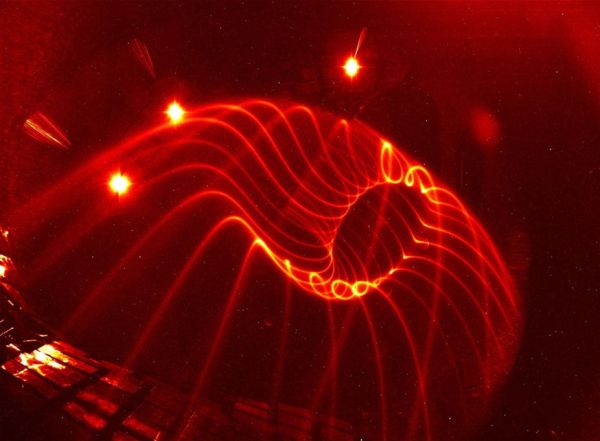
Fueling Up For Fusion: MAST’s Super-X, JET’s Deuterium-Tritium Experiments For ITER, And More

We’ve had nuclear fission reactors in operation all over the world for ages, but nuclear fusion always seems to be a decade or two away. While one cannot predict when we’ll reach the goal of sustained nuclear fusion, the cutting edge in test hardware is advancing at a rapid pace that makes us optimistic. Beginning as soon as this month and extending over a few years, we’re living through a very exciting time for nuclear fusion and plasma physics.

The Mega Ampere Spherical Tokamak (MAST) got a big upgrade to test a new cooled divertor design. JET (Joint European Torus) will be testing the deuterium-tritium fuel mixture that will be powering the ITER (the research project whose name began as an acronym for International Thermonuclear Experimental Reactor but has since been changed to just ITER). And the Wendelstein 7-X stellarator is coming back online with upgraded cooled divertors by next year.

Here the MAST Upgrade’s Super-X divertors have so far shown a ten-fold decrease in the temperature which the divertor is exposed to while carrying thermal energy out of the tokamak reactor. This means a divertor design and ultimately a fusion reactor that will last longer between maintenance sessions. On the stellarator side of things, Wendelstein 7-X’s new divertors may allow it to demonstrate the first continuous operation of a stellarator fusion reactor. Meanwhile, JET’s fuel experiments should allow us to test the deuterium-tritium fuel while ITER is working towards first plasma by 2025.


Continue reading “Fueling Up For Fusion: MAST’s Super-X, JET’s Deuterium-Tritium Experiments For ITER, And More”

High Voltage Gives Metal Balls A Mind Of Their Own

Have you ever seen something that’s so fascinating you’re sure there has to be some kind of practical application for it, but you just can’t figure out what? That’s how we feel when watching tiny ball bearings assemble themselves into alien-like structures under the influence of high voltage in the latest Plasma Channel video from [Jay Bowles].

Now to be clear, [Jay] isn’t trying to take credit for the idea. He explains that researchers at Stanford University first documented the phenomenon back in 2015, and that his goal was to recreate their initial results as a baseline and go from there. The process is pretty simple: put small metal ball bearings into a tray of oil, apply high voltage, and watch them self-assemble into “wires” that branch out in search of the ground terminal like a plant’s roots looking for water. With the encouragement of his 500,000 volt Van de Graaff generator, the ball bearings leaped into action and created structures just like in the Stanford study.

With the basic pieces now in place, [Jay] starts to push the envelope. He experiments with various oils to see how their viscosity impacts the ball’s ability to assemble, finding that olive oil seems to be the ideal candidate (at least of those he’s tried so far). He also switches up the size and shape of the tray, to try and find how far the balls can realistically stretch out on their own.

In the end we’re no closer to finding a practical application for this wild effect than the good folks at Stanford were back in 2015, but at least we got to watch the little fellows do their thing in glorious 4K and with the exceptional production value we’ve come to expect from Plasma Channel. That said, [Jay] does hint at his ongoing efforts to turn the structures into works of art by “freezing” them with clear resin, so keep your eyes out for that.

Continue reading “High Voltage Gives Metal Balls A Mind Of Their Own”

Ptychography Shows Atoms At Amazing Resolution

Cornell University enhanced electron microscopy using a technique known as ptychography in 2018. At the time, it allowed an electron microscope to resolve things three times smaller than previously possible. But that wasn’t enough. The team has now doubled that resolution by improving on their previous work.

The team says that the images are so precise that the only blurring is due to the thermal motion of the atoms themselves. This could mean that you won’t see a further improvement in resolution in the future.

Continue reading “Ptychography Shows Atoms At Amazing Resolution”

Self-Driving Or Mind Control? Which Do You Prefer?

We know you love a good biohack as much as we do, so we thought you would like [Tony’s] brainwave-controlled RC truck. Instead of building his own electroencephalogram (EEG), he thought he would use NeuroSky’s MindWave. EEGs are pretty complex, multi-frequency waves that require some fairly sophisticated circuitry and even more sophisticated signal processing to interpret. So, [Tony] thought it would be nice to off-load a bit of that heavy-lifting, and luckily for him, the MindWave headset is fairly hacker-friendly.

EEGs are a very active area of research, so some of the finer details of the signal are still being debated. However, It appears that attention can be quantified by measuring alpha waves which are EEG content between 8-10 Hz. And it seems as though eye blinks can be picked from the EEG as well. Conveniently, the MindWave exports these energy levels to an accompanying smartphone application which [Tony] then links to his Arduino over Bluetooth using the ever-so-popular HC-05 module.

To control the car, he utilized the existing remote control instead of making his own. Like most people, [Tony] thought about hooking up the Arduino pins to the buttons on the remote control, thereby bypassing the physical buttons, but he noticed the buttons were a bit smaller than he was comfortable soldering to and he didn’t want to risk damaging the circuit board. [Tony’s] RC truck has a pistol grip transmitter, which inspired a slightly different approach. He mounted the servo onto the controller’s wheel mechanism, allowing him to control the direction of the truck by rotating the wheel using the servo. He then fashioned another servo onto the transmitter such that the servo could depress the throttle when it rotates. We thought that was a pretty nifty workaround.

Cool project, [Tony]! We’ve seen some cool EEG Hackaday Prize entries before. Maybe this could be the next big one.

Continue reading “Self-Driving Or Mind Control? Which Do You Prefer?”

Affordable Transilluminator Helps Visualize DNA

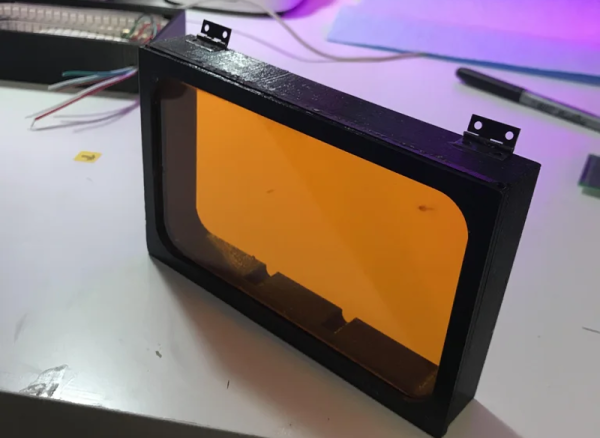
If you want to examine the results of gel electrophoresis — and who doesn’t — you need a transilluminator. These devices can be quite pricey, though, so you might want to check out [Gabriel St-Pierre’s] plans to make an affordable blue-light version. You can see a video about the device below.

Using a UV filter, an Arduino Nano, an LED strip, 3D printing, and some mechanical items, it looks like this is a very easy project if you need such a device. There are a few miscellaneous parts like a hinge and some mirror material, but nothing looks too exotic.

Continue reading “Affordable Transilluminator Helps Visualize DNA”

jellyandmarshmallows windTunnel close-up

Perfecting Paper Planes Peering Past Perspex Portals

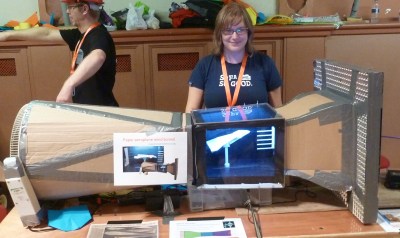
This wind tunnel is a pile of junk and we love it! When making science and engineering accessible to kids, it really helps to show that it doesn’t require a fancy research lab. [Jelly & Marshmallows] show kids that it takes little more than cardboard, duct tape, and dumpster-diving to up your paper airplane game to NASA levels of engineering.

[Jelly & Marshmallows] built their wind tunnel for a Maker Faire using the aforementioned cheap and free materials for the straightener, collector, diffuser, and fan sections. We especially love the efficient hack of using stacked ceiling light diffusers rather than hundreds of straws for the straightener.


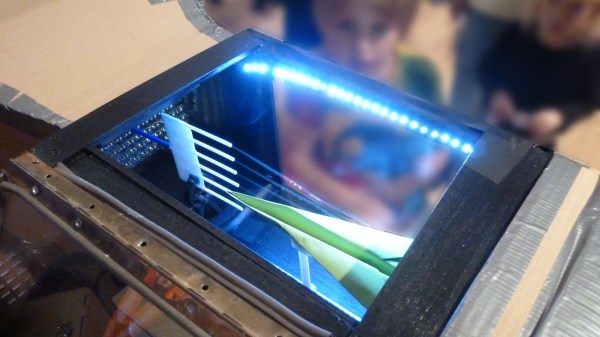
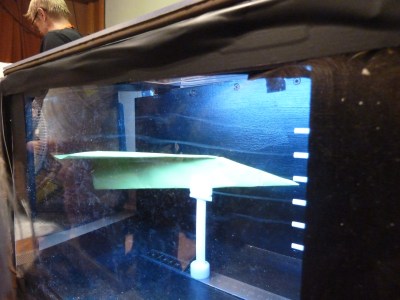
The most time went into the working section, custom-built from plywood frames and acrylic windows. Many 3D printed parts came together to convert a smoke-ring gun to emit smoke trails and LEDs were employed to make those trails a little easier to see. We think the magnetic clips for quick changes of aircraft and their position along a steel ruler were inspired.

The kids attending the Maker Faire (we miss those!) loved the exhibit, having the best time hitting a big green arcade button to spin up the fan. It’s the little things in life. How would you get the kids even more involved with analyzing aerodynamics and make the smoke trails more visible?


Thanks for the tip [Rómulo Antão]

Increased Neutron Levels At Chernobyl-4: How Dangerous Is Corium?

When the Chernobyl nuclear plant suffered the power output surge that would destroy its #4 reactor, a substance called ‘corium‘ was formed. This originally lava-like substance formed out of the destroyed fuel rods along with surrounding materials, like concrete, that made up the reactor. The corium ultimately cooled down and left large amounts of solid corium in the rooms where it had pooled.

Over the past few days there have been numerous reports in the media regarding a ‘sudden surge’ in neutron flux levels from this corium, with some predicting a ‘second Chernobyl disaster’. Obviously, this has quite a few people alarmed, but how dire are these neutron output changes exactly, and what do they tell us about the condition of the corium inside the ruins of the #4 reactor building? Continue reading “Increased Neutron Levels At Chernobyl-4: How Dangerous Is Corium?”