A Trio Of Photodiodes Make A Radiation Detector

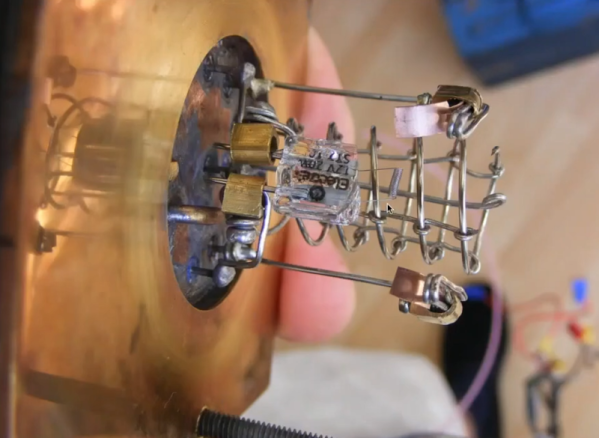
The instinctive reaction when measuring nuclear radiation is to think of a Geiger counter, as the low-pressure gas tube detectors have entered our popular culture through the Cold War. A G-M tube is not the only game in town though, and even the humble photodiode can be pressed into service. [Robert] gives us a good example, with a self-contained radiation detector head that uses a trio of BPW34s to do the job.

At its heart is a transimpedance amplifier, a not-often-seen op-amp configuration that serves as a very high gain current-to-voltage converter. This produces a spike for every radiation event detected by the diodes, which is fed to a comparator to produce a logic pulse. The diodes require a significant bias voltage, for which he’s used 48 V from a stack of 12 V photographic dry cells rather than a boost converter or other potentially noisy power supply. Such a sensitive high-gain device needs to be appropriately shielded, so the whole circuit is contained in a diecast box with a foil window to allow radiation to reach the diodes.

This isn’t the first BPW34-based radiation detector we’ve seen, so perhaps before looking for a Cold War era relic for our radiation experiments we should be looking in a semiconductor catalogue instead.

3D Printing May Disprove Lord Kelvin

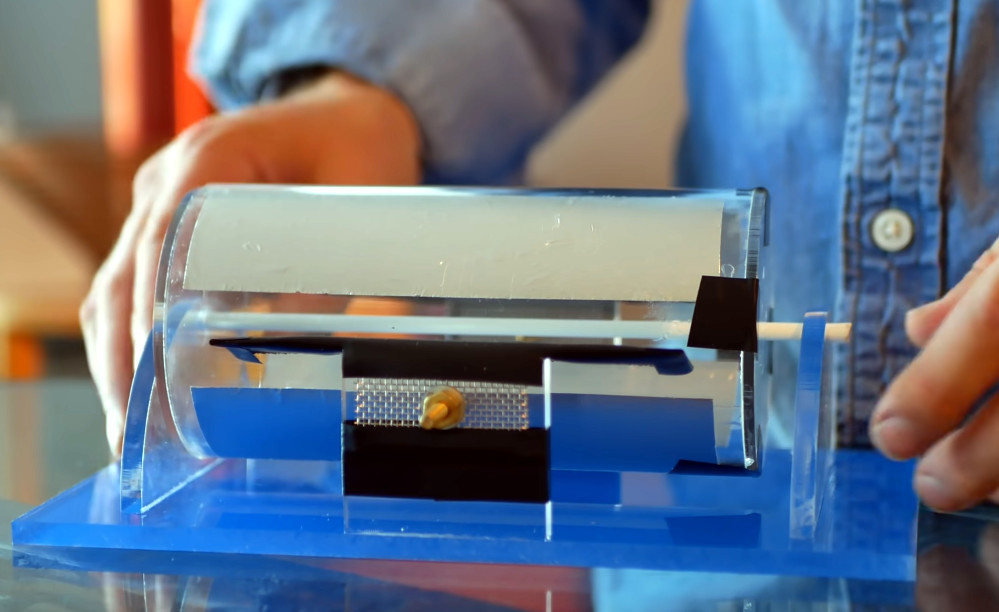
If you think 3D printing is only good for benchies, key chains, and printer parts, you might enjoy the paper by two physicists from Wesleyan University and the University of Gothenburg. Lord Kelvin — also known as William Thomson — hypothesized a shape known as an isotropic helicoid. As its name implies, the shape would look the same from any angle. Kelvin predicted that such a shape would spin as it sank in a liquid. Turns out, 3D printing proves it wrong. (The actual paywalled paper is available.)

It might seem strange that scientists are only now getting around to disproving a 150-year old hypothesis. However, the paper’s authors think Kelvin may have built the structures — he provided precise instructions — and simply dropped it when it proved incorrect.

Continue reading “3D Printing May Disprove Lord Kelvin”

Levitation By Sound

Levitating things with magnets is no great feat these days. We don’t see as many projects with sonic levitation. However, Japanese engineers have a new method to lift objects using sound. The process isn’t totally reliable yet, but it may lead to better methods in the future. You can see a video about the work below.

Manipulating very small items via laser or acoustics isn’t new. However, there are significant limitations to current methods. This new approach uses an array of hemispherical ultrasound transducers. By controlling the amplitude and phase of each transducer, an acoustic trap forms and can pick up a 3 mm polystyrene ball without direct contact.

Manipulating objects without contact interests us for a few reasons, not the least of which is circuit assembly. Robust technology of this type could also add new dimensions to additive manufacturing. Of course, it is a long way from a 3 mm polystyrene ball to a surface mount component. However, you have to admit watching components just float through the air to their final resting places would be something to see.

Not that we haven’t seen sonic levitation before. Magnetic levitation tends to be easier, but also has some limitations.

Continue reading “Levitation By Sound”

3D Printed Material Might Replace Kevlar

Prior to 1970, bulletproof vests were pretty iffy, with a history extending as far as the 1500s when there were attempts to make metal armor that was bulletproof. By the 20th century there was ballistic nylon, but it took kevlar to produce garments with real protection against projectile impact. Now a 3D printed nanomaterial might replace kevlar.

A group of scientists have published a paper that interconnected tetrakaidecahedrons made up of carbon struts that are arranged via two-photon lithography.

We know that tetrakaidecahedrons sound like a modern invention, but, in fact, they were proposed by Lord Kelvin in the 19th century as a shape that would allow things to be packed together with minimum surface area. Sometimes known as a Kelvin cell, the shape is used to model foam, among other things.

The 3D printing, in this case, is a form of lithography using precise lasers, so you probably won’t be making any of this on your Ender 3. However, the shape might have some other uses when applied to conventional 3D printing methods.

We’ve actually had an interest in the history of kevlar. Then again, kevlar isn’t the only game in town.

Liquid Nitrogen Isn’t Suitable For Steam Engines

Liquid nitrogen is fun stuff to play with, as long as you’re careful and avoid freezing your own fingers off and shattering them on the workbench. As the liquid turns to gaseous nitrogen at around -196 C, [The Action Lab] figured that it could be used to propel a simple steam engine at room temperature. Testing this out had amusing results.

The device under test is a Hero’s Engine, otherwise known as an aeolipile. This consists of a hollow sphere filled with water, fitted with a series of nozzles that shoot out steam when the vessel is heated. Via the rocket principle, this causes the device to rotate about its axis.

When filled with water and heated with a candle, the aeolipile spun at up to 2520 RPM. [The Action Lab] next tested it filled with water in a vacuum chamber, with the low pressure causing the water to boil at room temperature. The effect was less impressive however, with the engine spinning at a much slower rate.

The best result was with liquid nitrogen inside the engine. With the nitrogen quickly boiling at room temperature, the aeolipile quickly spun up to a great speed. The engine stand had to be steadied to avoid it tipping over, before the seal at the top of the engine blew off from overpressure.

We’d love to see the same experiment done with a piston-type steam engine, too. Video after the break.

Continue reading “Liquid Nitrogen Isn’t Suitable For Steam Engines”

RNA Therapeutics And Fighting Diseases By Working With The Immune System

Before the SARS-CoV-2 pandemic took hold, few people were aware of the existence of mRNA vaccines. Yet after months of vaccinations from Moderna and BioNTech and clear indications of robust protection to millions of people, it now seems hard to imagine a world without mRNA vaccine technology, especially as more traditional vaccines seem to falter against the new COVID-19 variants and the ravages of so-called ‘Long COVID’ become more apparent.

Yet, it wasn’t that long ago that Moderna and BioNTech were merely a bunch of start-ups, trying to develop profitable therapies for a variety of diseases, using the brand-new and largely unproven field of RNA therapeutics. Although the use of mRNA in particular for treatments has been investigated since 1989, even as recently as 2017 there were still many questions about safe and effective ways to deliver mRNA into cells, as per Khalid A. Hajj et al.

Clearly those issues have been resolved now in 2021, which makes one wonder about the other exciting possibilities that mRNA delivery offers, from vaccines for malaria, cancer, HIV, as well as curing autoimmune diseases. How did the field of mRNA vaccines develop so quickly, and what can we expect to see the coming years?

Continue reading “RNA Therapeutics And Fighting Diseases By Working With The Immune System”

Lord Kelvin’s Contraption Turns Drips Into Sparks

It’s easy to think that devices which generate thousands of volts of electricity must involve relatively modern technology, but the fact is, machines capable of firing sparks through open air predate Edison’s light bulb. Which means that recreating them with modern tools, construction techniques, and part availability, is probably a lot easier than most people realize. The fascinating machine [Jay Bowles] put together for his latest Plasma Channel video is a perfect example, as it’s capable of developing 6,000 volts without any electronic components.

Now as clever as [Jay] might be, he can’t take credit for the idea on this one. That honor goes to Lord Kelvin, who came up with this particular style of electrostatic generator back in 1867. Alternately called “Kelvin water dropper” or “Lord Kelvin’s Thunderstorm”, the machine is able to produce a high voltage charge from falling water without using any moving parts.

Diverging streams means a charge is building up.

Our very own [Steven Dufresne] wrote an in-depth look at how these devices operate, but the short version is that a negative and positive charge is built up in two sets of metallic inductor rings and buckets, with the stream of water itself acting as a sort of wire to carry the charge up to the overhead water reservoir. As [Jay] demonstrates the video, you’ll know things are working when the streams of water become attracted to the inductors they are passing through.

Rather than connecting a separate spark gap up to the water “receivers” on the bottom of his water dropper, [Jay] found the handles on the metal mugs he’s using worked just as well. By moving the mugs closer and farther away he can adjust the gap, and a second adjustment lets him move the vertical position of the inductors. It sounds like it takes some fiddling to get everything in position, but once it’s working, the whole thing is very impressive.

Of course if you’re looking to get serious with high voltage experiments, you’ll want to upgrade to some less whimsical equipment pretty quickly. Luckily, [Jay] has shown that putting together a reliable HV supply doesn’t need to be expensive or complicated.

Continue reading “Lord Kelvin’s Contraption Turns Drips Into Sparks”