Sulfur Hexafluoride: The Nightmare Greenhouse Gas That’s Just Too Useful To Stop Using

Sulfur hexafluoride (SF6) is not nearly as infamous as CO2, with the latter getting most of the blame for anthropogenic climate change. Yet while measures are being implemented to curb the release of CO2, for SF6 the same does not appear to be the case, despite the potentially much greater impact that SF6 has. This is because when released into the atmosphere, CO2 only has a global warming potential (GWP) of 1, whereas that of methane is about 28 over 100 years, and SF6 has a GWP of well over 22,000 over that same time period.

Also of note here is that while methane will last only about 12.4 years in the atmosphere, SF6 is so stable that it lasts thousands of years, currently estimated at roughly 3,200 years. When we touched upon sulfur hexafluoride back in 2019 in the context of greenhouse gases, it was noted that most SF6 is used for — and leaks from — high-voltage switchgear (mechanical switches), transformers and related, where the gas’ inert and stable nature makes it ideal for preventing and quenching electrical arcing.

With the rapid growth of highly distributed energy production in the form of mostly (offshore) wind turbines and PV solar parks, this also means that each of these is equipped with its own (gas-filled) switchgear. With SF6 still highly prevalent in this market, this seems like an excellent opportunity to look into how far SF6 usage has dropped, and whether we may be able to manage to avert a potential disaster.


Continue reading “Sulfur Hexafluoride: The Nightmare Greenhouse Gas That’s Just Too Useful To Stop Using”

Brain Implant Offers Artificial Vision To The Blind

Nothing makes you appreciate your vision more than getting a little older and realizing that it used to be better and that it will probably get worse. But imagine how much more difficult it would be if you were totally blind. That was what happened to [Berna Gomez] when, at 42, she developed a medical condition that destroyed her optic nerves leaving her blind in a matter of days and ending her career as a science teacher. But thanks to science [Gomez] can now see, at least to some extent. She volunteered after 16 years to have a penny-sized device with 96 electrodes implanted in her visual cortex. The research is in the Journal of Clinical Investigation and while it is a crude first step, it shows lots of promise and uses some very novel techniques to overcome certain limitations.

The 96 electrodes were in a 10×10 grid with the four corner electrodes missing. The resolution, of course, is lacking, but the project turned to a glasses-mounted camera to acquire images and process them, reducing them to signals for the electrodes that may not directly map to the image.

Continue reading “Brain Implant Offers Artificial Vision To The Blind”

Supersonic Baseball Hitting A Gallon Of Mayo Is Great Flow Visualization

Those of us who enjoy seeing mechanical carnage have been blessed by the rise of video sharing services and high speed cameras. Oftentimes, these slow motion videos are heavy on destruction and light on science. However, this video from [Smarter Every Day] is worth watching, purely for the fluid mechanics at play when a supersonic baseball hits a 1-gallon jar of mayo. 

The experiment uses the baseball cannon that [Destin] of [Smarter Every Day] built last year. Ostensibly, the broader aim of the video is to characterize the baseball cannon’s performance. Shots are fired with varying pressures applied to the air tank and vacuum levels applied to the barrel, and the data charted.

However, the real glory starts 18:25 into the video, where a baseball is fired into the gigantic jar of mayo. The jar is vaporized in an instant from the sheer power of the collision, with the mayo becoming a potent-smelling aerosol in a flash.

Amazingly, the slow-motion camera reveals all manner of interesting phenomena. There’s a flash of flame as the ball hits the jar, suggesting compression ignition happened at impact with the jar’s label. A shadow from the shockwave ahead of the ball can be seen in the video, and particles in the cloud of mayo can be seen changing direction as the trailing shock catches up.

The slow-motion footage deserves to be shown in flow-visualization classes, not only because it’s awesome, but because it’s a great demonstration of supersonic flow phenomena. Video after the break.

Continue reading “Supersonic Baseball Hitting A Gallon Of Mayo Is Great Flow Visualization”

Photo of an arid desert landscape

How Practical Is Harvesting Water From The Air?

Water is one of the most precious substances required to sustain human life. Unfortunately, in some areas like California, it’s starting to run out.

The ongoing drought has some people looking towards alternative solutions, such as sucking water out of the very air itself. In particular, a company called Tsunami Products has been making waves in the press with its atmospheric water generators, touting them as a solution for troubled drought-stricken areas, as reported by AP News. Today, we’ll look at how these machine capture water, and whether or not they can help in areas short on water.

Continue reading “How Practical Is Harvesting Water From The Air?”

Eye-Tracking Device Is A Tiny Movie Theatre For Jumping Spiders

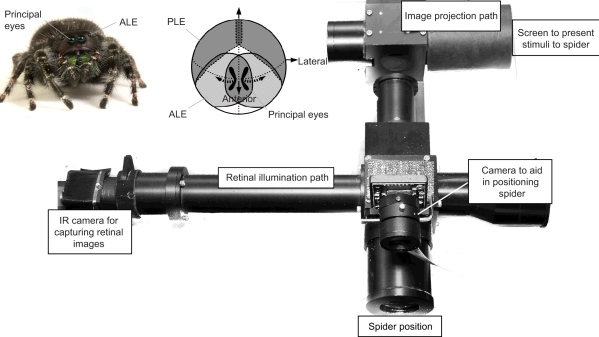
The eyes are windows into the mind, and this research into what jumping spiders look at and why required a clever device that performs eye tracking, but for jumping spiders. The eyesight of these fascinating creatures in some ways has a lot in common with humans. We both perceive a wide-angle region of lower visual fidelity, but are capable of directing our attention to areas of interest within that to see greater detail. Researchers have been able to perform eye-tracking on jumping spiders, literally showing exactly where they are looking in real-time, with the help of a custom device that works a little bit like a miniature movie theatre.

A harmless temporary adhesive on top (and a foam ball for a perch) holds a spider in front of a micro movie projector and IR camera. Spiders were not harmed in the research.

To do this, researchers had to get clever. The unblinking lenses of a spider’s two front-facing primary eyes do not move. Instead, to look at different things, the cone-shaped inside of the eye is shifted around by muscles. This effectively pulls the retina around to point towards different areas of interest. Spiders, whose primary eyes have boomerang-shaped retinas, have an X-shaped region of higher-resolution vision that the spider directs as needed.

So how does the spider eye tracker work? The spider perches on a tiny foam ball and is attached — the help of a harmless and temporary adhesive based on beeswax — to a small bristle. In this way, the spider is held stably in front of a video screen without otherwise being restrained. The spider is shown home movies while an IR camera picks up the reflection of IR off the retinas inside the spider’s two primary eyes. By superimposing the IR reflection onto the displayed video, it becomes possible to literally see exactly where the spider is looking at any given moment. This is similar in some ways to how eye tracking is done for humans, which also uses IR, but watches the position of the pupil.

In the short video embedded below, if you look closely you can see the two retinas make an X-shape of a faintly lighter color than the rest of the background. Watch the spider find and focus on the silhouette of a tasty cricket, but when a dark oval appears and grows larger (as it would look if it were getting closer) the spider’s gaze quickly snaps over to the potential threat.

Feel a need to know more about jumping spiders? This eye-tracking research was featured as part of a larger Science News article highlighting the deep sensory spectrum these fascinating creatures inhabit, most of which is completely inaccessible to humans.

Continue reading “Eye-Tracking Device Is A Tiny Movie Theatre For Jumping Spiders”

Building A Devil’s Toothpaste Rocket Motor

When it comes to weird and wacky homebrew rocket experiments, [Integza] keeps himself fairly busy. He’s now attempted a design repurposing Devil’s Toothpaste for propulsion.

Devil’s Toothpaste is really the same as the famous Elephant Toothpaste experiment, just executed with higher concentration hydrogen peroxide. In this case, [Integza] is using 50% hydrogen peroxide combined with potassium permanganate as a catalyst. When the two are combined, the hydrogen peroxide breaks down into oxygen and water, which [Integza] uses here to propel a skateboard.

The potassium permanganate catalyst is impregnated into 3D printed porous ceramic parts. The peroxide is then  injected into this matrix via a compressed air mechanism, where it decomposes, creating a jet of water and oxygen that then blasts out of a 3D printed rocket nozzle to generate thrust.

It works surprisingly well, even if it’s a messy and unconventional way to build a rocket. It’s also a lot less fiery than most of [Integza]’s previous projects. Video after the break.

Continue reading “Building A Devil’s Toothpaste Rocket Motor”

A 1971 Thermos compliments this mid-century corner of my office.

The Incredible Tech Of The Vacuum-Seal Flask

I recently started using a 50-year-old vacuum-seal flask that belonged to my Grandpa so that I don’t have to leave the dungeon as often to procure more caffeine. Besides looking totally awesome on my side desk, this thing still works like new, at least as far as I can tell — it’s older than I am.

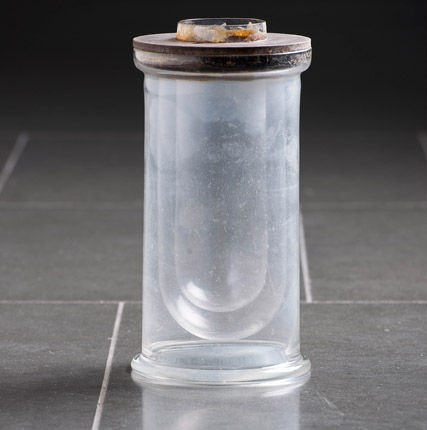
Sir James Dewar's original vacuum-seal flask.
Sir James Dewar’s original vacuum-seal flask. Image via the Royal Institute

Of course this got me to wondering how exactly vacuum-seal flasks, better known in household circles as Thermoses work, and how they were invented. The vacuum-seal flask is surprisingly old technology. It was first invented by Scottish chemist Sir James Dewar and presented to the Royal Institute in 1892. Six years later, he would be the first person to liquefy hydrogen and is considered a founding father of cryogenics. Continue reading “The Incredible Tech Of The Vacuum-Seal Flask”