Tipping Points In The Climate System: The Worst Kind Of Positive Feedback

With global temperatures continuing to break records in recent years, it’s important to cast an eye towards the future. While efforts to reduce emissions remain in a political quagmire, time is running out to arrest the slide into catastrophe.

Further compounding the issue are a variety of positive feedback loops that promise to further compound the problem. In these cases, initial warming has flow-on effects that then serve to further increase global temperatures. Avoiding these feedback mechanisms is crucial if the Earth is to remain comfortably livable out to the end of the century.

A Multitude of Causes

The issue of climate change often appears as a simple one, with the goal being to reduce greenhouse gas emissions in order to prevent negative consequences for human civilization. Despite this, the effects of climate change are often diffuse and intermingled. The various climate systems of the Earth interact in incredibly complex ways, and there are many mechanisms at play in these feedback effects that could tip things over the edge.

Continue reading “Tipping Points In The Climate System: The Worst Kind Of Positive Feedback”
Growing Human Neurons Hooked Up To Electrodes

Philosophers have long mused about the concept of a “brain in a jar”, but thus far, it’s remained the preserve of science fiction rather than reality. However, after reading some scientific papers, [Justin] wanted to attempt the feat himself, so set out to grow some human neurons on an electrode array. 

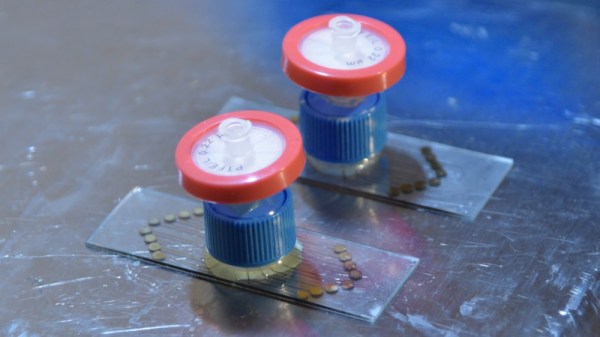
The project builds on [Justin]’s earlier work, using his DC sputtering rig to coat a glass microscope slide with electrodes. The first layer is silver for high conductivity, with an added gold layer for biocompatibility. The screw cap from a Falcon tube is then epoxied on to act as a reservoir for culture media for the neurons. Finally, an air filter is added to allow the biological mixture to breathe.

This was [Justin]’s first attempt at culturing neurons, and there were plenty of hurdles along the way. The custom culture assemblies had issues with the epoxy bonds leaking or failing entirely, leading to only one slide making it through the sterilization process. Additionally, the neurons were accidentally added in too high a quantity. While some growth was observed under the microscope, [Justin] was unable to detect any real signal from the system.

Despite a poor final result, plenty was learned along the way. [Justin] has already put plans into place to fix some of the pitfalls of the original experiment, and we look forward to seeing future updates from the project. Video after the break.

Continue reading “Growing Human Neurons Hooked Up To Electrodes”

Tricking The Brain Into Seeing Boosted Contrast In Stereo Imagery

Last year a team of researchers published a paper detailing a method of boosting visual contrast and image quality in stereoscopic displays. The method is called Dichoptic Contrast Enhancement (DiCE) and works by showing each eye a slightly different version of an image, tricking the brain into fusing the two views together in a way that boosts perceived image quality. This only works on stereoscopic displays like VR headsets, but it’s computationally simple and easily implemented. This trick could be used to offset some of the limitations of displays used in headsets, for example making them appear capable of deeper contrast levels than they can physically deliver. This is good, because higher contrasts are generally perceived as being more realistic and three-dimensional; important factors in VR headsets and other stereoscopic displays.

Stereoscopic vision works by having the brain fuse together what both eyes see, and this process is called binocular fusion. The small differences between what each eye sees mostly conveys a sense of depth to us, but DiCE uses some of the quirks of binocular fusion to trick the brain into perceiving enhanced contrast in the visuals. This perceived higher contrast in turn leads to a stronger sense of depth and overall image quality.

Example of DiCE-processed images, showing each eye a different dynamic contrast range. The result is greater perceived contrast and image quality when the brain fuses the two together.

To pull off this trick, DiCE displays a different contrast level to both eyes in a way designed to encourage the brain to fuse them together in a positive way. In short, using a separate and different dynamic contrast range for each eye yields an overall greater perceived contrast range in the fused image. That’s simple in theory, but in practice there were a number of problems to solve. Chief among them was the fact that if the difference between what each eyes sees is too great, the result is discomfort due to binocular rivalry. The hard scientific work behind DiCE came from experimentally determining sweet spots, and pre-computing filters independent of viewer and content so that it could be applied in real-time for a consistent result.

Things like this are reminders that we experience the world only through the filter of our senses, and our perception of reality has quirks that can be demonstrated by things like this project and other “sensory fusion” edge cases like the Thermal Grill Illusion, which we saw used as the basis for a replica of the Pain Box from Dune.

A short video overview of the method is embedded below, and a PDF of the publication can be downloaded for further reading. Want a more hands-on approach? The team even made a DiCE plugin (freely) available from the Unity asset store.

Continue reading “Tricking The Brain Into Seeing Boosted Contrast In Stereo Imagery”

Tensors Explained

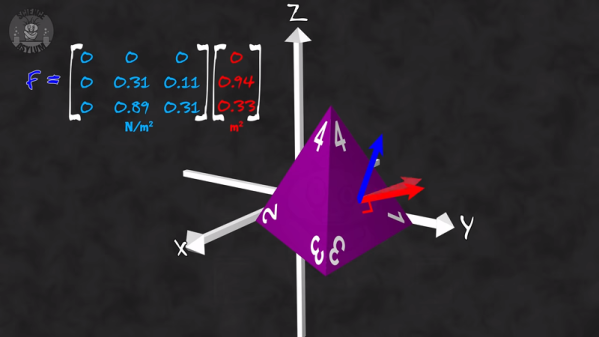
You can do a lot of electronics without ever touching a tensor, but there are some situations in which tensors are absolutely essential. The problem is that most math texts give you a very dry description that is difficult to internalize. That’s where [The Science Asylum] comes in. Their recent video (see below) starts with the dry definition and then shows you what it means and why.

According to the video, the textbook definition is:

A rank-n tensor in m-dimensions is a mathematical object that has n indices and mn components and obeys certain transformational rules.

That sounds a lot like an array but we are not sure what “certain transformational rules” really means to anyone.

Wikipedia does a little better:

[A]n algebraic object that describes a linear mapping from one set of algebraic objects to another.

These constructs are key to anything electromagnetic (including antennas) and show up a lot in stress calculations and quantum mechanics. Even Einstien’s theory of relativity uses tensors.

Continue reading “Tensors Explained”

Alternative Uses For Nuclear Waste

Nuclear power is great if you want to generate a lot of electricity without releasing lots of CO2 and other harmful pollutants. However, the major bugbear of the technology has always been the problem of waste. Many of the byproducts from the operation of nuclear plants are radioactive, and remain so for thousands of years. Storing this waste in a safe and economical fashion continues to be a problem.

Alternative methods to deal with this waste stream continue to be an active area of research. So what are some of the ways this waste can be diverted or reused?

Fast Breeders Want To Close The Fuel Cycle

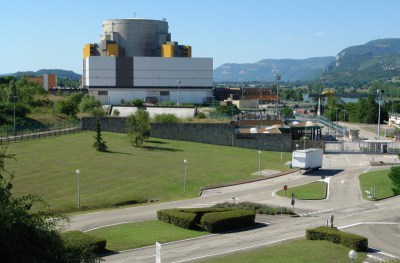
The Superphénix reactor in France is one of a handful of operational fast-neutron reactor designs.

One of the primary forms of waste from a typical nuclear light water reactor (LWR) is the spent fuel from the fission reaction. These consist of roughly 3% waste isotopes, 1% plutonium isotopes, and 96% uranium isotopes. This waste is high in transuranic elements, which have half-lives measured in many thousands of years. These pose the biggest problems for storage, as they must be securely kept in a safe location for lengths of time far exceeding the life of any one human society.

The proposed solution to this problem is to instead use fast-neutron reactors, which “breed” non-fissile uranium-238 into plutonium-239 and plutonium-240, which can then be used as fresh fuel. Advanced designs also have the ability to process out other actinides, also using them as fuel in the fission process. These reactors have the benefit of being able to use almost all the energy content in uranium fuel, reducing fuel use by 60 to 100 times compared to conventional methods.

Continue reading “Alternative Uses For Nuclear Waste”

Lead-Free Solder Alloys: Their Properties And Best Types For Daily Use

Lead-free solder alloys have been around for as long as people have done soldering, with sources dating back about 5,000 years. Most of these alloys were combinations like copper-silver or silver-gold and used with so-called hard soldering. That’s a technique still used today to join precious and semi-precious metals together. A much more recent development is that of soldering electronic components together, using ‘soft soldering’, which entails much lower temperatures.

Early soft soldering used pure tin (Sn), yet gradually alloys were sought that would fix issues like thermal cycling, shock resistance, electron migration, and the development of whiskers in tin-based alloys. While lead (Pb) managed to fill this role for most soldering applications, the phasing out of lead from products, as well as new requirements for increasingly more fine-pitched components have required the development of new solder alloys that can fill this role.

In this article we’ll be looking at the commonly used lead-free solder types for both hobby and industrial use, and the dopants that are used to improve their properties.

Continue reading “Lead-Free Solder Alloys: Their Properties And Best Types For Daily Use”

CRISPR Could Fry All Cancer Using Newly Found T-Cell

One of the human body’s greatest features is its natural antivirus protection. If your immune system is working normally, it produces legions of T-cells that go around looking for abnormalities like cancer cells just to gang up and destroy them. They do this by grabbing on to little protein fragments called antigens that live on the surface of the bad cells and tattle on their whereabouts to the immune system. Once the T-cells have a stranglehold on these antigens, they can release toxins that destroy the bad cell, while minimizing collateral damage to healthy cells.

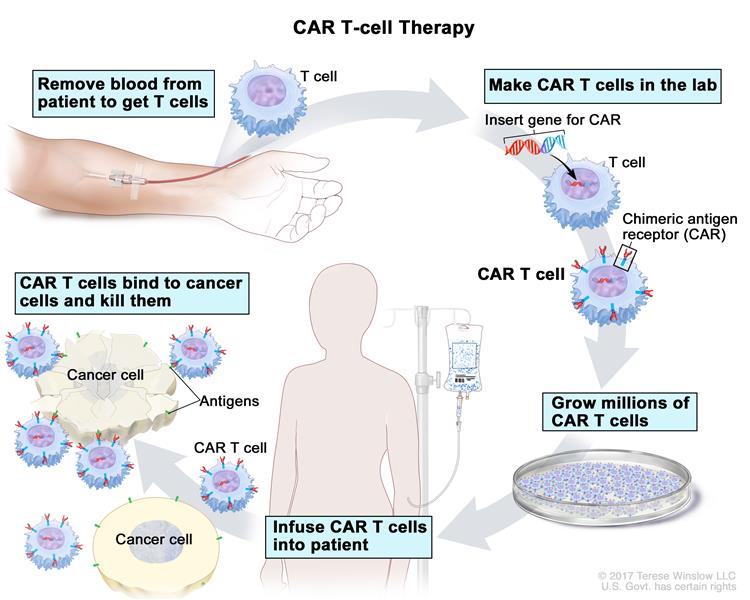
CAR T-cell therapy process via National Cancer Institute

This rather neat human trick doesn’t always work, however. Cancer cells sometimes mask themselves as healthy cells, or they otherwise thwart T-cell attacks by growing so many antigens on their surface that the T-cells have no place to grab onto.

Medical science has come up with a fairly new method of outfoxing these crafty cancer cells called CAR T-cell therapy. Basically, they withdraw blood from the patient, extract the T-cells, and replace the blood. The T-cells are sent off to a CRISPR lab, where they get injected with a modified, inactive virus that introduces a new gene which causes the T-cells to sprout a little hook on their surface.

This hook, which they’ve dubbed the chimeric antigen receptor (CAR), allows the T-cell to chemically see through the cancer cells’ various disguises and attack them. The lab multiplies these super soldiers and sends them back to the treatment facility, where they are injected into the patient’s front lines.

Continue reading “CRISPR Could Fry All Cancer Using Newly Found T-Cell”