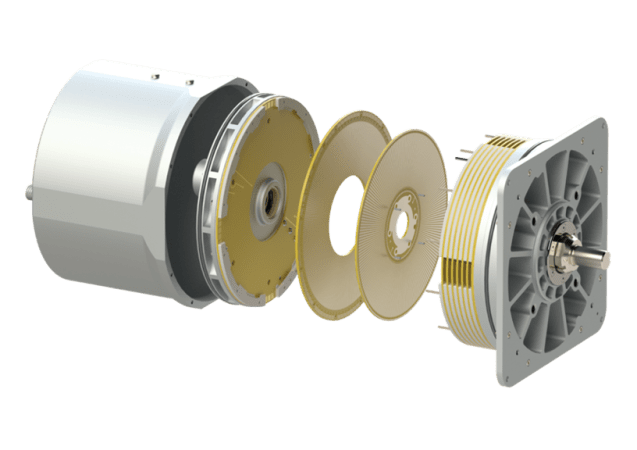
Electrostatic motors are now common in MEMS applications, but researchers at the University of Wisconsin and spinoff C-Motive Technologies have brought macroscale electrostatic motors back. [via MSN/WSJ]
While the first real application of an electric motor was Ben Franklin’s electrostatically-driven turkey rotisserie, electromagnetic type motors largely supplanted the technology due to the types of materials available to engineers of the time. Newer dielectric fluids and power electronics now allow electrostatic motors to be better at some applications than their electromagnetic peers.
The main advantage of electrostatic motors is their reduced critical materials use. In particular, electrostatic motors don’t require copper windings or any rare earth magnets which are getting more expensive as demand grows for electrically-powered machines. C-Motive is initially targeting direct drive industrial applications, and the “voltage driven nature of an electrostatic machine” means they require less cooling than an electromagnetic motor. They also don’t use much if any power when stalled.
In 2020 international shipping saw itself faced with new fuel regulations for cargo ships pertaining to low sulfur fuels (IMO2020). This reduced the emission of sulfur dioxide aerosols from these ships across the globe by about 80% practically overnight and resulting in perhaps the biggest unintentional geoengineering event since last century.
As detailed in a recent paper by [Tianle Yuan] et al. as published in Nature, by removing these aerosols from the Earth’s atmosphere, it also removed their cooling effect. Effectively this change seems to have both demonstrated the effect of solar engineering, as well as sped up the greenhouse effect through radiative forcing of around 0.2 Watt/m2 of the global ocean.
The inadvertent effect of the pollution by these cargo ships appears to have been what is called marine cloud brightening (MCB), with the increased reflectivity of said clouds diminishing rapidly as these pollution controls came into effect. This was studied by the researchers using a combination of satellite observations and a chemical transport model, with the North Atlantic, the Caribbeans and South China Sea as the busiest shipping channels primarily affected.
Although the lesson one could draw from this is that we should put more ships on the oceans burning high-sulfur fuels, perhaps the better lesson is that MCB is a viable method to counteract global warming, assuming we can find a method to achieve it that doesn’t also increase acid rain and similar negative effects from pollution.
Featured image: Time series of global temperature anomaly since 1980. (Credit: Tianle Yuan et al., Nature Communications Earth Environment, 2024)
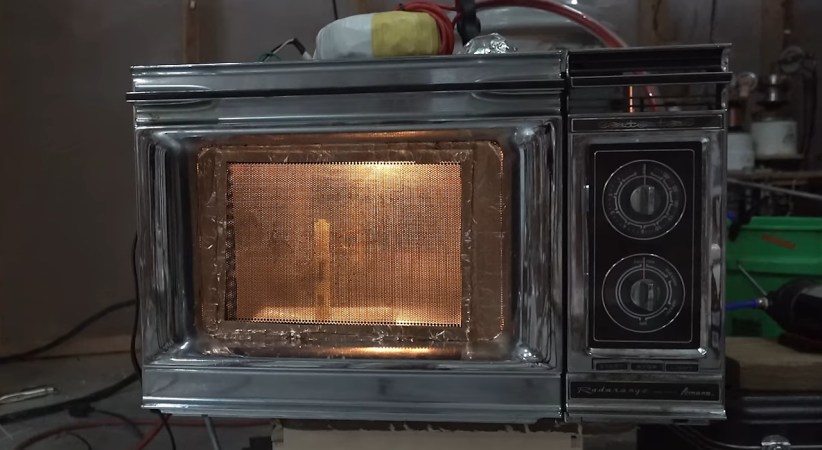
Whilst microwave plasmas are nothing new around here, we were curious to see what happens at 20x the power, and since YouTuber [Styropyro] had put out a new video, we couldn’t resist seeing where this was going. Clearly, as your bog standard microwave oven can only handle at most one kilowatt; the ‘oven’ needed a bit of an upgrade.
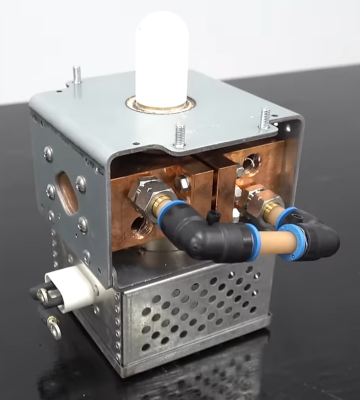
A 16 kW water-cooled magnetron. Why not over-drive it to 20 kW for fun?
Getting hold of bigger magnetrons is tricky, but as luck — or perhaps fate — would have it, a 16 kW, water-cooled beast became available on eBay thanks to a tip from a Discord user. It was odd but perhaps not surprising that this Hitatch H0915 magnetron was being sold as a ‘heat exchanger.’
[Styropyro] doesn’t go into much detail on how to supply the anode with its specified 16 kW at 9.5 kVDC, but the usual sketchy (well down-right terrifying) transformers in the background indicate that he had just what was needed kicking around the ‘shop. Obviously, since this is a [Styropyro] video, these sorts of practical things have been discussed before, so there is no need to waste precious time and get right on to blowing stuff up!
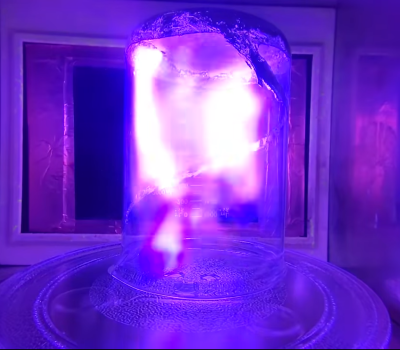
Some classic microwave tricks are shown, like boiling water in five seconds, cooking pickles (they really do scream at 20 kW) and the grape-induced plasma-in-a-jar. It was quite clear that at this power level, containing that angry-looking plasma was quite a challenge. If it was permitted to leak out for only a few seconds, it destroyed the mica waveguide cover and risked coupling into the magnetron and frying it. Many experiments followed, a lot of which seemed to involve the production of toxic brown-colored nitrogen dioxide fumes. It was definitely good to see him wearing a respirator for this reason alone!
Is it purple or is it indigo? Beauty is in the eye of the beholder!
The main star of the demonstration was the plasma-induced emissions of various metal elements, with the rare indigo and violet colors making an appearance once the right blend of materials was introduced into the glassware. Talking of glassware, we reckon he got through a whole kitchen’s worth. We lost count of the number of exploded beakers and smashed plates. Anyway, plasma science is fun science, but obviously, please don’t try any of this at home!
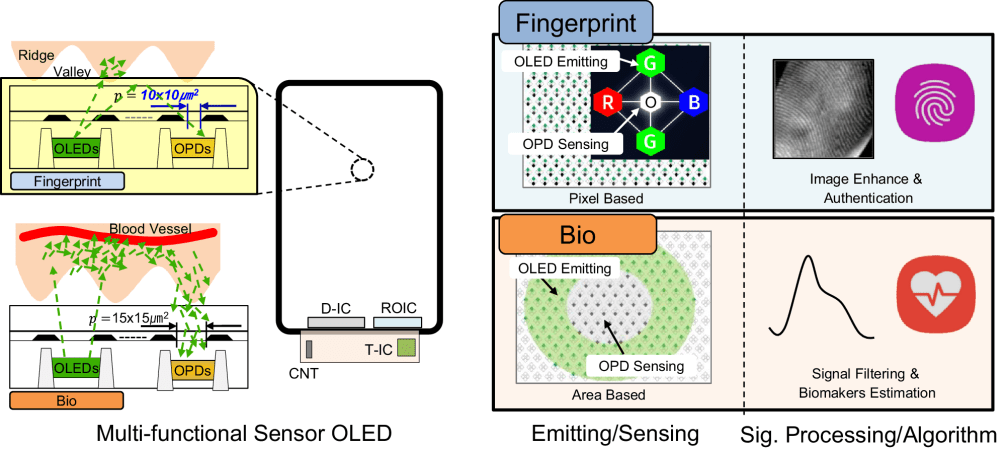
These days displays are increasingly expected to be bidirectional devices, accepting not only touch inputs, but also to integrate fingerprint sensing and even somehow combine a camera with a display without punching a hole through said display. Used primarily on smartphone displays, these attempts have been met with varying degrees of success. But a paper published in the Communications Engineering journal describes a version which combines an OLED with photosensors in the same structure — a design that may provide a way to make such features much more effective.
The article by [Chul Kim] and colleagues of the Samsung Display Research Center in South Korea the construction of these bidirectional OLED displays is described, featuring the standard OLED pixels as well as an organic photodiode (OPD) placed side-by-side. Focusing on the OLED’s green light for its absorption characteristics with the human skin, the researchers were able to use the produced OLED/OPD hybrid display for fingerprint recognition, as well as a range of cardiovascular markers, including heart rate, blood pressure, etc.
The basic principle behind these measurements involves photoplethysmography, which is commonly used in commercially available pulse oximeters. Before these hybrid displays can make their way into commercial devices, there are still a few technical challenges to deal with, in particular electrical and optical leakage. The sample demonstrated appears to work well in this regard, but the proof is always in the transition from the lab to mass-production. We have to admit that it would be rather cool to have a display that can also handle touch, fingerprints and record PPG data without any special layers or sensor chips.
It’s easy to use electricity — solar-generated or otherwise — to desalinate water. However, traditional systems require a steady source of power. Since solar panels don’t always produce electricity, these methods require some way to store or acquire power when the solar cells are in the dark or shaded. But MIT engineers have a fresh idea for solar-powered desalination plants: modify the workload to account for the amount of solar energy available.
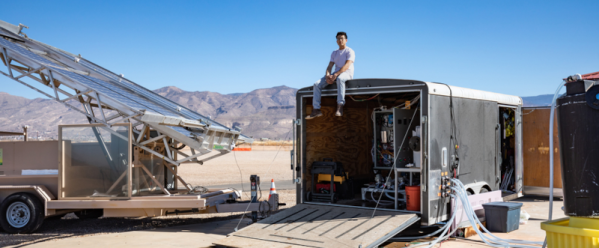
This isn’t just a theory. They’ve tested community-sized prototypes in New Mexico for six months. The systems are made especially for desalinating brackish groundwater, which is accessible to more people than seawater. The goal is to bring potable water to areas where water supplies are challenging without requiring external power or batteries.
The process used is known as “flexible batch electrodialysis” and differs from the more common reverse osmosis method. Reverse osmosis, however, requires a steady power source as it uses pressure to pump water through a membrane. Electrodialysis is amenable to power fluctuations, and a model-based controller determines the optimal settings for the amount of energy available.
Everyone knows those small bags of forbidden “Do not eat” candy that come with fresh rolls of FDM filament as well as a wide range of other products. Containing usually silica gel but sometimes also bentonite clay, these desiccant bags are often either thrown away or tossed into bags of FDM filament with a ‘adding one can’t hurt’ attitude. As [Stefan] over at CNC Kitchenrecently figured out, adding an already saturated bag of desiccant into e.g. an airtight container with a freshly dried spool of filament can actually make the humidity in the container spike as the desiccant will start releasing moisture. So it’s best to dry those little bags if you intend to reuse them, but what is the best way?
Among the ‘safe’ contenders are an oven, a filament dryer and the ‘filament drying’ option of [Stefan]’s Bambu Lab FDM printer. These managed to remove most of the moisture from the desiccant in a few hours. The more exciting option is that of a microwave, which does the same in a matter of minutes, requiring one or more ~5 minute sessions at low power, which effectively also used less power than the other options. Among the disadvantages are potentially melting bags, silica beads cracking, the bentonite clay desiccant heating up rather dangerously and the indicator dye in silica beads may be damaged by the rapid heating.
After all of this testing, it would seem that there are many good options to reuse those desiccant bags with a bit of care, although for those who happen to have a vacuum chamber nearby, that might be an even faster option.
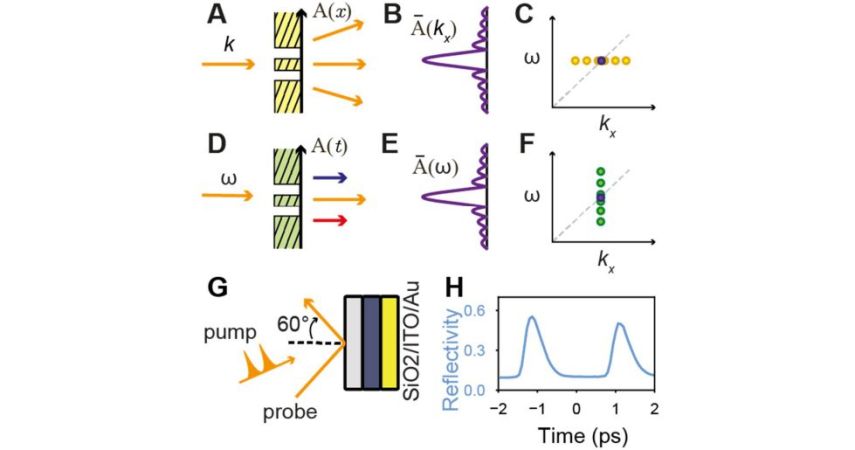
The double-slit experiment, first performed by [Thomas Young] in 1801 provided the first definitive proof of the dual wave-particle nature of photons. A similar experiment can be performed that shows diffraction at optical frequencies by changing the reflectivity of a film of indium-tin-oxide (ITO), as demonstrated in an April 2024 paper (preprint) by [Romain Tirole] et al. as published in Nature Physics. The reflectivity of a 40 nm thick film of ITO deposited on a glass surface is altered with 225 femtosecond pulses from a 230.2 THz (1300 nm) laser, creating temporal ‘slits’.
Interferogram of the time diffracted light as a function of slit separation (ps) and frequency (THz). (Credit: Tirole et al., Nature Physics, 2024)
The diffraction in this case occurs in the temporal domain, creating frequencies in the frequency spectrum when a separate laser applies a brief probing pulse. The effect of this can be seen most clearly in an interferogram (see excerpt at the right). Perhaps the most interesting finding during the experiment was how quickly and easily the ITO layer’s reflectivity could be altered. With ITO being a very commonly used composition material that provides properties such as electrical conductivity and optical transparency which are incredibly useful for windows, displays and touch panels.
Although practical applications for temporal diffraction in the optical or other domains aren’t immediately obvious, much like [Young]’s original experiment the implications are likely to be felt (much) later.
Featured image: the conventional and temporal double-slit experiments, with experimental setup (G). (Credit: Tirole et al., Nature Physics, 2024)