Malware Posing As Change.gov

change

PandaLabs has identified a botnet running a malware campaign impersonating president-elect Obama’s website. The front page of the site features a sensational story titled “Barack Obama has refused to be a president”. Clicking the link will download the malware and make the target’s machine part of the botnet. They’re using fast-flux to assign the malicious domains to the massive number of compromised nodes that are hosting the actual site. The team has contacted the domain name registrar in China to get the domains removed. Using a sensational headline is not new to malware; it’s how the Storm Worm got its name.

[via lithium]

Dismantling The Storm Worm Botnet

malware

Zero Day has an interview with German researchers who have found a way to take down the Storm Worm botnet. Their program, Stormfucker, takes advantage of flaws in Storm’s command network: Nodes that are NAT‘d only use a four-byte XOR challenge. Nodes that aren’t NAT’d are only using a trivial 64bit RSA signature. Their solution can clean infected machines and also distribute to other nodes. Unfortunately, installing software without the user’s consent is the exact same behavior as malware. Don’t expect to see this in any sort of widespread use. The researchers did point out that some ISPs have moved to shutting off service for infected customers until their machines are cleaned.

Interview With An Adware Author

toolbars2

Philosecurity has an interview with [Matt Knox], a former coder for Direct Revenue, an adware company which was sued in 2006 by New York governor Eliot Spitzer. The interview contains some interesting details of how the adware code worked internally: it created a Browser Helper Object, then ensured that the Browser Helper Object stayed up by creating a poller to check every ten seconds and regenerate the Browser Helper Object if it had stopped running. The poller ingeniously masked itself partly by exploiting Windows’ Create Remote Thread function to run itself as a series of threads instead of as an executable.

The truly fascinating bit of the interview is how [Knox] defies your initial suspicion that he’s a complete scumbag; he started off writing spam filtering software, was hired by Direct Revenue to do traffic analysis, started writing tiny bits of code to improve the adware, and eventually wound up knee-deep in the code.  [Knox] notes that you can get ordinary people to do incredibly distasteful things if you break those things into small enough chunks and introduce them gradually.

[via Waxy]

[photo: xcaballe]

Automated Protocol Analysis

wireshark

[I)ruid] from BreakingPoint Labs has been doing quite a bit of protocol reverse engineering as part of his work. He put together a post covering some of the tools that have been useful for this task. Text-based protocols have a lot of human readable characters that can help you identify fields. Binary protocols don’t have this luxury though. He recommends the Protocol Informatics Project for tackling these situations. It applies bioinformatics algorithms to network traffic. You give it a packet dump of the protocol and it compares them to find similarities the same way genetic sequences are compared. It can be confused by protocols that waste a lot of space, but it’s still a very clever approach to reversing.

[photo: slashcrisis]

Intel 4004 Internals

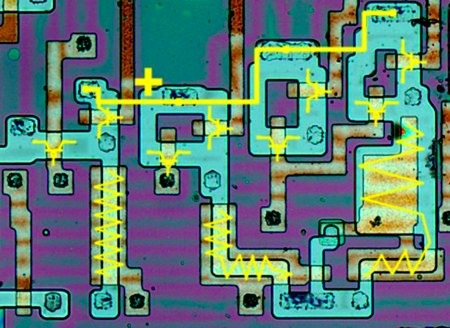
The silicon wizards at Flylogic have certainly posted an interesting chip this time around. The Intel 4004 was the first widely used microprocessor. The logic gates are much larger than you’d find in modern chips. The unique feature is that each gate is designed to make the most efficient use of the silicon instead of the standardized shapes you find now. They’ve uploaded a full image of the chip.

For an introduction to silicon hacking, we reccomend [bunnie]’s talk from Toorcon and [Karsten]’s talk from 24C3. You can find many more posts on the topic in our silicon tag.

Brute Force Attack On Twitter

[youtube=http://www.youtube.com/watch?v=IKNbggNJMVI]

Wired Threat Level has posted an interview with the hacker who recently broke into several high profile twitter accounts, such as Fox News, and Barack Obama. Since we know how much you all love twitter, we thought you might want to learn more about it. Apparently he used a brute force method to get into a member of the support team. The password was “happiness” which was cracked pretty quickly. This might be a good time to review your own strategies to prevent brute force attacks.

The Malware Challenge

malware

Our own [Anthony Lineberry] has written up his experience participating in the 2008 Malware Challenge as part of his work for Flexilis. The contest involved taking a piece of provided malware, doing a thorough analysis of its behavior, and reporting the results. This wasn’t just to test the chops of the researchers, but also to demonstrate to network/system administrators how they could get into malware analysis themselves.

[Anthony] gives a good overview of how he created his entry (a more detailed PDF is here). First, he unpacked the malware using Ollydbg. Packers are used to obfuscate the actual malware code so that it’s harder for antivirus to pick it up. After taking a good look at the assembly, he executed the code. He used Wireshark to monitor the network traffic and determine what URL the malware was trying to reach. He changed the hostname to point at an IRC server he controlled. Eventually he would be able to issue botnet control commands directly to the malware. We look forward to seeing what next year’s contest will bring.