Identifying Malware By Sniffing Its EM Signature

The phrase “extraordinary claims require extraordinary evidence” is most often attributed to Carl Sagan, specifically from his television series Cosmos. Sagan was probably not the first person to put forward such a hypothesis, and the show certainly didn’t claim he was. But that’s the power of TV for you; the term has since come to be known as the “Sagan Standard” and is a handy aphorism that nicely encapsulates the importance of skepticism and critical thinking when dealing with unproven theories.

It also happens to be the first phrase that came to mind when we heard about Obfuscation Revealed: Leveraging Electromagnetic Signals for Obfuscated Malware Classification, a paper presented during the 2021 Annual Computer Security Applications Conference (ACSAC). As described in the mainstream press, the paper detailed a method by which researchers were able to detect viruses and malware running on an Internet of Things (IoT) device simply by listening to the electromagnetic waves being emanated from it. One needed only to pass a probe over a troubled gadget, and the technique could identify what ailed it with near 100% accuracy.

Those certainly sound like extraordinary claims to us. But what about the evidence? Well, it turns out that digging a bit deeper into the story uncovered plenty of it. Not only has the paper been made available for free thanks to the sponsors of the ACSAC, but the team behind it has released all of code and documentation necessary to recreate their findings on GitHub.

Unfortunately we seem to have temporarily misplaced the $10,000 1 GHz Picoscope 6407 USB oscilloscope that their software is written to support, so we’re unable to recreate the experiment in full. If you happen to come across it, please drop us a line. But in the meantime we can still walk through the process and try to separate fact from fiction in classic Sagan style.

Continue reading “Identifying Malware By Sniffing Its EM Signature”

Illustrated Kristina with an IBM Model M keyboard floating between her hands.

Keebin’ With Kristina: The One With The Tri-lingual Typewriter

Isn’t it just fantastic when a project finally does what you wanted it to do in the first place? [Simon Merrett] isn’t willing to compromise when it comes to the Aerodox. His original vision for the keyboard was a wireless, ergonomic split that could easily switch between a couple of PCs. Whereas some people are more into making layout after layout, [Simon] keeps pushing forward with this same design, which is sort of a mashup between the ErgoDox and the Redox, which is itself a wireless version of the ErgoDox.

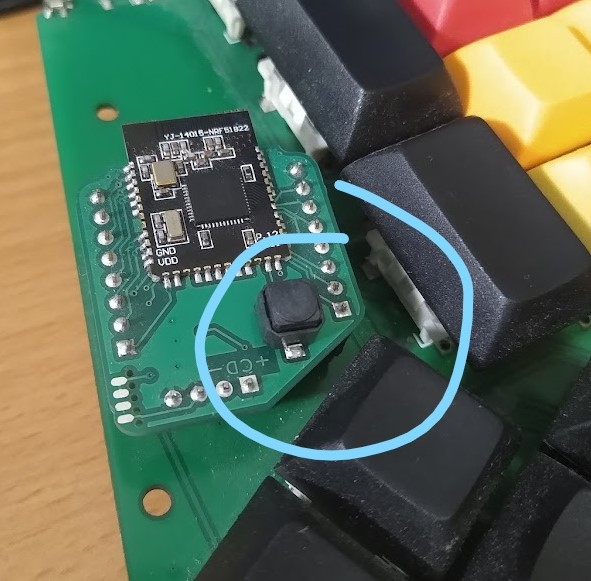
The Aerodox has three nRF51822 modules — one for the halves to communicate, one for the control half to send key presses, and a third on the receiver side. [Simon] was using two AA cells to power each one, and was having trouble with the range back to the PC.

The NRFs want 3.3 V, but will allegedly settle for 2 V when times are hard. [Simon] added a boost converter to give each a solid 3.3 V, and the Aerodox became reliable enough to be [Simon]’s daily driver. But let’s go back to the as-yet-unrealized potential part.

Continue reading “Keebin’ With Kristina: The One With The Tri-lingual Typewriter”

KiCAD 6.0: What Made It And What Didn’t

I’ve been following the development of KiCAD for a number of years now, and using it as my main electronics CAD package daily for a the last six years or thereabouts, so the release of KiCAD 6.0 is quite exciting to an electronics nerd like me. The release date had been pushed out a bit, as this is such a huge update, and has taken a little longer than anticipated. But, it was finally tagged and pushed out to distribution on Christmas day, with some much deserved fanfare in the usual places.

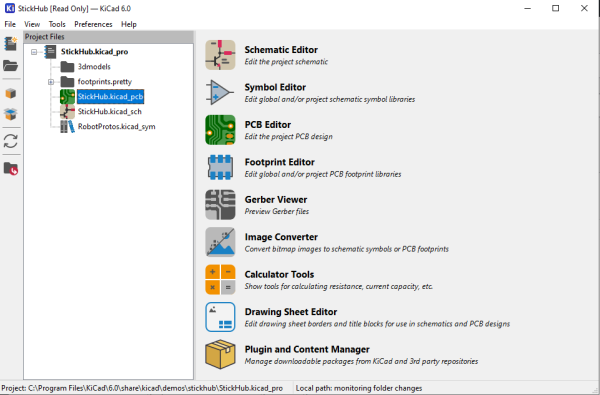
So now is a good time to look at which features are new in KiCAD 6.0 — actually 6.0.1 is the current release at time of writing due to some bugfixes — and which features originally planned for 6.0 are now being postponed to the 7.0 roadmap and beyond. Continue reading “KiCAD 6.0: What Made It And What Didn’t”

Hackaday Links Column Banner

Hackaday Links: January 16, 2022

As winter well and truly grips the northern hemisphere, it’s time once again to dunk on Tesla for leaving some owners out in the cold — literally. It seems that some Model 3 and Model Y owners are finding their ride’s heat pump isn’t exactly up to the task of, you know, pumping heat. That this seems to be happening mostly in the northeastern US and southern Canada, where a polar vortex is once again dominating the weather and driving temperatures down into the -30 °C (-22 °F) range, perhaps speaks more to the laws of thermodynamics than it does to the engineering of the Tesla climate control system. After all, if there’s not much heat outside the car, it’s hard to pump it inside. But then again, these are expensive machines, some of which have had extensive repairs to address this exact same issue when it cropped up last year. It seems to us that owners have a legitimate gripe with Tesla about this, and they may be getting some help from the Feds, who are taking an interest in the situation from a safety standpoint. After all, no heat likely means fogged up windows, and that’s hardly conducive to a safe trip. But hey, that’s what self-driving is for, right?

Much has been made of the dearth of engineering cameras on the James Webb Space Telescope, and the fact that we’ve been relying on animations to illustrate the dozens of deployments needed to unfurl the observatory and make it ready for its mission. Putting aside the fact that adding extra cameras to the spacecraft makes little sense since the interesting stuff was all happening on the side where the sun doesn’t shine, we did get treated to what was billed as “humanity’s last look at Webb” thanks to an engineering camera on the Ariane 5 rocket. But not so fast — an astrophotographer named Ethan Gone managed to spot the JWST as it transited to L2 the day after launch. Granted, the blip of light isn’t as spectacular as the Ariane shots, and it took a heck of a lot of astrophotography gear to do it, but it’s still thrilling to watch Webb moving gracefully through Orion.

Continue reading “Hackaday Links: January 16, 2022”

Remoticon 2021 // Hash Salehi Outsmarts His Smart Meter

Smart meters form mesh networks among themselves and transmit your usage data all around. Some of them even allow the power company to turn off your power remotely, through the mesh. You might want to know if any of this information is sensitive, or if the power shutdown system has got glaring security flaws and random people could just turn your house off. Hash Salehi has set out to get inside these meters, and luckily for the rest of us, he was kind enough to share his findings during Remoticon 2021. It’s a journey filled with wonderful tidbits about GNU Radio, embedded devices, and running your own power company inside a Faraday cage.

The smart meter in question is deployed by a power company known as Oncor in the Dallas, Texas, area. These particular meters form an extensive mesh network using a ZigBee module onboard that allows them to to pass messages amongst themselves that eventually make their way to a collector or aggregator to be uploaded to a more central location. Hash obtained his parts via everyone’s favorite online auction house and was surprised to see how many parts were available. Then, with parts in hand, he began all the usual reverse engineering tricks: SDR, Faraday cages, flash chip readers, and recreating the schematic. Continue reading “Remoticon 2021 // Hash Salehi Outsmarts His Smart Meter”

Four Wheel Steering, Always The Option, Never The Defining Feature

A couple of weeks ago when it emerged that a new Tesla might have a four-wheel steering capability, our colleague Dan Maloney mused aloud as to how useful a four-wheel steering system might be, and indeed whether or not one might be necessary at all. This is hardly the first time four-wheel steering has appeared as the Next Big Thing on the roads. It’s time to take a look at the subject and ask whether it’s an idea with a future, or set to go the way of runflat tyres as one of those evergreen innovations that never quite catches on.

What’s your dream vehicle? If you’re like me, you have more than one. There in my lottery-winner’s garage, alongside the trail bikes and the mobile hackerspace, the dictator-size Mercedes and the Golf Mk1, will be a vehicle that by coincidence has four-wheel steering. The JCB Fastrac is a tractor that can travel across almost any terrain at full speed, and though I have no practical use for one and will never own one, I have lusted after one of these machines for over three decades. Their four-wheel steering system is definitely unusual, but that makes it the perfect vehicle with which to demonstrate four-wheel steering. Continue reading “Four Wheel Steering, Always The Option, Never The Defining Feature”

It's a keyboard!

The Charachorder Keyboard Is Too Fast For Competition

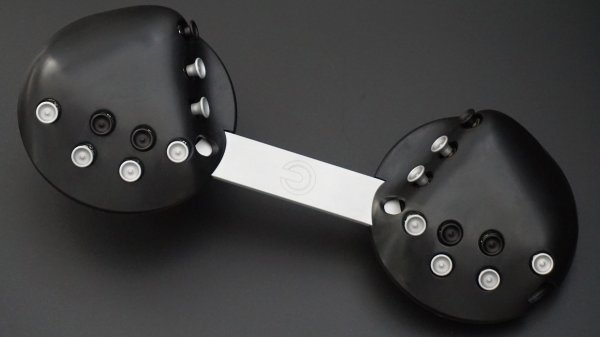
We interrupt the flow of Keebin’ with Kristina to bring you this special bulletin. When three different people alert you to a keyboard within 48 hours or so, it calls for more than just a paragraph in the roundup column. So here are several paragraphs, an animated GIF, and some extended commentary about the Charachorder, a new kind of input that came up through Kickstarter in 2021.

Driving this hype train are some short viral videos that show the founder hitting 500+ WPM on this crazy thing. FYI, that is fast enough to get you banned from typing competitions, including the monkeytype leaderboard. Those apes forbid chorded input altogether, and automatically throw out entries above 300 WPM. It acheives these insane speeds through clever mechanical design and, of course, firmware.

Continue reading “The Charachorder Keyboard Is Too Fast For Competition”