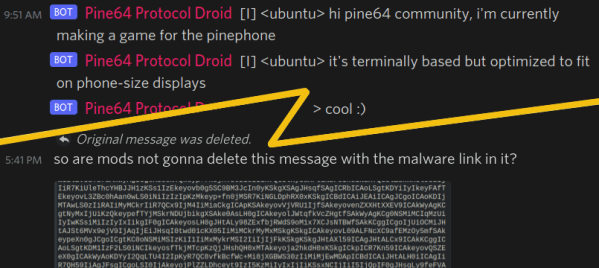
On December 5th, someone by the IRC nickname of [ubuntu] joined the Pine64 Discord’s #pinephone channel through an IRC bridge. In the spirit of December gift-giving traditions, they have presented their fellow PinePhone users with an offering – a “Snake” game. What [ubuntu] supposedly designed had the potential to become a stock, out-of-the-box-installed application with a small but dedicated community of fans, modders and speedrunners.
Unfortunately, that would not be the alternate universe we live in, and all was not well with the package being shared along with a cheerful “hei gaiz I make snake gaem here is link www2-pinephnoe-games-com-tz replace dash with dot kthxbai” announcement. Shockingly, it was a trojan! Beneath layers of Base64 and Bashfuscator we’d encounter shell code that could be in the “example usage” section of a modern-day thesaurus entry for the word “yeet“.
Among brain researchers there’s a truism that says the reason people underestimate how much unconscious processing goes on in your brain is because you’re not conscious of it. And while there is a lot of unconscious processing, the truism also points out a duality: your brain does both processing that leads to consciousness and processing that does not. As you’ll see below, this duality has opened up a scientific approach to studying consciousness.
Are Subjective Results Scientific?
Checking fMRI images.
In science we’re used to empirical test results, measurements made in a way that are verifiable, a reading from a calibrated meter where that reading can be made again and again by different people. But what if all you have to go on is what a person says they are experiencing, a subjective observation? That doesn’t sound very scientific.
That lack of non-subjective evidence is a big part of what stalled scientific research into consciousness for many years. But consciousness is unique. While we have measuring tools for observing brain activity, how do you know whether that activity is contributing to a conscious experience or is unconscious? The only way is to ask the person whose brain you’re measuring. Are they conscious of an image being presented to them? If not, then it’s being processed unconsciously. You have to ask them, and their response is, naturally, subjective.
Skepticism about subjective results along with a lack of tools, held back scientific research into consciousness for many years. It was taboo to even use the C-word until the 1980s when researchers decided that subjective results were okay. Since then, here’s been a great deal of scientific research into consciousness and this then is a sampling of that research. And as you’ll see, it’s even saved a life or two.
It’s dangerous for a hardware hacker to go into a second-hand store. I was looking for a bed frame for my new apartment, but of course I spent an age browsing all the other rubbish treasures on offer. I have a rough rule of thumb: if it’s not under a tenner and fits in one hand, then it has to be exceptional for me to buy it, so I passed up on a nice Grundig reel-to-reel from the 1960s and instead came away with a folding Palm Pilot keyboard and a Fuji 8mm home movie camera after I’d arranged delivery for the bed. On those two I’d spent little more than a fiver, so I’m good. The keyboard is a serial device that’s a project for a rainy day, but the camera is something else. I’ve been keeping an eye out for one to use for a Raspberry Pi camera conversion, and this one seemed ideal. But once I examined it more closely, I was drawn into an unexpected train of research that shed some light on what must of been real objects of desire for my parents generation.
A Thrift Store Find Opens A Whole New Field
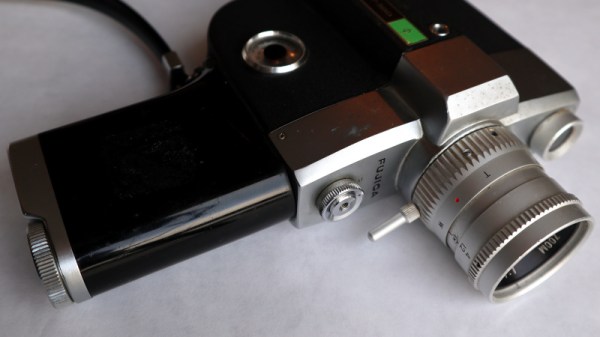
One of the surprises comes in just how small this thing is.
The Fuji P300 from 1972 is typical among consumer movie cameras of the day. It takes the form of a film magazine with a zoom lens assembly on its front, a reflex viewfinder on its side, and a handle with a shutter trigger button on it protruding vertically below the magazine and also housing the batteries.
Surprisingly it still has a mercury cell that would have powered its light meter; a minor annoyance to dispose of this correctly. Sometimes these devices had clockwork motors, but this one has an electric motor. It also has a light sensor that is coupled to some kind of electromechanical aperture. It would have been an expensive camera when it was new, probably as much of a purchase as an SLR or a decent mirrorless camera here in 2021.
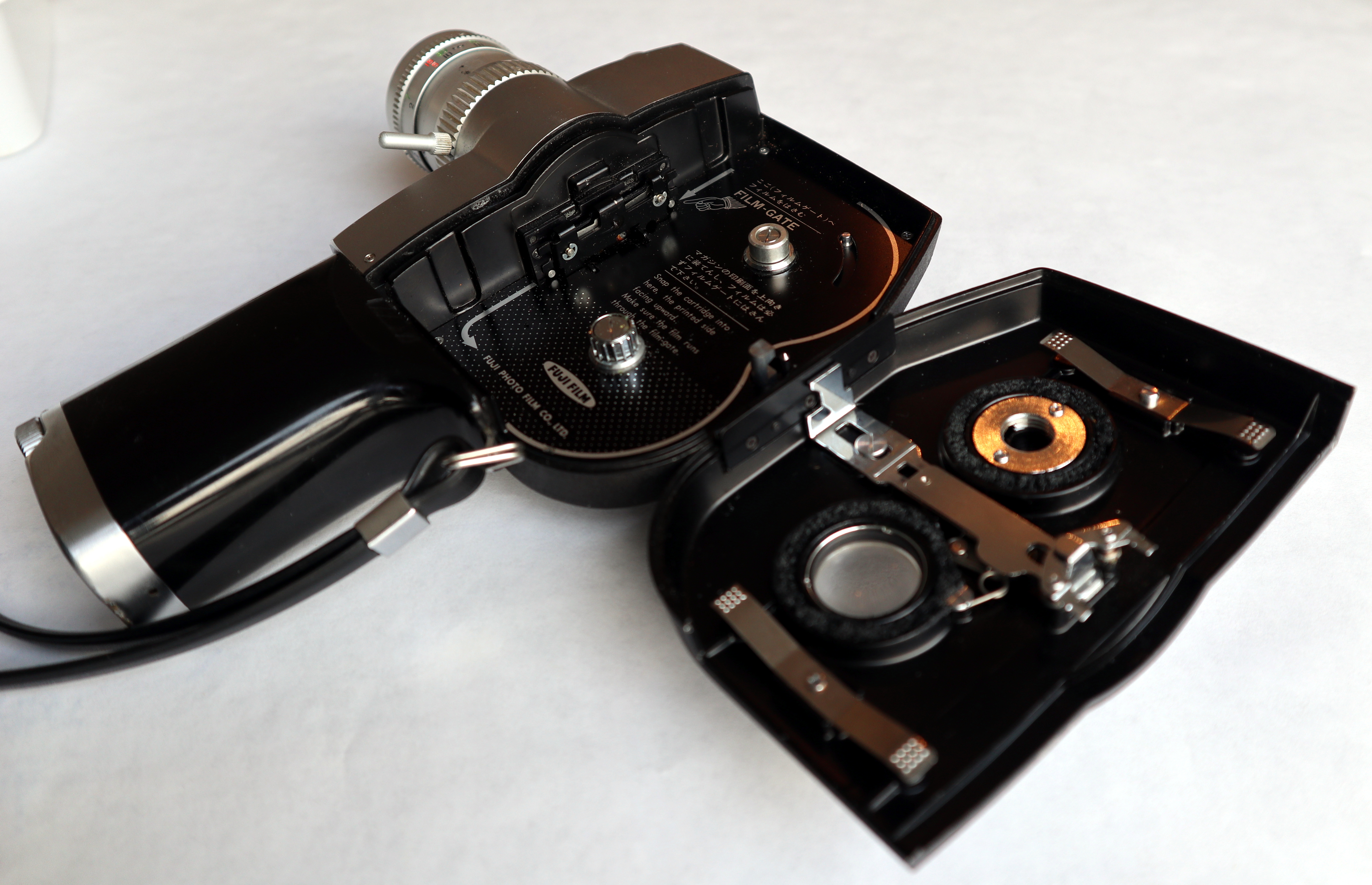
The surprise came when I opened it up, for it looked like no other 8mm camera I had seen. I’m familiar wit the two reels of a Standard 8 or the boxy cassette of Super 8, but this one used something different. That film magazine is made to fit a compact twin-reel cartridge whose film fits in a metal film gate. This is a Single 8 camera, Fuji’s entry in the all-in-one 8 mm film market, and a format I never knew existed. To explain my unexpected discovery it was necessary to delve into the world of home movie formats in the decade before videotape arrived and drove them out. Continue reading “The Seductive Pull Of An Obsolete Home Movie Format”→
Toolchanging in 3D printers is no longer something from the bleeding edge; it’s going mainstream. E3D has a high-quality kit for a toolchanger and motion system, our own Joshua Vasquez has shared details about the open-source toolchanging Jubilee design, and just recently Prusa3D formally announced the Prusa XL, which promises toolchanging with up to five different extruders.
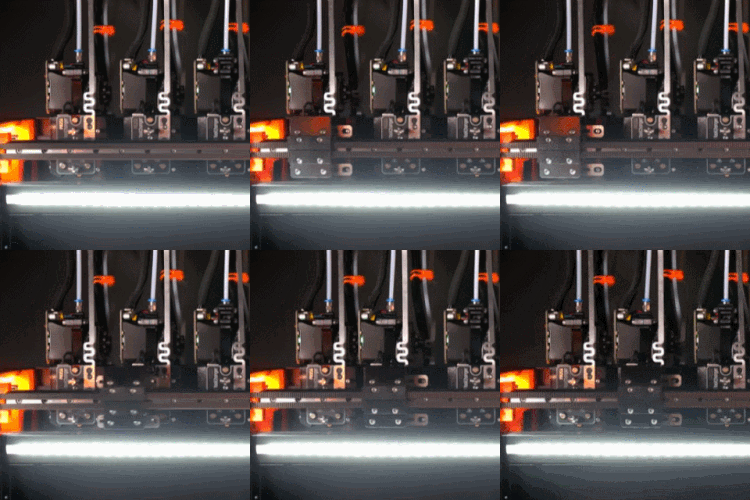
A toolchange in progress
It’s safe to say toolchanging on 3D printers has stepped to the front, but what comes next? What kind of tools other than extruders make sense on a 3D printer?
First, let’s explain what makes separate extruders such fantastic tools. Being able to change extruders on-demand during a print enables things like true multi-material printing. Printing in more than one color or material will no longer be done by pushing different filaments through a single nozzle, which limits a print to materials that extrude under similar conditions and temperatures. Toolchanging means truly being able to print in multiple materials, even if they have different requirements, because each material has its own extruder. That’s a clear benefit, but what about tools other than extruders?
No matter how many syllables you use to say it, aluminum is one of the most useful industrial metals we have. Lightweight, strong, easily alloyed, highly conductive, and easy to machine, cast, and extrude, aluminum has found its way into virtually every industrial process and commercial product imaginable.
Modern life would be impossible without aluminum, and yet the silver metal has been in widespread use only for about the last 100 years. There was a time not all that long ago that aluminum dinnerware was a status symbol, and it was once literally worth more than its weight in gold. The reason behind its one-time rarity lies in the effort needed to extract the abundant element from the rocks that carry it, as well as the energy to do so. The forces that locked aluminum away from human use until recently have been overcome, and the chemistry and engineering needed to do that are worth looking into in our next installment of “Mining and Refining.”
I have decided to make a career move and have accepted a position as Developer Relations Engineer at Golioth.io. I’m happy to announce that Elliot Williams will be the next Editor in Chief of Hackaday.
Right now I’m in my 13th year at Hackaday, having started in the summer of 2009. But like all of the Hackaday writing crew, I began as a loyal reader of the site. I remember hearing about Hackaday when Kevin Rose mentioned in on an episode of the old CNET TV program The Screensavers early in 2005. Having already been building robots and just starting on 8-bit AVR microcontrollers, Hackaday was exactly the source of new and interesting projects I was looking for.
An enormous amount has changed since then. When I started as a writer we had just stopped using black and white photos. A few articles later, we removed the CSS that forced all articles to be lowercase. When I became head editor in 2013 we stopped calling it Hack a Day in favor of Hackaday, and about a year later we overhauled the site, moving from green-on-black to yellow-on black and expanding the 470 pixel content width to 800. Progress.
What hasn’t changed is how we stay fresh. Hackaday has always trusted our writers to guide us by following their own interests. The people who write for Hackaday have far better things to do, but they use their writing as a creative outlet to focus on leveling up their skills, to discover new uses of available technology, and to share that energy with the greater Hackaday community. They live all over the world and work in many different fields. These experiences come together in there collective writings. I’m lucky to have this great group of writers, and so are you. When their time has ended, the hope is that a new group of readers will step up to the plate and make sure the good times never end.
Hackaday editors Elliot Williams and Mike Szczys get caught up on the week that was. People go to great lengths for video game saves, but this Pokemon hack that does hardware-based trade conversion between the Game Boy’s Pokemon 2 and Pokemon 3 is something else. Why do we still use batteries when super capacitors exist? They’re different components, silly, and work best at different things. Turns out you can study the atmosphere by sending radio waves through it, and that’s exactly what the ESA is doing… around Mars! And will machined parts become as easy to custom order as PCBs have become? This week we take a closer look at prototyping as a service.
Take a look at the links below if you want to follow along, and as always, tell us what you think about this episode in the comments!