Impression Products V. Lexmark International: A Victory For Common Sense

A few months ago we reported on a case coming before the United States Supreme Court that concerned recycled printer cartridges. Battling it out were Impression Products, a printer cartridge recycling company, and Lexmark, the printer manufacturer. At issue was a shrinkwrap licence on inkjet cartridges — a legal agreement deemed to have been activated by the customer opening the cartridge packaging — that tied a discounted price to a restriction on the cartridge’s reuse.

It was of concern to us because of the consequences it could have had for the rest of the hardware world, setting a potential precedent such that any piece of hardware could have conditions still attached to it when it has passed through more than one owner, without the original purchaser being aware of agreeing to any legal agreement. This would inevitably have a significant effect on the work of most Hackaday readers, and probably prohibit many of the projects we feature.

We are therefore very pleased to see that a few days ago the Supremes made their decision, and as the EFF reports, it went in favor of Impression Products, and us, the consumer.  In their words, when a patent owner:

…chooses to sell an item, that product is no longer within the limits of the monopoly and instead becomes the private individual property of the purchaser, with the rights and benefits that come along with ownership.

In other words, when you buy a printer cartridge or any other piece of hardware, it is yours to do with as you wish. Continue reading “Impression Products V. Lexmark International: A Victory For Common Sense”

Self balancing robot

Building A Self-Balancing Robot Made Easy

Not only has [Joop Brokking] built an easy to make balancing robot but he’s produced an excellent set of plans and software for anyone else who wants to make one too. Self-balancers are a milestone in your robot building life. They stand on two-wheels, using a PID control loop to actuate the two motors using data from some type of Inertial Measurement Unit (IMU). It sounds simple, but when starting from scratch there’s a lot of choices to be made and a lot of traps to fall into. [Joop’s] video explains the basic principles and covers the reasons he’s done things the way he has — all the advice you’d be looking for when building one of your own.

He chose steppers over cheaper DC motors because this delivers precision and avoids issues when the battery voltage drops. His software includes a program for getting a calibration value for the IMU. He also shows how to set the drive current for the stepper controllers. And he does all this clearly, and at a pace that’s neither too fast, nor too slow. His video is definitely worth checking out below.

Continue reading “Building A Self-Balancing Robot Made Easy”

FPGA Rescues Scope From The Dumpster

I’m always on the lookout for a quality addition to my lab that would respect my strict budget. Recently, I’ve found myself pushing the Hertz barrier with every other project I do and hence desperately wanted a high bandwidth scope. Unfortunately, only recently have 70 MHz to 100 MHz become really affordable, whilst a new quad channel oscilloscope in the 500 MHz to 1 GHz range still costs a fortune to acquire. My only option was to find an absolute miracle in the form of an old high bandwidth scope.

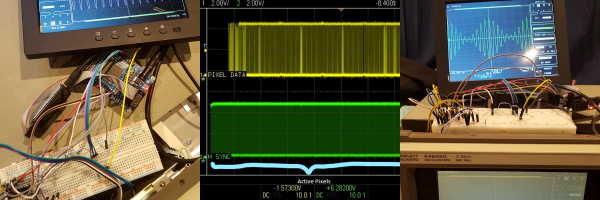
It seemed the Gods of Hand Me Down electronics were smiling upon me when I found this dumpster destined HP 54542C. It appeared to be in fairy good shape and was the Top Dog in its day. But something had to be broken right? Sure enough, the screen was clearly faulty and illegible. Want to know how I fixed it? Four letters: FPGA.

Continue reading “FPGA Rescues Scope From The Dumpster”

Hijacking The Sonoff OTA Mechanism

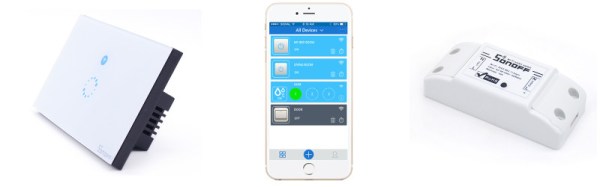
ITEAD’s Sonoff line is a range of Internet-of-Things devices based around the ESP8266. This makes them popular for hacking due to their accessibility. Past projects have figured out how to reflash the Sonoff devices, but for [mirko], that wasn’t enough – it was time to reverse engineer the Sonoff Over-The-Air update protocol.

[mirko]’s motivation is simple enough – a desire for IoT devices that don’t need to phone home to the corporate mothership, combined with wanting to avoid the labor of cracking open every Sonoff device to reflash it with wires like a Neanderthal. The first step involved connecting the Sonoff device to WiFi and capturing the traffic. This quickly turned up an SSL connection to a remote URL. This was easily intercepted as the device doesn’t do any certificate validation – but a lack of security is sadly never a surprise on the Internet of Things.

After capturing the network traffic, [mirko] set about piecing together the protocol used to execute the OTA updates. After a basic handshake between client and server, the server can ask the client to take various actions – such as downloading an updated firmware image.  After determining the messaging format, [mirko] sought to create a webserver in Python to replicate this behaviour.

There are some pitfalls – firmware images need to be formatted slightly differently for OTA updates versus the usual serial upload method, as this process leaves the stock bootloader intact. There’s also the split-partition flash storage system to deal with, which [mirko] is still working on.

Nevertheless, it’s great to see hackers doing what they do best – taking control over hardware and software to serve their own purposes. To learn more, why not check out how to flash your Sonoff devices over serial? They’re just an ESP8266 inside, after all.

Counterfeit Hardware May Lead To Malware And Failure

Counterfeit parts are becoming increasingly hard to tell the difference from the real deal, the technology used by the counterfeiters has come on leaps and bounds, so even the experts struggle to tell the real product from a good fake. Mere fake branding isn’t the biggest problem with a counterfeit though, as ieee.com reports, counterfeit parts could contain malware or be downright dangerous.

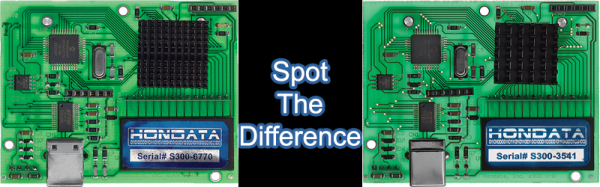
Way back in 2014 the FBI charged [Marc Heera] with selling clones of the Hondata S300, a plugin engine module for Honda cars that reads sensors, and depending on their values can change idle speed, air-fuel mixture and a plethora of other car/engine related settings. What, might you ask, is the problem, except they are obviously not genuine parts? According to Honda they had a number of issues such as random limits on engine rpm and occasionally failure to start. While the fake Hondata S300 parts where just poor clones that looked the part, anything connected to an engine control unit brings up huge safety concerns and researchers have shown that through ECU access, they could hijack a car’s steering and brakes.

It’s not just car parts being cloned, remember the fake USB-to-serial chips of FTDI-Gate? Entire routers are also being cloned, which doesn’t sound too bad until you realise that the cloners could configure your internet traffic to be redirected through their network for snooping. In 2010 Saudi citizen [Ehab Ashoor] was convicted of buying cloned Cisco Systems gigabit interface converters with the intention of selling them to the U.S Dept of Defense. While nothing sinister was afoot in [Ashoor]’s case other than greed, these routers were to be deployed in Iraq for use by the Marine Corps networks. They were then to be used for security, transmitting troop movements and relaying intelligence from field operations back to HQ.

So who are the cloners and why are they doing it? It is speculated that some of them may be state funded, as there are a lot of countries who do not trust American silicon. Circuits are reverse engineered and find their way to the international market. Then just like the FTDI-Gate case, cloners want to make profits from others intellectual property. This also brings up another question, if there is a mistrust of American silicon, nearly everything is made in China these days so why should we trust anything from there? Even analog circuits can be made to spy on you, as you can see from the piece we recently featured on compromising a processor using an analog charge pump. If you want to defend yourself from such attacks, perhaps look at previous Hackaday Prize finalist, ChipWhisperer.

PS Vita Hacked To Accept Micro SD Instead Of Costly Memory Cards

Sony loves to have control of their own media formats: Beta, DAT, Minidisc, MemoryStick, Universal Media Disc, MemoryStick Micro, and more. When they released the PS Vita they used a format that was similar in shape to SD but not compatible. The higher capacity ones can be quite costly, However [thesixthaxis] Report there is a PS Vista Micro SD hack on the way.

PS Vita hacker [Yifan Lu]’s adapter replaces the 3G modem, allowing end users to plug a MicroSD card in its place.  And this means using standard MicroSD memory cards instead of Sony’s overpriced proprietary memory. This is the coolest PS Vita hack since  PS Vita’s Final Fantasy X.

Sounds like good news all round? Well, there are a few small caveats. In order to use the hack you need a 3G-capable Vita running HENkaku which means running firmware 3.60 or under. The adapter is still in prototype stage, but it’s available from the fully-funded Indiegogo campaign if you’re interested.

How To Build Your Own Google AIY Without The Kit

Google’s voice assistant has been around for a while now and when Amazon released its Alexa API and ported the PaaS Cloud code to the Raspberry Pi 2 it was just a matter of time before everyone else jumped on the fast train to maker kingdom. Google just did it in style.

Few know that the Google Assistant API for the Raspberry Pi 3 has been out there for some time now but when they decided to give away a free kit with the May 2017 issues of MagPi magazine, they made an impression on everyone. Unfortunately the world has more makers and hackers and the number of copies of the magazine are limited.

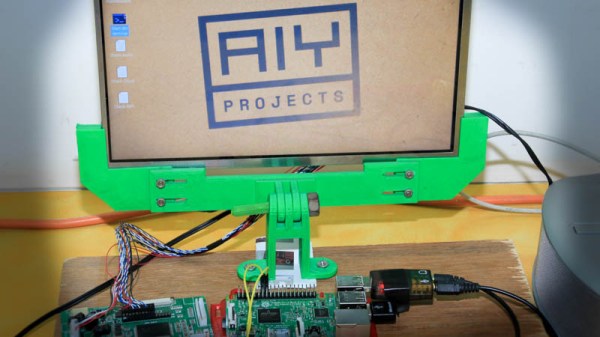
In this writeup, I layout the DIY version of the AIY kit for everyone else who wants to talk to a cardboard box. I take a closer look at the free kit, take it apart, put it together and replace it with DIY magic. To make things more convenient, I also designed an enclosure that you can 3D print to complete the kit. Lets get started.

Continue reading “How To Build Your Own Google AIY Without The Kit”