Scrap Wood And Metal Combined For DIY Mecanum Wheels

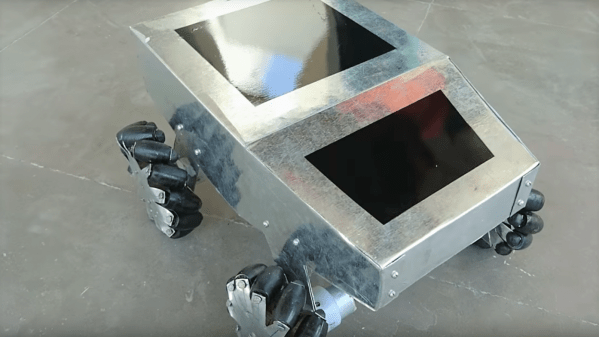
Some scrap wood, a few pieces of sheet metal, a quartet of old gear motors, and a few basic hand tools. That’s all it takes to build an omni-bot with Mecanum wheels, if you’ve got a little know-how too.

For the uninitiated, Mecanum wheels can rotate in any direction thanks to a series of tapered rollers around the circumference that are canted 45° relative to the main axle.  [Navin Khambhala]’s approach to Mecanum wheel construction is decidedly low tech and very labor intensive, but results in working wheels and a pretty agile bot. The supports for the rollers are cut from sheet steel and bent manually to hold the wooden rollers, each cut with a hole saw and tapered to a barrel shape on a makeshift lathe. Each wheel is connected directly to a gear motor shaft, and everything is mounted to a sheet steel chassis. The controls are as rudimentary as the construction methods, but the video below shows what a Mecanum-wheeled bot can do.

There’s a lot of room here for improvement, but mainly in the manufacturing methods. The entire wheel could be 3D printed, for instance, or even laser cut from MDF with a few design changes. But [Navin] scores a win for making a working wheel and a working bot from almost nothing.

Continue reading “Scrap Wood And Metal Combined For DIY Mecanum Wheels”
The BeagleBone Blue – Perfect For Robots

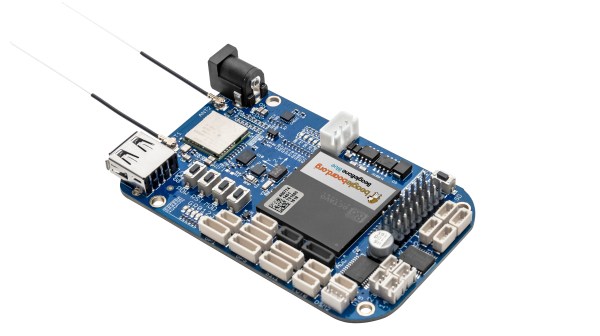
There’s a new BeagleBone on the block, and it’s Blue. The BeagleBone Blue is built for robots, and it’s available right now.

If a cerulean BeagleBone sounds familiar, you’re not wrong. About a year ago, the BeagleBone Blue was introduced in partnership with UCSD. This board was meant for robotics, and had the peripherals to match. Support for battery charging was included, as well as motor drivers, sensor inputs, and wireless. If you want to put Linux on a moving thingy, there are worse choices.

The newly introduced BeagleBone Blue is more or less the same. A 9-axis IMU, barometer, motor driver, quad encoder sensor, servo driver, and a balancing LiPo charger are all included. The difference in this revision is the processor. That big square of epoxy in the middle of the board is the Octavo Systems OSD3358, better known as a BeagleBone on a chip. This is the first actual product we’ve seen using this neat chip, but assuredly not the last – a few people are working on stuffing this chip onto a board that fits in mini Altoids tins.

How An Oscilloscope Probe Works, And Other Stories

The oscilloscope is probably the most versatile piece of test equipment you can have on your electronics bench, offering a multitude of possibilities for measuring timing, frequency and voltage as well as subtleties in your circuits revealed by the shape of the waveforms they produce.

On the front of a modern ‘scope is a BNC socket, into which you can feed your signal to be investigated. If however you simply hook up a co-axial BNC lead between source and ‘scope, you’ll immediately notice some problems. Your waveforms will be distorted. In the simplest terms your square waves will no longer be square.

Why is this? Crucial to the operation of an oscilloscope is a very high input impedance, to minimise current draw on the circuit it is investigating. Thus the first thing that you will find behind that BNC socket is a 1 megohm resistor to ground, or at least if not a physical resistor then other circuitry that presents its equivalent. This high resistance does its job of presenting a high impedance to the outside world, but comes with a penalty. Because of its high value, the effects of even a small external capacitance can be enough to create a surprisingly effective low or high pass filter, which in turn can distort the waveform you expect on the screen.

The answer to this problem is to be found in your oscilloscope probe. It might seem that the probe is simply a plug with a bit of wire to a rigid point with an earth clip, but in reality it contains a simple yet clever mitigation of the capacitance problem.

Continue reading “How An Oscilloscope Probe Works, And Other Stories”

This WAV File Can Confuse Your Fitbit

As the devices with which we surround ourselves become ever more connected to the rest of the world, a lot more thought is being given to their security with respect to the internet. It’s important to remember though that this is not the only possible attack vector through which they could be compromised. All devices that incorporate sensors or indicators have the potential to be exploited in some way, whether that is as simple as sniffing the data stream expressed through a flashing LED, or a more complex attack.

Researchers at the University of Michigan and the University of South Carolina have demonstrated a successful attack against MEMS accelerometers such as you might find in a smartphone. They are using carefully crafted sound waves, and can replicate at will any output the device should be capable of returning.

MEMS accelerometers have a microscopic sprung weight with protruding plates that form part of a set of capacitors. The displacement of the weight due to acceleration is measured by looking at the difference between the capacitance on either side of the plates.

The team describe their work in the video we’ve put below the break, though frustratingly they don’t go into quite enough detail other than mentioning anti-aliasing. We suspect that they vibrate the weight such that it matches the sampling frequency of the sensor, and constantly registers a reading at a point on its travel they can dial in through the phase of their applied sound. They demonstrate interference with a model car controlled by a smartphone, and spurious steps added to a Fitbit. The whole thing is enough for the New York Times to worry about hacking a phone with sound waves, which is rather a predictable overreaction that is not shared by the researchers themselves.

Continue reading “This WAV File Can Confuse Your Fitbit”

Arpeggio – The Piano SuperDroid

I never had the musical talent in me. Every now and then I would try to pick up a guitar or try and learn the piano, romanticising a glamorous career out of it at some point. Arpeggio – the Piano SuperDroid (YouTube, embedded below) sure makes me glad I chose a different career path. This remarkable machine is the brain child of [Nick Morris], who spent two years building it.

Although there are no detailed technical descriptions yet, at its heart this handsome robot consists of a set of machined ‘fingers’ connected to a set of actuators — most likely solenoids . The solenoids are controlled by proprietary software that combines traditional musical data with additional parameters to accurately mimic performances by your favourite pianists, right in your living room. Professional pianists, who were otherwise assuming excellent job security under Skynet, clearly have to reconsider now.

Continue reading “Arpeggio – The Piano SuperDroid”

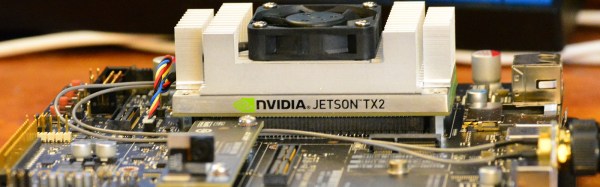
Hands-On Nvidia Jetson TX2: Fast Processing For Embedded Devices

The review embargo is finally over and we can share what we found in the Nvidia Jetson TX2. It’s fast. It’s very fast. While the intended use for the TX2 may be a bit niche for someone building one-off prototypes, there’s a lot of promise here for some very interesting applications.

Last week, Nvidia announced the Jetson TX2, a high-performance single board computer designed to be the brains of self-driving cars, selfie-snapping drones, Alexa-like bots for the privacy-minded, and other applications that require a lot of processing on a significant power budget.

This is the follow-up to the Nvidia Jetson TX1. Since the release of the TX1, Nvidia has made some great strides. Now we have Pascal GPUs, and there’s never been a better time to buy a graphics card. Deep learning is a hot topic that every new CS grad wants to get into, and that means racks filled with GPUs and CUDA cores. The Jetson TX1 and TX2 are Nvidia’s strike at embedded deep learningor devices that need a lot of processing power without sucking batteries dry.

Continue reading “Hands-On Nvidia Jetson TX2: Fast Processing For Embedded Devices”

Tea Making The Mechanical Way

For some of those who are aficionados of the drink, tea making can be serious business. For them, strong, black, leaf tea left for ages to stew in a stained teapot that would strip the hairs off your chest (like it should be made) just won’t do. These beverage anarchists demand a preparation process of careful temperature regulation and timing, and for some reason repeatedly dunking a teabag in the water.

For them, [Dorian Damon] has an automated solution to getting the crucial dunking process right. He’s made an automatic tea bag dunker. The teabag is mounted on a slide operated by a crank, and the crank is driven through a pair of bicycle hubs. Motive power comes from a mains shaded-pole motor, an unusual bi-directional one of which he only uses one side. He measured his personal dunking rate at about 50 per minute, so he only needed a 4:1 reduction to match the motor at 200 RPM.

The resulting machine will happily dunk his tea bag at that rate for as long as it’s left switched on. He’s put a few videos up, of which we’ve posted one below the break.

Continue reading “Tea Making The Mechanical Way”