Fail Of The Week: Dave Jones And The Case Of The Terrible Tablet

Nothing spices up a quiet afternoon like the righteous indignance of an upset engineer, especially if that engineer is none other than [Dave Jones], on his EEVblog YouTube Channel. This week [Dave] has good reason to be upset. A viewer sent him what looked to be a nondescript 2010 era tablet from a company called Esinomed. From the outside it looked like a standard issue medical device. Opening up the back panel tells a completely different story though. This thing is quite possibly the worst hack job [Dave] (and we) have ever seen. This is obviously some kind of sales demo or trade show model. Even with that in mind, this thing is a fail.

wtf-solderThe tablet is based upon an off-the-shelf embedded PC motherboard and touchscreen controller. [Dave] took some offense at the hacked up USB connector on the touchscreen. We have to disagree with [Dave] a bit here, as the video seems to show that a standard mini-b connector wouldn’t have fit inside the tablet’s case. There’s no excuse for the USB cable shield draped over the bare touch controller board though. Things go downhill from there. The tablet’s power supply is best described as a bizarre mess. Rather than use a premade DC to DC converter, whoever built this spun their own switch mode power supply on a home etched board. The etching job looks good, but everything else, including the solder job, is beyond terrible. All the jumps and oddly placed components make it look like a random board from the junk bin was used to build this supply.

The story gets even worse with the batteries. The tablet has horribly hand soldered NiMH cells shoved here, there and everywhere. Most of the cells show split shrink wrap – a sure sign they have been overheated. It’s hard to tell from the video, but it appears as if a few cells have their top mounted vent holes covered with solder. That’s a great way to turn a simple rechargeable battery into a pipe bomb. Batteries can be safely hand soldered – Radio Controlled modelers did it for decades before LiPo cells took over.

We’ve all hacked projects together at the last minute; that’s one of the things we celebrate here on Hackaday. However, since this is a commercial medical device (with serial number 11 no less) we have to stamp this one as a fail.

Continue reading “Fail Of The Week: Dave Jones And The Case Of The Terrible Tablet”

The $5 Raspberry Pi Zero

Rumors about a new Raspberry Pi have been circulating around the Internet for the past week or so. Speculation has ranged from an upgraded Model A or compute module to a monster board with Gigabit Ethernet, USB 3.0, SATA and a CPU that isn’t even in production yet. The time is now, and the real news is even more interesting: it’s a $5 Raspberry Pi Zero. It’s the smallest Pi yet, while still keeping the core experience.

Continue reading “The $5 Raspberry Pi Zero”

Defeating Chip And PIN With Bits Of Wire

One of many ways that Americans are ridiculed by the rest of the world is that they don’t have chip and PIN on their credit cards yet; US credit card companies have been slow to bring this technology to millions of POS terminals across the country. Making the transition isn’t easy because until the transition is complete, the machines have to accept both magnetic stripes and chip and PIN.

This device can disable chip and PIN, wirelessly, by forcing the downgrade to magstripe. [Samy Kamkar] created the MagSpoof to explore the binary patterns on the magnetic stripe of his AmEx card, and in the process also created a device that works with drivers licenses, hotel room keys, and parking meters.

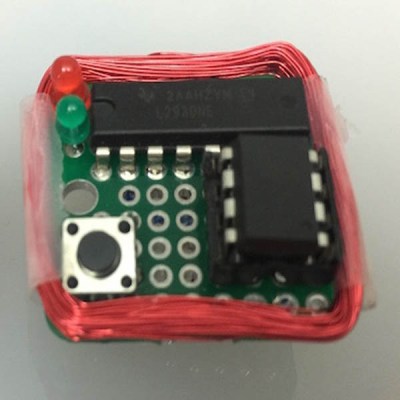
magspoofThe electronics for the MagSpoof are incredibly simple. Of course a small microcontroller is necessary for this build, and for the MagSpoof, [Samy] used the ATtiny85 for the ‘larger’ version (still less than an inch square). A smaller, credit card-sized version used an ATtiny10. The rest of the schematic is just an H-bridge and a coil of magnet wire – easy enough for anyone with a soldering iron to put together on some perfboard.


By pulsing the H-bridge and energizing the coil of wire, the MagSpoof emulates the swipe of a credit card – it’s all just magnetic fields reversing direction in a very particular pattern. Since the magnetic pattern on any credit card can be easily read, and [Samy] demonstrates that this is possible with some rust and the naked eye anyway, it’s a simple matter to clone a card by building some electronics.

[Samy] didn’t stop there, though. By turning off the bits that state that the card has a chip onboard, his device can bypass the chip and PIN protection. If you’re very careful with a magnetized needle, you could disable the chip and PIN protection on any credit card. [Samy]’s device doesn’t need that degree of dexterity – he can just flip a bit in the firmware for the MagSpoof. It’s all brilliant work, and although the code for the chip and PIN defeat isn’t included in the repo, the documents that show how that can be done exist.

[Samy]’s implementation is very neat, but it stands on the shoulders of giants. In particular, we’ve covered similar devices before (here and here, for instance) and everything that you’ll need for this hack except for the chip-and-PIN-downgrade attack are covered in [Count Zero]’s classic 1992 “A Day in the Life of a Flux Reversal“.

Thanks [toru] for sending this one in. [Samy]’s video is available below.

Continue reading “Defeating Chip And PIN With Bits Of Wire”

APRS Repeaters Get The Signal Out Of Mammoth Cave

APRS Cave-Link uses the amateur radio’s Automatic Packet Reporting System (APRS) inside caves to get their position data (and other messages) out.

Imagine that you’re coordinating a large scale search-and-rescue mission in a cave. You need to know where all your groups are, and whether or not they’ve found anything. But how do they all communicate to the command center?

You’d guess radio, but you’d guess wrong. Radio doesn’t propagate well at all in a maze of twisty passages, all alike; rocks absorb radio waves, especially in the VHF/UHF range that’s best suited for most small radios. In the past, you’d run wire and transmit along it. This article runs through the options in detail. But adding miles of wire to your already heavy caving and climbing gear is a nuisance or worse.

Continue reading “APRS Repeaters Get The Signal Out Of Mammoth Cave”

Building The Infinite Matrix Of Tamagotchis

Tamagotchi is a digital pet, living in and cared for through a key-chain size piece of hardware. The mid-90’s toy lives in pop culture, but now it lives well beyond. A limitless network of Tamagachi has been created using some amazing tricks to feed, socialize, and monitor the beast now known as the Tamagachi Singularity.

Last weekend at the Hackaday SuperConference we were graced with a talk by [Jeroen Domburg], a.k.a. [Sprite_tm]. [Sprite] is a favorite of ours and over the years his hacker cred includes everything from reverse engineering hard drive controller chips to putting video games in his keyboard.

[Sprite] is also something of an Architect, and like all Architects he only wants what is best for the system he created. In this case, it’s a Matrix of Tamagotchis. [Sprite] created a hive of Tamagotchis that are able to interact with each other in their own separate world. The best part about this Matrix? There’s no allusions to violating the laws of thermodynamics in the exposition.

xkcd.com/1546
xkcd.com/1546

Like all good hacks, a Tamagotchi Matrix wasn’t created in a vacuum. A few years ago at 29C3, [Natalie Silvanovich] dumped the ROM in the current generation of Tamagotchis. This is an incredible feat of reverse engineering, that allows anyone to use the full capabilities of the 6502-based microcontroller that controls these digital pets

After [Sprite] figured out how to read and run the code in the Tamagotchi, the next obvious step towards a world of egg-shaped pods containing an entire population of Tamagotchis is virtual Tamagotchis. [Sprite] used a hard-coded state machine that takes care of pooping, flushing, training, feeding, and turning the lights off at bedtime.

With a single Tamagotchi described as a state machine, it’s a simple matter to build another. This is where things get interesting and Matrix-ey. Tamagotchis don’t live alone; they have an IR LED and receiver that allows them to interact with each other, eat, play, marry, and have kids. Emulating a single Tamagotchi is one thing, but controlling multiples is another thing entirely; some sort of protocol was needed to breed Tamagotchis and keep them happy and well-fed.

Continue reading “Building The Infinite Matrix Of Tamagotchis”

Swans, Pigs, And The CIA: An Unlikely Radio Story

Shortwave radio is boring, right? Maybe not. You never know what intrigue and excitement you might intercept. We recently covered secret number stations, and while no one knows for sure exactly what their purpose is, it is almost surely involving cloaks and daggers. However, there’s been some more obvious espionage radio, like Radio Swan.

The swan didn’t refer to the animal, but rather an island just off of Honduras that, until 1972, was disputed between Honduras and the United States. The island got its name–reportedly–because it was used as a base for a pirate named Swan in the 17th century. This island also had a long history of use by the United States government. The Department of Agriculture used it to quarantine imported beef and a variety of government departments had weather stations there.

You might wonder why the United States claimed a tiny island so far away from its shores. It turns out, it was all about guano. The Guano Islands Act of 1856 allowed the president to designate otherwise unclaimed territory as part of the United States for the purpose of collecting guano which, in addition to being bird excrement, is also important because it contains phosphates used in fertilizer and gunpowder. (Honestly, you couldn’t make this stuff up if you tried.)

However, the most famous occupant of Swan Island was Radio Swan which broadcast on the AM radio band and shortwave. The station was owned by the Gibraltar Steamship Company with offices on Fifth Avenue in New York. Oddly, though, the company didn’t actually have any steamships. What it did have was some radio transmitters that had been used by Radio Free Europe and brought to the island by the United States Navy. Did I mention that the Gibraltar Steamship Company was actually a front for the Central Intelligence Agency (CIA)?

Continue reading “Swans, Pigs, And The CIA: An Unlikely Radio Story”

Pre-order This Graphically Stunning Print Edition Of Hackaday

Now is your chance to hold a piece of Hackaday in your hands. Last year we announced our first ever print edition. We continue that tradition with a much bigger offering. Hackaday Omnibus vol #02 gathers the best content from Hackaday over the last year. This includes in-depth original content, incredible art, the events that mattered over the last 12 months, and a few cryptic easter eggs.

omnibus-vol2-on-your-coffee-table[Joe Kim], Hackaday’s Art Direct, really outdid himself with the cover this year. Inspired by an epic movie, the illustration includes a shoutout to almost every article found within. Of course there is a lot more of his work inside, along with the efforts of dozens of writers, artists, editors, and more.


All 128 pages of Omnibus vol #02 were painstakingly laid out by [Aleksandar Bradic] who enlisted the help of a dedicated core of Hackaday.io members to help pore over the final drafts, ensuring the presentation is immaculate. Along the way some of them teamed up to roll in those easter eggs that I previously mentioned. We don’t even know what all of it means, you should be the first to solve the mystery.

Most of the 31 articles that grace these pages have run past the front page of Hackaday. But there are a few that were written specifically for the print edition. These will be published on our front page starting in 90 minutes and continuing for a few weeks. It is important to us to share these great works without the need to purchase anything. But the Omnibus is truly one of the coolest pieces of tech literature that you can own. It deserves a place on your coffee table, reception area at work, and as a gift for all who love to know how things work, how things were built, and the legacy of knowledge that has come from generations of hacking.

We’re only running a single printing of this gorgeous volume. Make sure you get one of your own by placing a pre-order now. Be one of the first 500 using coupon code OMNIBUS2015 and get it for just $10! Show that you support great content and help make future projects like this possible.