A Look At A 1960s Tube-Based Magnavox Concert Grand Console Stereo

Back in presumably the early 1960s, [David]’s grandfather bought a console stereo featuring a record player, AM/FM radio and a rather astounding stereo speaker system that would be more than enough to cover a small concert hall. Having inherited this piece of auditory art after his grandfather’s passing, [David] has given the console stereo a prominent place in his living room, which is where we start the tour in a new video on the [Usagi Electric] YouTube channel.

Plentiful I/O on this 1960s vintage piece of Magnavox audio equipment.

Being a 1950s-vintage design that got produced into the 1960s in a variety of models, the Magnavox Concert Grand is an all-tube affair, with the only presence of semiconductors being the three transistors found in the ‘Phantom’ remote control. [David] unfortunately does not posses this remote control, although the receiver module is present in the unit. It appears to be similar to the 1960 1ST800F in possession by [electra225] over at the Classic HiFi Care forum, which can provide 50 Watt per channel, yet as noted in the forum post, the 44 tubes alone draw about 250 Watt, with [electra225] recording 377 Watt total with everything cranked up. Clearly a high power bill was a price one had to pay for having high-end audio back in that era.

After [David] takes his unit apart – made very easy due to the modular construction – he goes through the basic circuitry of the power supply, the amplifiers and even has a peek at the circuitry of the remote control which appears to use basic frequency modulation to transfer the intended action to the receiver. All of this is made quite easy as full schematics are available for the entire system, as was standard back in those days. Interesting is also the I/O module, which features an MPX section, for demodulating stereo FM which wasn’t standardized yet at the time. Finally, tape drive connectors are available, which would have been likely a reel-to-reel unit for maximum HiFi enjoyment.

With the only broken thing in [David]’s unit being the snapped wire on the tuner of the radio module (ironically caused by the disassembly), all that was changed before reassembly was a good clean, after which the console stereo was put back and tested. Reflecting an era when HiFi equipment was supposed to blend in with other furniture, it will likely continue to do service for [David] as the world’s fanciest TV soundbar for the foreseeable future.

Continue reading “A Look At A 1960s Tube-Based Magnavox Concert Grand Console Stereo”

Blaupunkt Tube Radio Is The Sultan Of Radios

According to [M Caldeira], the Blaupunkt Sultan 24300 was one of the last tube radios made in the 1960s. He’s got one but it needed some tender loving care, and you can see how he approaches a restoration like this in the video below.

The radio was actually in better shape physically than most of the old radios we see. It wasn’t perfect, but it looked good on the outside. Electrically, though, it did need some work, and the dial had problems, too. The first obstacle was identifying exactly the model of the radio since there were a number of Sultan radios produced.

Continue reading “Blaupunkt Tube Radio Is The Sultan Of Radios”

Cheap LCD Uses USB Serial

Browsing the Asian marketplaces online is always an experience. Sometimes, you see things at ridiculously low prices. Other times, you see things and wonder who is buying them and why — a shrimp pillow? But sometimes, you see something that probably could have a more useful purpose than the proposed use case.

That’s the case with the glut of “smart displays” you can find at very low prices. Ostensibly, these are being sold as system monitors. A business-card-sized LCD hooks up via USB and shows your CPU speed, temperature, and so on. Of course, this requires sketchy Windows software. I don’t run Windows, and if I did, I wouldn’t be keen to put some strange service on just so I could see tiny displays of my system information. But a 3.5-inch IPS LCD screen for $15 or less probably has some other uses. But how to drive it? Turns out, it is easier than you think and the hardware looks reasonably hackable, too.

Like a lot of this cheap stuff, these screens are sold under a variety of names, and apparently, there are some subtle differences. Two of the main makers of these screens are Turing and XuanFang, although you rarely see those names in the online listings. As you might expect, though, someone has reverse-engineered the protocol, and there is Python software that will replace the stock Windows software the devices use. Even better, there is an example of using the library for your own purposes.

Continue reading “Cheap LCD Uses USB Serial”

Industrial Surge Protector Teardown

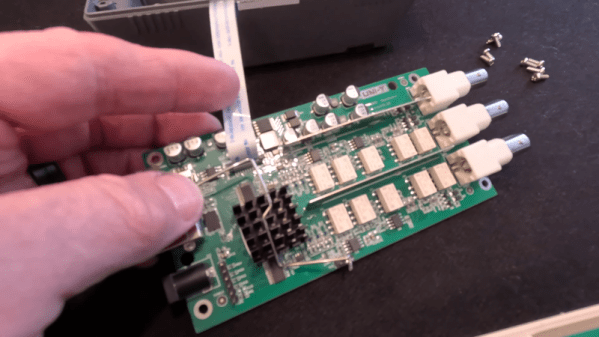
Surge protectors are a common item in the modern household, but the Meanwell unit that [Big Clive] tears apart was clearly intended for commercial use. In fact, he mentions it was made for outdoor signage. Removing the rear panel didn’t help much — the entire unit was potted in resin — but that didn’t stop [Clive]. Removing the resin revealed only a few components surrounded by a sand-like substance.

There’s no circuit board inside. Components are just wired together before potting. The significant player inside is a metal oxide varistor with a thermal fuse. [Clive] draws out a schematic, which is deceptively simple. The two LEDs are an older style of green LED, and he explains why the choice of LED is important in this application. In typical operation, the LEDs light. If a fuse blows, at least one of the LEDs will extinguish.

Not all useful circuits have to be complicated. This is an excellent example of how a simple but well-constructed design can succeed commercially.

Not all surge protectors are built this well. If you need a refresher on how varistors work, we can help with that.

Continue reading “Industrial Surge Protector Teardown”

Rare Arcade Game Teardown And Mods

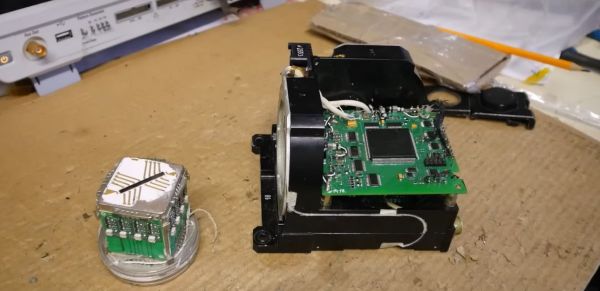
[Video Game Esoterica] loves a 1990s video game called Operation Tiger. Apparently, there are only a few of these known to exist in 2023, and he managed to find one of them. Well, it is really just a module so he has to figure out how to give it enough input and output to be actually playable. You can see several videos of his work with the Taito game below.

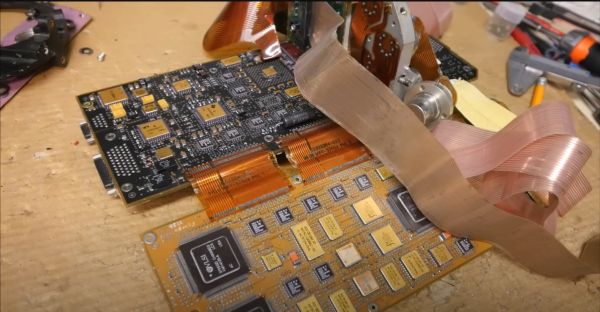
The board has a lot of ICs and a Power PC to handle the 3D graphics. The graphics seem clunky today, but they were impressive for the time. According to the video, the CPU board was only used for this game. The ROM that holds the software is separate with a mix of mask-programmed memory and EPROMs.

The machine is meant to live in an arcade box. So wiring things like coin selectors, video, speakers, and controllers is a non-trivial exercise. The wiring paid off, though, as the board started up but with no buttons, it wasn’t able to start in the first video. The controls go through a 60-pin connector and he tackles that project in part two.

The next step is to actually update the game software, which is hard but possible. Of course, you can run many of these old games with MAME or, if you prefer, use it to score that primo engineering workstation you used to covet.

Continue reading “Rare Arcade Game Teardown And Mods”

An Unexpected Appearance Of An Iconic Motorola Chip

Big Clive's reverse-engineered schematic of the USB charger containing the MC34063 IC.
Big Clive’s reverse-engineered schematic of the USB charger containing the MC34063 IC.

Generally when you crack open a cheap car-to-USB charger unit that came with some widget, you do not expect to find anything amazing inside. That’s why it was such a surprise to [Big Clive] when said car USB charger revealed a blast from the past in the form of an MC34063. This is a switching regulator that supports buck, boost and inverting topologies, but perhaps it most notable feature is that it was first produced by Motorola in the early 1980s.

This particular IC is marked as having been produced by ON Semiconductor which means that it’s technically still manufactured by Motorola – with ON Semiconductor being the Phoenix division that was spun off in 1999 – but it’s somewhat remarkable that this particular chip isn’t only produced by ON Semi today, but also by Texas Instruments. Much like the venerable NE555 timer IC and Intel’s 8051 MCU architecture, it would seem that certain chips and designs are simply made to become commodities in the future.

This appears to be the case for the MC34063 as well, which may lack some niceties of more modern ICs, such as built-in thermal protection, and it switches at only up to 100 kHz, but it can be bought for peanuts, has a wide input voltage range of 3 to 40 V, can switch up to 1.5 A and supports multiple common topologies. Often a 100 kHz switching regulator is all you need, in which case it’s handy to have a stack of such commodity chips lying around, plus the MC34063 comes in PDIP packaging as well, which is a boon for prototyping.

Continue reading “An Unexpected Appearance Of An Iconic Motorola Chip”

Retro Gadgets: The 1974 Breadboard Project

It is hard to imagine experimenting with electronics without the ubiquitous solderless breadboard. We are sure you have a few within arm’s reach. The little plastic wonders make it easy to throw together a circuit, try it, and then tear it down again. But, surprisingly, breadboards of that type haven’t always been around, and — for a while — they were also an expensive item. Maybe that’s what motivated [R. G. Cooper] to build Slip-n-Clip — his system for quickly building circuits that he published in a 1974 edition of the magazine Elementary Electronics.

The system isn’t really what you would think of as a breadboard today, but it was effective and certainly cheap to build. The biggest problem? It wasn’t something you’d use with DIP ICs. But in the early 1970s, you might not be building very much with ICs, and the ones you used might be in oddball transistor-like packages. Things were strange in the 70s!

A Brief History of Breadboards

In the very old days, people built radios and such on wooden substrates that were actually bread-cutting boards. That’s where the name came from. It was common to draw a diagram with the physical layout you had in mind, glue it to the board, and use it as a guide for building and troubleshooting. Wood was easy to drill and cut. A nail or a thumbtack would make dandy terminals. Probably the last time we saw that done was about a dozen years ago in Make Magazine. Even then, it was only a novelty — few people still build circuits like this, but you can see how [Colin] did it in the video below.

Continue reading “Retro Gadgets: The 1974 Breadboard Project”