Making A Bluetooth Headset Into A Wireless Music Streaming Device

This bluetooth headset hack, although simple, may provide some hacking inspiration. Turning a Bluetooth headset into a wireless input for one’s stereo is definitely something that makes one think “why didn’t I think of that?” It’s also good if you’ve got a tight hacking budget as there’s not a lot of stuff to buy.

In addition to a possibly broken headset, a 3.5mm stereo plug and some wires are needed for this. Throw in some tools that every good hacker should have around like a soldering iron and glue gun and you’re ready to get started. [Dex] does a good job of describing the process, from disassembling the headset to wiring the stereo plug to it. When making the conversion, one must remember to bridge the left and right output channels, as most headsets only output a mono signal.

There’s not a whole lot else required to do this hack.  Could be a good beginner project. For another Bluetooth-based hack using scrounged equipment, check out this Cellphone controlled retro-radio hack.

Adding Wireless Controls To Vintage Stereo Equipment

marantz_wifi_remote_control

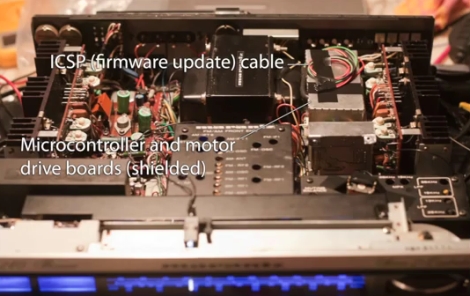
[Jean] was shopping around for a vintage stereo receiver, and happened upon a broken, but repairable Marantz 4240. After getting things back to working order, he thought it would be great if he could use his iPhone to remotely control the unit (PDF Writeup, Schematics and Code).

He scrounged around for parts, and after locating a PIC and a handful of parts from old copiers and printers, he got down to business. He etched some custom boards to house electronic bits, then strapped motors to the volume and source selection knobs. He also rigged up the push button power switch on the receiver, using a small servo and a bit of string.

Now, he can control everything using his iPhone, which communicates with the stereo over WiFi. While the power, volume knob, and input selector can be triggered remotely, he still has the ability to tweak any of these items manually if desired.

We think that this is a great way to add modern amenities to vintage electronics, without ruining the aesthetics of the components. Don’t take our word for it though, check out the video demonstrations [Jean] but together after the jump.

Continue reading “Adding Wireless Controls To Vintage Stereo Equipment”

Robotic Gardener Takes Its Cue From Bomb Disposal Bots

[Dave] posted some pictures and videos of his ‘Nuntius’ robot on the Propeller forums. From the pictures it’s an impressive build, but to really appreciate [Dave]’s skill, check out the Youtube demo.

The controller is a Propeller protoboard with bits of angle aluminum fastened together. Pots are positioned at the joints of the remote’s arm so the robot’s arm can mirror the shape of the remote. We usually see Armatron bots controlled via computer, or in the rare case of human control, a mouse. [Dave]’s build just might be one of the first remote manipulator builds we’ve seen on Hack A Day.

Continue reading “Robotic Gardener Takes Its Cue From Bomb Disposal Bots”

RC Transmitter Does Everything

[Demetris] sent in a tip about a project he’s working on: an Open Source Remote Control transmitter. This is one of the most impressive looking RC transmitters we’ve ever seen. The OSRC could be great for a small UAV – just get the GPS position from the aircraft and map it with the transmitter’s screen. There’s also support for a video downlink so flying around New York City is possible with a single device.

Continue reading “RC Transmitter Does Everything”

FabLab Helps The Developing World Set Up Long-distance Wireless Ethernet

The wooden frame seen above hosts a parabolic reflector making up one side of a wireless network link. This is a Fab Lab project called FabFi which uses common networking hardware to setup long-distance wireless Ethernet connections. It’s a bit hard to tell in the image above, but the reflector focuses radio waves on the antennae of a router we’re quite familiar with, the Linksys WRT54G. It’s held upside-down in an enclosure meant to protect it from the elements. The node above manages to complete a connection spanning 2.41 miles!

One of the core values of the project is to develop hardware that is easy to build with limited resources, then to make that knowledge freely available. Anyone who has the ability to download and print out the 2D design file can build a reflector for themselves. As we’ve seen in other projects, paper stencils and hand tools can handle this job with no need for a laser-cutter (which was used for the prototype). WRT54G routers are inexpensive and the project uses the open source firmware OpenWRT. They can be run from 12VDC power which means a car battery works when mains power is not an option. The system has been running in Afghanistan for two years and hardware failure is still in the low single-digits.

[Thanks das_coach]

Tweeting Bird Feeder Keeps A Picture Record Of All Visitors

wireless_tweeting_bird_feeder

If you weren’t aware, Adafruit Industries is sponsoring the “Make it Tweet” contest over at Instructables, and this Twitter-enabled bird feeder is [quasiben’s] entry into the competition.

His bird feeder not only sends messages to Twitter, it also sends a picture of each bird to Twitpic. The feeder itself is a standard off the shelf model which has been fitted with a LinkSprite camera. A LilyPad Arduino controls the camera, sending images to his computer via a pair of XBee modules. To detect when a bird has stopped by for something to eat, [quasiben] used an infrared LED and an IR detector. The emitter and detector are positioned at opposing sides of the feeder’s opening, triggering the Arduino to snap a picture whenever the beam is broken. Once the image has been transferred to his computer, it is posted to TwitPic.

We’re pretty sure [quasiben] built this Tweeting bird feeder just because he could, but we think it’s a pretty smart idea for people who don’t necessarily have the free time to gaze out the window into their yard. It’s a great way to keep tabs on all your new winged visitors while on the go.

Launching Model Rockets Wirelessly

We love ballistic trajectories and the smell of black powder in the morning, so we’re really interested in the wireless rocket launch pad sent in by [Brent Strysko].

[Brent] used an ATmega with an enc28j60 ethernet shield and wireless router to launch the rocket without a physical connection with ‘the button.’ Everything on the launchpad is powered by a 12 Volt motorcycle battery, and there’s also a flashing LED for the countdown. All that’s needed to launch a rocket is to send a command from the laptop. We think this would be an awesome project when combined with the radio telemetry build we covered earlier – the computer is already there with the range safety officer.

Although amateur rocketry is extremely safe, with no high-power flight ever hitting a person (PDF warning), there’s still some risk of from black powder engines CATOing. We think [Brent] came up with a great way to make a safe hobby even safer, and managed an interesting project in the process. Check out the walkthrough of the launchpad after the break, or check out this video of the launchpad in action.

Continue reading “Launching Model Rockets Wirelessly”