Next-Gen Autopilot Puts A Robot At The Controls

While the concept of automotive “autopilots” are still in their infancy, pretty much any aircraft larger than an ultralight will have some mechanism to at least hold a fixed course and altitude. Typically the autopilot system is built into the airplane’s controls, but this new system replaces the pilot themselves in a manner reminiscent of the movie Airplane.

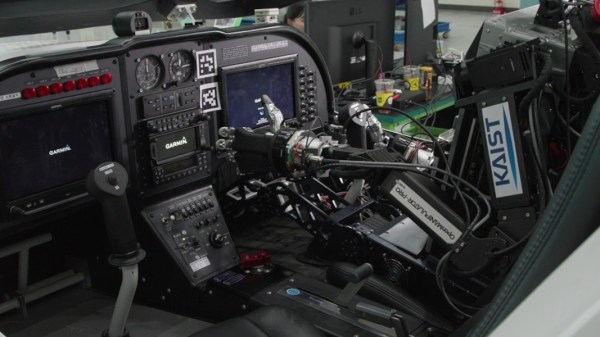
The robot pilot, known as PIBOT, uses both AI and robotics technology to fly the airplane without altering the aircraft. Unlike a normal autopilot system, this one can be fed the aircraft’s manuals in natural language, understand them, and use that information to fly the airplane. That includes operating any of the aircraft’s cockpit controls, not just the control column and pedal assembly. Supposedly, the autopilot can handle everything from takeoff to landing, and operate capably during heavy turbulence.

The Korea Advanced Institute of Science and Technology (KAIST) research team that built the machine hopes that it will pave the way for more advanced autopilot systems, and although this one has only been tested in simulators so far it shows enormous promise, and even has certain capabilities that go far beyond human pilots’ abilities including the ability to remember a much wider variety of charts. The team also hopes to eventually migrate the technology to the land, especially military vehicles, although we’ve seen how challenging that can be already.
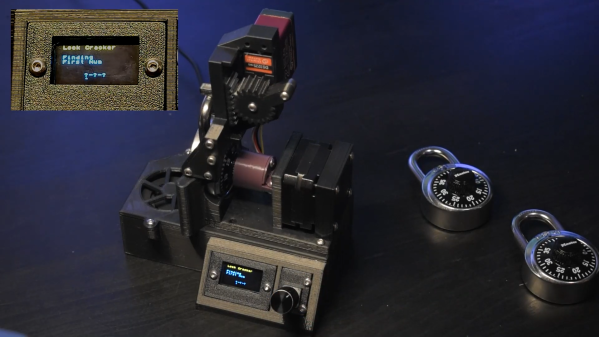
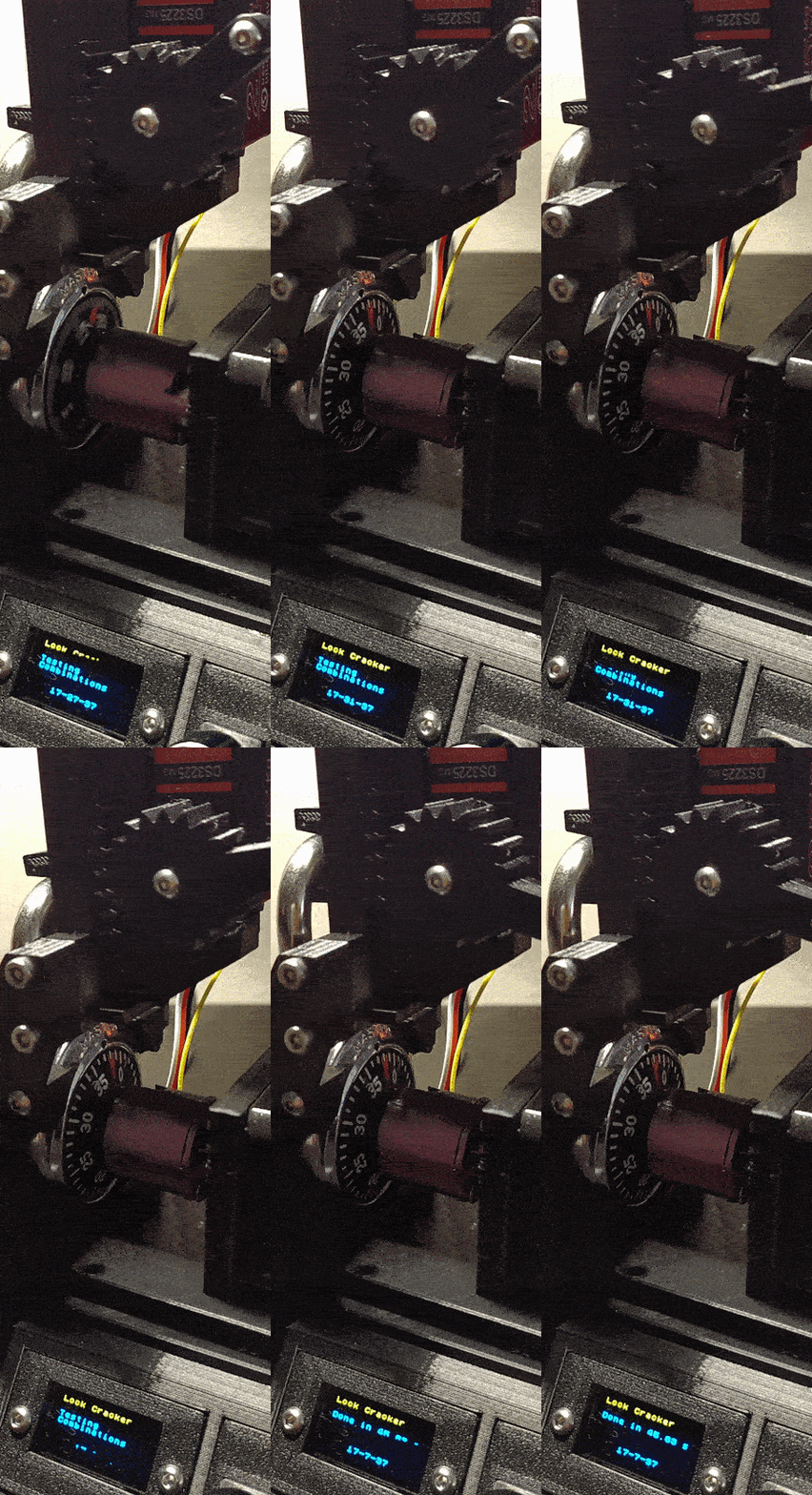
A machine that holds a combination padlock and turns its dial, with two padlocks next to it

Robot Opens Master Combination Locks In Less Than A Minute

A common trope in bank heist B-movies is someone effortlessly bypassing a safe’s combination lock. Typically, the hero or villain will turn the dial while listening to the internal machinery, then deduce the combination based on sounds made by the lock. In real life, high-quality combination locks are not vulnerable to such simple attacks, but cheap ones can often be bypassed with a minimum of effort. Some are so simple that this process can even be automated, as [Mew463] has shown by building a machine that can open a Master combination lock in less than a minute.

A machine that holds a combination padlock and turns its dialThe operating principle is based on research by Samy Kamkar from a couple of years ago. For certain types of Master locks, the combination can be found by applying a small amount of pressure on the shackle and searching for locations on the dial where its movement becomes heavier. A simple algorithm can then be used to completely determine the first and third numbers, and find a list of just eight candidates for the second number.

[Mew463]’s machine automates this process by turning the dial with a stepper motor and pulling on the shackle using a servo and a rack-and-pinion system. A magnetic encoder is mounted on the stepper motor to determine when the motor stalls, while the servo has its internal position encoder brought out as a means of detecting how far the shackle has moved. All of this is controlled by an Arduino Nano mounted on a custom PCB together with a TMC2208 stepper driver.

The machine does its job smoothly and quickly, as you can see in the (silent) video embedded below. All design files are available on the project’s GitHub page, so if you’ve got a drawer full of these locks without combinations, here’s your chance to make them sort-of-useful again. After all, these locks’ vulnerabilities have a long history, and we’ve even seen automated crackers before.

Continue reading “Robot Opens Master Combination Locks In Less Than A Minute”

Robotic Boat Rides High On PVC Pipe Pontoons

If you want to build your own rover, there’s plenty of cheap RC trucks out there that will provide a serviceable chassis to work with. Looking to go airborne with a custom drone? Thanks to the immense popularity of first-person view (FPV) flying, you’ll find a nearly infinite variety of affordable fixed wing and quadcopter platforms out there to chose from. But when it comes to robotic watercraft, the turn-key options aren’t nearly as plentiful; the toys are all too small, and the commercial options are priced for entities that have an R&D budget to burn. For amateur aquatic explorers, creativity is the name of the game.

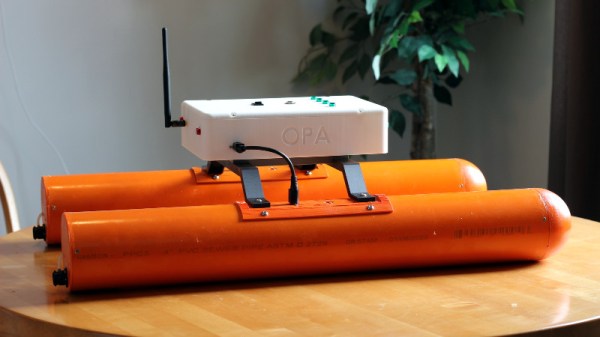
Take for example this impressive vessel built by [wesgood]. With a 3D printed electronics enclosure mounted to a pair of pontoons made of cheap 4-inch PVC pipe available from the hardware store, it provides a stable platform without breaking the bank. Commercial jet drive units built into the printed tail caps for the pipes provide propulsion, and allow the craft to be steered through differential thrust. Without rudders or exposed propellers, this design is particularly well-suited for operating in shallow waters.

A removable electronics tray allows for easy access.

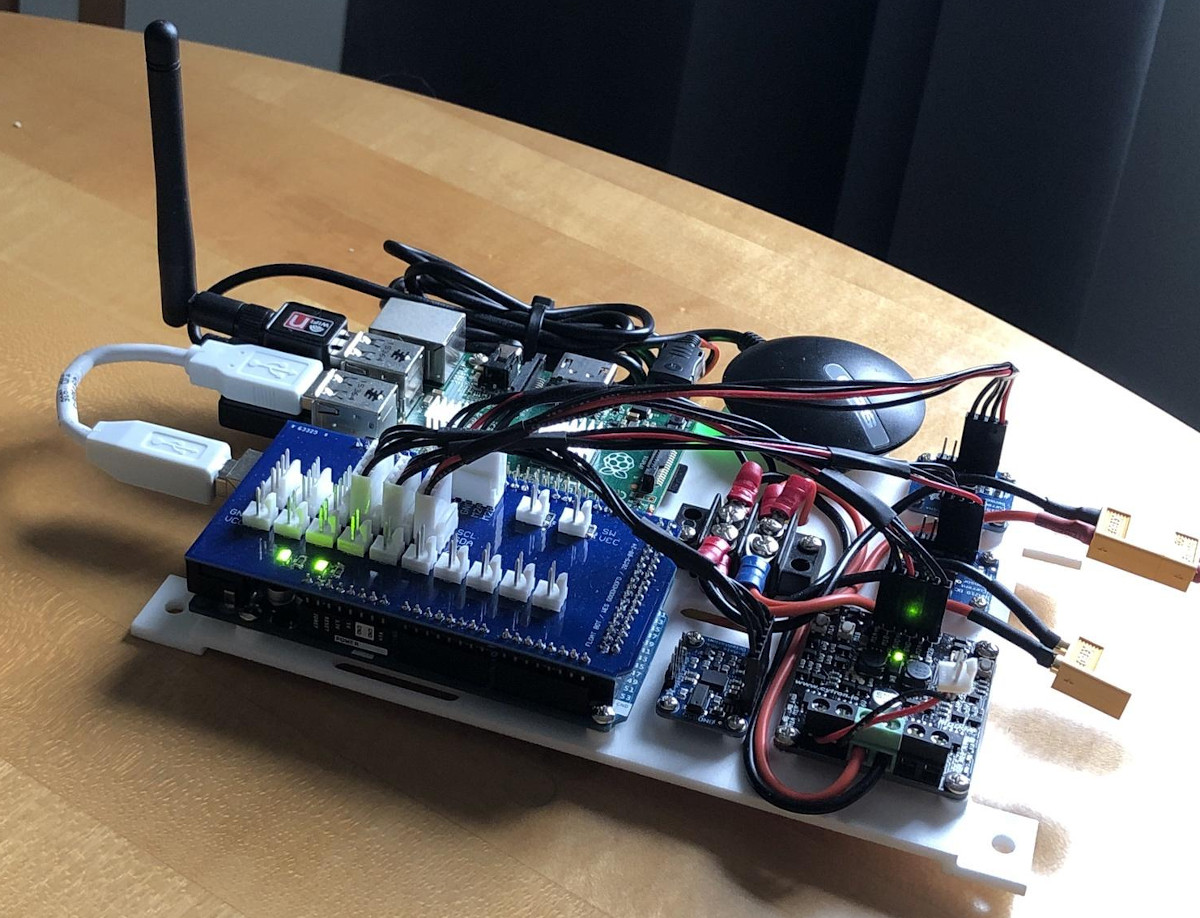
Perched high above the water, the electronics box contains a Raspberry Pi 2, BU353 USB GPS receiver, and a Arduino Mega 2560 paired with a custom PCB that offers up convenient ports to connect a dual-channel Cytron 3 amp motor driver and Adafruit BNO055 9-DOF IMU. Power is provided by two 6,000 mAh LiPo batteries mounted low in the pontoons, and a matching pair of Adafruit current/voltage sensors are used to keep track of the energy budget. A small USB WiFi dongle with an external antenna plugged into the Pi offers up a WiFi network that [wesgood] can connect to with an iPad for control.

If the control software for the craft looks particularly well-polished, it’s probably because [wesgood] just so happens to be a professional developer with a focus on mobile applications. While we’re a bit skeptical of using WiFi for a critical long-distance link, we can’t deny that the iPad allows for a very slick interface. In addition to showing the status of the craft’s various systems, it lets the user either take manual control or place waypoints for autonomous navigation — although it sounds like that last feature is only partially implemented right now.

We love this design, and are eager to see more as the project develops. Recently [wesgood] experimented with payloads that can be suspended from the bottom of the electronics box, specifically a sonar module for performing bathymetric observations. There’s considerable interest in crowd sourced depth maps for inland waterways, and a robotic craft that can reliably chart these areas autonomously is certainly a step up from having to collect the data manually.

Cranes made by Origami (Orizuru). The height is 35mm.

Bringing The Art Of Origami And Kirigami To Robotics And Medical Technology

Traditionally, when it comes to high-tech self-assembling microscopic structures for use in medicine delivery, and refined, delicate grippers for robotics, there’s been a dearth of effective, economical options. While some options exist, they are rarely as effective as desired, with microscopic medicine delivery mechanisms, for example, not having the optimal porosity. Similarly, in so-called soft robotics, many compromises had to be made.

A promising technology here involves the manipulation of flat structures in a way that enables them to either auto-assemble into 3D structures, or to non-destructively transform into 3D structures with specific features such as grippers that might be useful in both micro- and macroscopic applications, including robotics.

Perhaps the most interesting part is how much of these technologies borrow from the Japanese art of origami, and the related kirigami.

Continue reading “Bringing The Art Of Origami And Kirigami To Robotics And Medical Technology”

Robot Delivery To Your Door

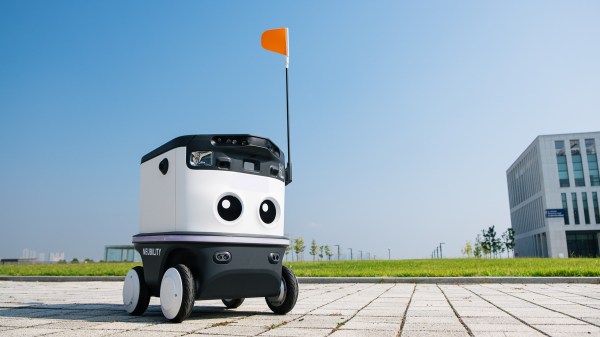
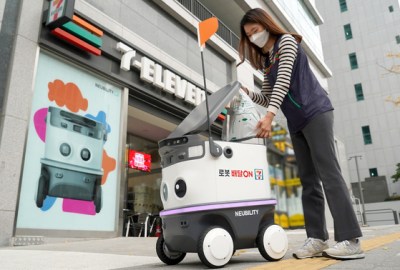
While online shopping was already very popular in South Korea, it has become even more so as people stay home more during the pandemic. Several robotic delivery services have launched around the city, such as 7-Eleven using the Neubie robot by Neubility, the GS25 convenience store using LG’s CLOi ServeBot, and the Baemin food delivery service using the Delidrive robot.

Love it or hate it, in the dense population of big cities like Seoul the vast majority of people live in apartment complexes. This lends itself well to these robot delivery projects. In fact, many of these pilot projects are only available in one apartment complex, which can consist of ten to twenty 15+ story buildings. Training your robot to navigate the sidewalks, operating the doors, calling the elevators, and buzzing the customer’s home intercom is an easier task when dealing with only one campus.

Some projects are more ambitious, like another Neubility system operating on the Yonsei University Songdo City campus. You can order fried chicken and have it delivered by a Neubie robot, which comes to your address along the sidewalk at a brisk 5 to 6 km/h. There are some issues, however. First of all, government regulations haven’t quite kept up with the technology. These services are basically operating case-by-case, temporary waiver basis. They are not allowed to operate on the streets, and when driving on the sidewalks they have to avoid bumping into people.

We wrote about a prototype RC truck delivery system last year, and covered Amazon drones and Automating Freight Delivery as well. These all show promise, but are not mainstream yet. The vast majority of your orders are still delivered by a person. Will these automated delivery services eventually replace humans? Let us know your thoughts in the comments below.

Telepresence Robot For “Doing The Rounds”

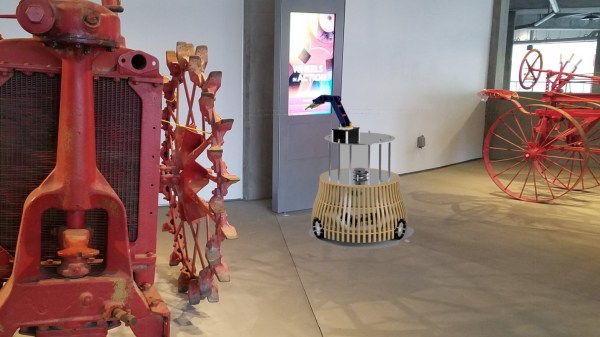
When you are responsible for maintaining devices at a client’s location, software tools like remote desktop and SSH are great, but sometimes they are not enough. For some problems, you need to get eyes and hands on the device to figure out what’s going on and fix the problem. This is a challenge [Will Donaldson] from EDM Studio is all too familiar with. They develop and maintain interactive museum exhibits all over the world, so they created Omni, a modular telepresence robot for inspection, maintenance, and a variety of other tasks.

The Omni uses a set of three omni-wheels under its base, powered by DC geared motors with encoders, each controlled by a separate motor driver and Arduino Nano. A similar arrangement was used by Mark Rober for his domino art robot. The main controller is a Raspberry Pi 4 running ROS2 (Robot Operating System), which takes inputs from a 360 LIDAR sensor, high-quality camera module, and IMU.

All the components are mounted on a series of plates separated using threaded rods. This arrangement allows for maximum flexibility and space, especially the open-top plate, which has a grid of holes machined in to allow almost anything to be mounted. In this case, a robotic arm is mounted for manipulating the environment. Another neat feature is the charging station connector, consisting of two parallel metal strips on the outside of the robot.

Omni’s mission is very similar to that of Spot, the robotic dog from Boston Dynamics intended, among other things, for Industrial Inspection. What practical purposes would you use Omni for? Let us know in the comments below.

Self-Driving RC Truck Is A Master’s Thesis In Cybernetics And Robotics

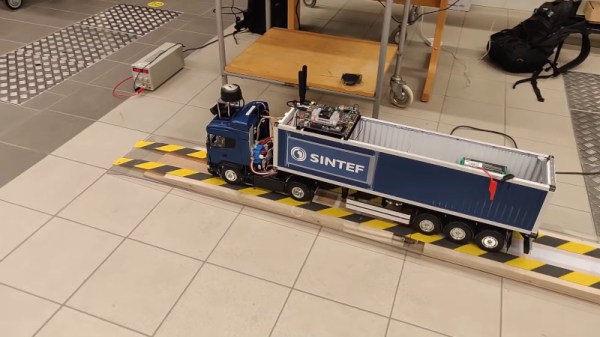
RC cars are a fun pastime, but for many hackers, taking things to the next level involves making the cars drive themselves. For his Masters thesis, [Jon] did just that, building a self-driving robot truck that confidently cruises the floor of his laboratory.

The truck is based on a 1/14th scale Tamiya chassis, and had been fitted out by a prior group with an inductive charging system. On top of this platform, [Jon] added a Jetson TX2 to act as the brains of the system, hooking it up with a Slamtec RPLIDAR scanner to map its surrounding environment. There’s also a Teensy microcontroller onboard which handles synthesizing PWM signals for the radio control hardware that drives the truck, and a Logitech webcam up front for machine vision. The truck is capable of operating in a variety of modes, from full manual operation, to driving based on LIDAR mapping or with an AI controlling the truck based on camera data. The truck is programmed to drive a route including an inductive charging pad so it can keep its power levels up without human intervention.

It’s a great blueprint for a self-driving system, and [Jon]’s thesis goes into great detail on how everything works at the base level (available on this page as a 67 MB PDF). His Code is on Github for the curious. We’ve seen similar projects before too, like this robot that navigates its builder’s house using LIDAR. Video after the break.

Continue reading “Self-Driving RC Truck Is A Master’s Thesis In Cybernetics And Robotics”