Automated Chicken Coop Door Is Solar-powered

[Fileark] has been busy with the hacks lately. This time around he’s built a solar-powered chicken coop door that opens in the morning, and closes at night. A single motor slides the door open and closed using a loop of spring-loaded string. There are limiting switches on either side of the door jamb to ensure proper positioning. The grey box seen above houses the hardware; a regulator for the solar panels perched atop the roof line, a battery from a broken UPS, and the driver board itself. An AVR chip running the Arduino bootloader monitors a phototransistor to detect sunup and sundown, driving the door motor appropriately using a pair of relays.

Check out the demonstration and hardware overview after the break. [Fileark] was inspired to build his after seeing the alarm-clock coop door. We don’t know if he got a chance to look at the vertical coop door, but we think his less mechanically-complicated solution is just as elegant.

Continue reading “Automated Chicken Coop Door Is Solar-powered”
Hopefully Detect Trolls Before They Devour You

In the cold and mysterious wilderness of Norway, it pays to be ready for anything–especially heavy-walking trolls. The team at [nullohm] decided to prepare thoroughly for their trek into the woods to witness the Leonids meteor shower by putting together an Arduino-based “troll detector”.

The device is based on the superstition of hammering a steel spike into a tree to keep trolls away from camp. This goes one step further by including an accelerometer and LED indicators so that you can tell exactly what type of troll is just about to feast upon your tender human flesh.

When the detector is installed into a nearby tree, it takes an average seismic measurement and then looks for telltale footfalls. Even if you’re not concerned with perpetuating superstitions, you might find a use for the source code for simple seismic activity monitoring at home to supplement your miniature seismic reflector.

Building A Bandwidth Meter

Here’s an analog bandwidth meter made to look like an old pressure gauge. It’s actually new, but the paper showing the graduated scale was stained in a bath of black tea, then dried in an oven to give it an aged appearance. We think it’s quite effective.

The dial itself is a volt meter driven by an Arduino in much the same way as the multimeter clock. Bandwidth data is pulled from a Linux router, filtered down to the target data using ‘grep’, and sent over the serial connection by a Perl script. Since the meter itself is just waiting for serial data, alterations to the router’s scripting make it easy to represent a count of unread emails, tweets, or whatever data your code can scrape.

[Thanks Ben]

Build A Pong Gaming Console

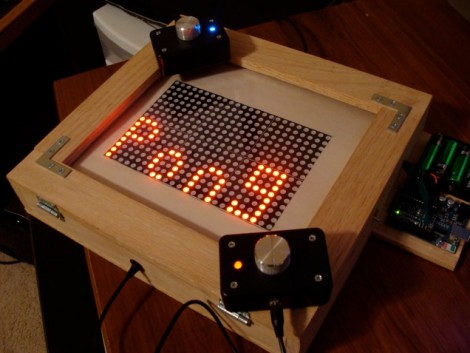
A lot of thought went into [Patrick Mccabe’s] Pong gaming console build. He used components we’re familiar with; an Arduino as a controller, 8×8 LED modules as the display, and potentiometers (with fancy knobs) in project boxes as the controllers. But every step along the way he took care to build this cleanly and robustly. Even the MAX7219CNG drivers for the six LED modules reside on PCBs from a fab house. The finished project is something you’d be proud to pull out and play when you have friends over. Even if they’re not part of the geek elite we think they’d enjoy a game or two. Great job [Patrick]. We hope to see an internalized microcontroller and scoring in your next update!

Want to do this but the cost of the matrix drivers scared you away? Follow our tutorial to build your own display using an AVR for the multiplexing.

Paper Touchpad

If you don’t mind getting your fingers a little dirty you can replace your mouse with a piece of paper. [Dr. West] made this touchpad himself, which measures signals at the corners of the paper using four voltage dividers. The paper has been completely covered with graphite from a pencil (which we see in hacks from time to time), making it conductive. The user wears an anti-static strap that grounds their hand, allowing an Arduino to calculate contact points on two axes when a finger completes the circuit. See this controlling a cursor in the video after the break.

Continue reading “Paper Touchpad”

Playing Hacker With A Toy Vault

[Thomas Cannon] created his own hacking game by adding some circuitry to this toy vault. The original toy uses the keypad to control a solenoid keeping the door shut. He kept the mechanical setup, but replaced the original circuit board with his own ATmega328 based internals. He also added a USB port to the front. The gist of the game is that you plug-in through USB to gain access to the vault’s terminal software. If you can make your way through the various levels of admin access the loot inside will be yours.

Nixie Tubes Live In A Cool Box

This set of four Nixie tubes display the number of people following bildr on Twitter. That’s neat; it uses an Arduino and some open source driver boards. But what caught out eye is the enclosure. The image above shows only half, but when assembled it’s a nice little cube that keeps the insides safe. This was laser cut using the Ponoko service and kicks off a design contest. Come up with the best idea for using 4 Nixies, their drivers, and $50 worth of Ponoko’s services and they’ll give you the materials to make it happen.