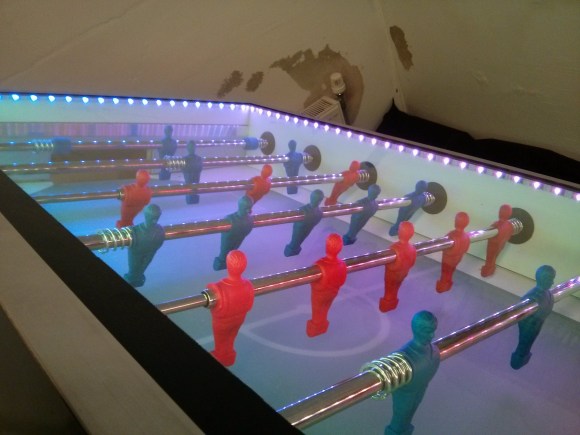
At a local LAN event, [Thomas] wanted a way to easily show off the capabilities from some of the Internet-of-Things devices everyone keeps talking about. His idea was to build an internet-connected foosball/table soccer/table football table to show off some hardware and software.
[Thomas]’s table automates almost everything that is part of the great sport of foosball. Once a user logs in using the barcode scanner, the game begins by deploying the tiny ball with parts salvaged from a Roomba. The table uses infrared sensors to detect the ball. Once a goal is scored, it is posted online where anyone can see the current score and a history of all of the games played on the table.
There are a few other unique touches on the foosball table, such as the LED lighting, touch screen displays, and an STM32-E407 ARM processor to tie the whole machine together.
For more information including the source code and demonstrations, check out [Thomas]’s project blog. And, if you get lonely, perhaps you can try the robot foosball player!

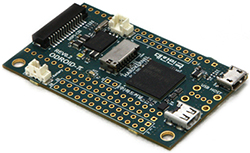 A few years ago, Broadcom had a pretty nice chip – the BCM2835 – that could do 1080 video, had fairly powerful graphics performance, run a *nix at a good click, and was fairly cheap. A Broadcom employee thought, “why don’t we build an educational computer with this” and the Raspberry Pi was born. Since then, Broadcom has kept that chip to themselves, funneling all of them into what has become a very vibrant platform for education, tinkering, and any other project that could use a small Linux board. Recently, Broadcom has started to sell the BCM2835 to anyone who has the cash and from the looks of it,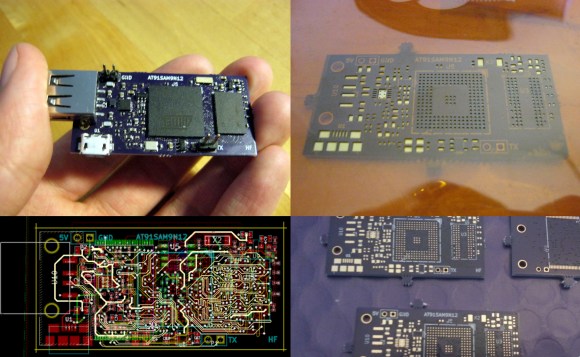
 Texas Instruments’ CC3000 WiFi chip is the darling of everyone producing the latest and greatest Internet of Thing, and it’s not much of a surprise: In quantity, these chips are only $10 a piece. That’s a lot less expensive than the WiFi options a year ago. Now, TI is coming out with
  While the most common use for a Raspberry Pi is probably a media center PC or retro game emulator, the Pi was designed as an educational computer meant to be an easy-to-use system in the hands of millions of students. Team 28 at Imperial College London certainly living up to the Raspberry Pi Foundation’s expectations
 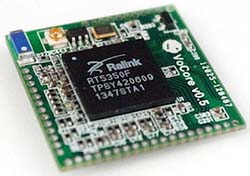 With tiny Linux boards popping up like dandelions, it was only a matter of time before someone came out with a really tiny Linux board.