Ultrasonic Tracking Beacons Rising

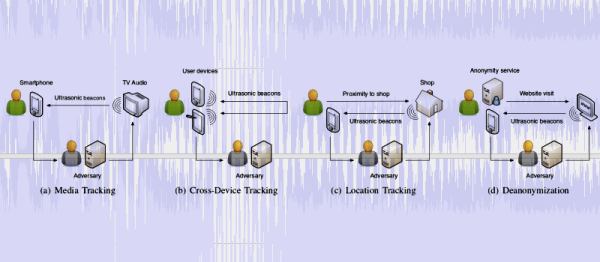
An ultrasonic beacon is an inaudible sound with encoded data that can be used by a listening device to receive information on just about anything. Beacons can be used, for example, inside a shop to highlight a particular promotion or on a museum for guided tours where the ultrasonic beacons can encode the location. Or they can be used to track people consumers. Imagine if Google find outs… oh, wait… they already did, some years ago. As with almost any technology, it can be used to ‘do no harm’ or to serve other purposes.

Researchers from the Technische Universitat Braunschweig in Germany presented a paper about Ultrasonic Side Channels on Mobile Devices and how can they be abused in a variety of scenarios , ranging from simple consumer tracking to deanonymization. These types of ultrasonic beacons work in the 18 kHz – 20 kHz range, which the human being doesn’t have the ability to hear, unless you are under twenty years old, due to presbycusis. Yes, presbycusis. This frequency range can played via almost any speaker and can be picked up easily by most mobile device microphones, so no special hardware is needed. Speakers and mics are almost ubiquitous nowadays, so there is a real appeal to the technology.
Continue reading “Ultrasonic Tracking Beacons Rising”

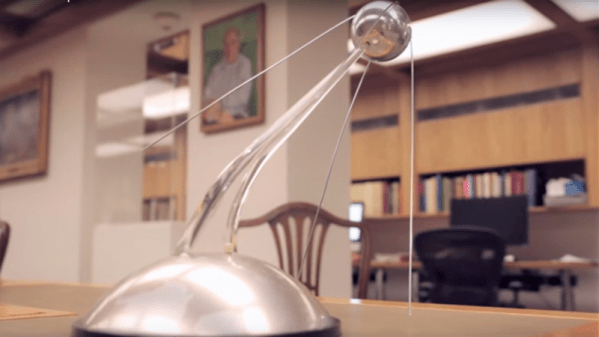
Model Sputnik Finds Its Voice After Decades Of Silence

As we approach the 60th anniversary of the human race becoming a spacefaring species, Sputnik nostalgia will no doubt be on the rise. And rightly so — even though Sputnik was remarkably primitive compared to today’s satellites, its 1957 launch was an inflection point in history and a huge achievement for humanity.

The Soviets, understandably proud of their accomplishment, created a series of commemorative models of Earth’s first artificial moon as gifts to other countries. How one came into possession of the Royal Society isn’t clear, but [Fran Blanche] found out about it through a circuitous route detailed in the video below, and undertook to reproduce the original electronics from the model that made the distinctive Sputnik beeps.

The Royal Society’s version of the model no longer works, but luckily it came with a schematic of the solid-state circuit used to emulate the original’s vacuum-tube guts. Intent on building the circuit as close to vintage as possible and armed with a bag of germanium transistors from the 60s, [Fran] worked through the schematic, correcting a few issues here and there, and eventually brought the voice of Sputnik back to life.

If you think we’ve covered Sputnik’s rebirth before, you may be thinking about our article on how some hams rebuilt Sputnik’s guts from a recently uncovered Soviet-era schematic. [Fran]’s project just reproduces the sound of Sputnik — no license required!

Continue reading “Model Sputnik Finds Its Voice After Decades Of Silence”

Little Laser Light Show Is Cleverly Packaged, Cheap To Build

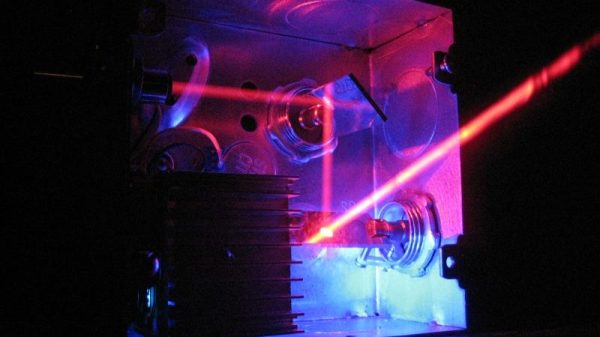
We’re suckers for any project that’s nicely packaged, but an added bonus is when most of the components can be sourced cheaply and locally. Such is the case for this little laser light show, housed in electrical boxes from the local home center and built with stuff you probably have in your junk bin.

When we first came across [replayreb]’s write-up and saw that he used hard drives in its construction, we assumed he used head galvanometers to drive the mirrors. As it turns out, he used that approach in an earlier project, but this time around, the hard drive only donated its platters for use as low mass, first surface mirrors. And rather than driving the mirrors with galvos, he chose plain old brushed DC motors. These have the significant advantage of being cheap and a perfect fit for 3/4″ EMT set-screw connectors, designed to connect thin-wall conduit, also known as electromechanical tubing, to electrical boxes and panels. The motors are mounted to the back and side of the box so their axes are 90° from each other, and the mirrors are constrained by small cable ties and set at 45°. The motors are driven directly by the left and right channels of a small audio amp, wiggling enough to create a decent light show from the laser module.

We especially like the fact that these boxes are cheap enough that you can build three with different color lasers. In that case, an obvious next step would be bandpass filters to split the signal into bass, midrange, and treble for that retro-modern light organ effect. Or maybe figuring out what audio signals you’d need to make this box into a laser sky display would be a good idea too.

Continue reading “Little Laser Light Show Is Cleverly Packaged, Cheap To Build”

Retro Teardown: Inside An 8-Track Stereo Player

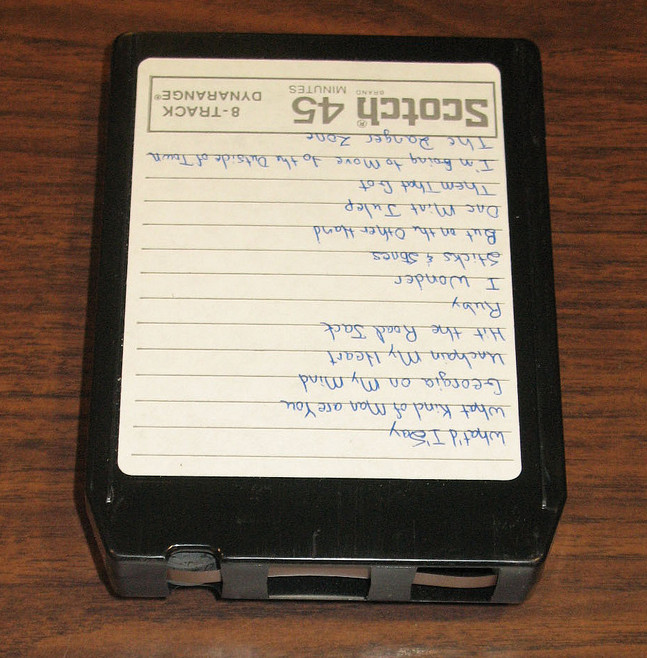
If you are a connoisseur of analogue audio, it’s probable you might have a turntable and a stack of records at home somewhere. If you are of a certain age you may even have a cassette deck, though you’re more likely to have abandoned that format some time in the 1990s. If you are old enough to have been around in the 1960s or 1970s though, you may have owned another analogue audio format. One of several that you might have found in a well-equipped home of that period was the 8-track stereo cartridge, a self-contained tape cassette format that fit four stereo tracks onto a single quarter-inch tape loop as eight parallel tracks, four each of left and right. A triumph of marketing, really, it should more accurately have been called 4-track stereo.

An 8-track stereo cartridge. Government & Heritage Library, State Library of NC (CC BY 2.0).

8-track cartridges were developed from earlier tape cartridge formats, largely to satisfy the demands of the automotive industry for interchangeable in-car entertainment. Thus if you owned an 8-track player it was most likely to have been found in your car, but it was not uncommon to find them also incorporated into home hi-fi systems. Thus we come to our subject today. Our retrotechtacular series usually highlights a video showing a bygone technology, but today we’re going to get a little more hands-on.

Some time in the early 1990s, I acquired an 8-track player, a BSR McDonald unit manufactured in the UK and dating from the early 1970s. BSR were much more well-known for their turntables, so this is something of an oddity. Where I found it has disappeared into the mists of time, but it was probably at a radio rally or junk sale. I certainly didn’t buy it because I wanted it to play 8-track tapes, instead I wanted a talking point for my hi-fi, something quirky to set it apart from everyone else’s. So every incarnation of listening enjoyment chez List for the last quarter century has had an 8-track player nestling within it, even if it has never played a tape while in my ownership. Thus we have a unique opportunity for this retro teardown.

Continue reading “Retro Teardown: Inside An 8-Track Stereo Player”

Scratchy Brings Digital Clarity To The Vinyl World

If you walk the halls of audiophilia, you may be aware that there has been a huge amount of work put in to software designed to clean up older audio recordings without compromising the quality of the recording itself. Sometimes the results can be amazing, such as when a stereo image is created from parallel mono recordings made before stereo was even a glint in the eye of a 1930s EMI engineer.

Bob Widlar on analogue versus digital. Original: EDN
[Bob Widlar] on analogue versus digital. Original: EDN.
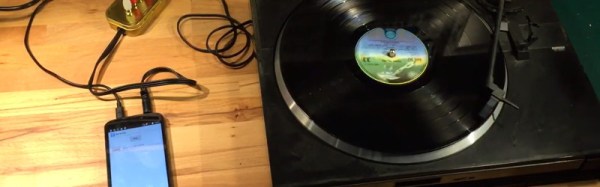
But what if you are at home, without the benefit of a state-of-the-art studio or high-end digital signal processing? How can you then have pop and crackle free sound from your hi-fi when you put on a piece of vinyl? [Paul Wallace] may just have the answer, he’s made a smartphone app called Scratchy which listens to the output of a turntable, identifies the track being played, and plays the appropriate MP3 file for a digital experience from vinyl. It uses the algorithm published by Shazam to recognize tunes. The software also has a learn mode during which it can be taught about new records in the collection. The app itself is written using the Xamarin framework and has its source code in his GitHup repository, so it’s possible it could be produced for other platforms as well as Android.

Now vinyl purists will be speechless with horror at this wanton desecration of their format while audiophiles will be fuming at the smeary-in-the-midrange MP3s, but we can see its appeal if your vinyl is on the grubby side. It’s fair to say though that the stereo here won’t be sporting it, you’ll tear our analogue signal path from our cold dead hands. Take a look for yourselves, he’s put up a video showing it in operation.

Continue reading “Scratchy Brings Digital Clarity To The Vinyl World”

Introducing The Hackaday Passive Aligned Ferrite Active Quantum Crystal Nanoparticle Reference Sticker

As you know, here at Hackaday we take our audio equipment very seriously indeed. We’ve seen it all over the years and have a pretty jaded view of a lot of the audiophile products that come past our door, but once in a while along comes something that’s a bit special. That’s why today we’d like to introduce you to a new product, The Hackaday Passive Aligned Ferrite Active Quantum Crystal Nanoparticle Reference Sticker.

Here’s the problem: we’re surrounded by electrical noise. You can’t see it, you can’t touch it, and you can’t hear it, but your audio equipment can, and when that happens it will degrade your listening experience without your realising it. You might have shelled out your life savings on a top-end Hinari amp, Marc Vincent surround sound processor, Friedland carillon wire cables and a set of Saisho floor-standing speakers, but if you haven’t dealt with your system’s magnetic compatibility they’re never quite going to reach their potential and you’ll always be left wondering why your broader soundstage just doesn’t zing. You need an HPAFAQCNRS.

Continue reading “Introducing The Hackaday Passive Aligned Ferrite Active Quantum Crystal Nanoparticle Reference Sticker”

Record Players Explained For The Streaming Generation

How do you consume your music, these days? Aside from on the radio, that is. Do you play MP3 or other files on your phone and computer, or perhaps do you stream from an online service? If you’re really at the cutting edge though you’ll do none of those things, because you’ll be playing it on vinyl.

The legendary Technics SL1200 direct-drive turntable, as used by countless DJs. Dydric [CC BY-SA 2.5)], via Wikimedia Commons.
The legendary Technics SL1200 direct-drive turntable, as used by countless DJs. Photo by Dydric CC-BY-SA 2.5
A few years ago reporting on a resurgence of sales of vinyl records was something you would never have expected to see, but consumer tastes are unpredictable. Our red-trousered and extravagantly bearded hipster friends have rediscovered the glories of the format, and as a result it’s popping up everywhere. For those of us who are old enough to have genuinely been into the format before it was cool again, the sight of Sergeant Pepper and Led Zeppelin II on 12″ at outrageous prices on a stand at the local supermarket is a source of amusement. It’s good to see your first love back in vogue again, but is it really the £20($25) per album kind of good?

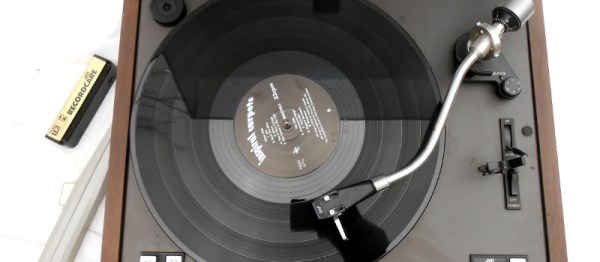
With the turntable having disappeared as an integral part of the typical hi-fi setup the new vinyl enthusiast is faced with a poor choice of equipment. Often the best available without spending serious money at an audiophile store is a USB device with the cheapest possible manufacture, from which the playback will be mediocre at best. We’ve lost the body of collective knowledge about what makes a good turntable to almost thirty years of CDs and MP3s, so perhaps it’s time for a quick primer.

Continue reading “Record Players Explained For The Streaming Generation”