Building Experience And Circuits For Lithium Capacitors

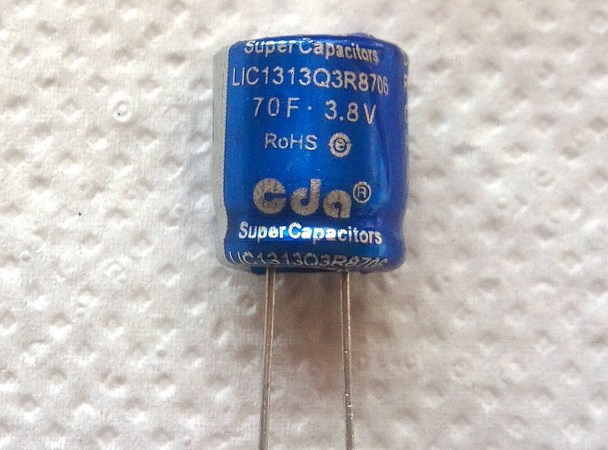
For the cautious, a good piece of advice is to always wait to buy a new product until after the first model year, whether its cars or consumer electronics or any other major purchase. This gives the manufacturer a year to iron out the kinks and get everything ship shape the second time around. But not everyone is willing to wait on new tech. [Berto] has been interested in lithium capacitors, a fairly new type of super capacitor, and being unwilling to wait on support circuitry schematics to magically show up on the Internet he set about making his own.

The circuit he’s building here is a solar charger for the super capacitor. Being a fairly small device there’s not a lot of current, voltage, or energy, but these are different enough from other types of energy storage devices that it was worth taking a close look and designing something custom. An HT7533 is used for voltage regulation with a Schottky diode preventing return current to the solar cell, and a DW01 circuit is used to make sure that the capacitor doesn’t overcharge.

While the DW01 is made specifically for lithium ion batteries, [Berto] found that it was fairly suitable for this new type of capacitor as well. The capacitor itself is suited for many low-power, embedded applications where a battery might add complexity. Capacitors like this can charge much more rapidly and behave generally more linearly than their chemical cousins, and they aren’t limited to small applications either. For example, this RC plane was converted to run with super capacitors.


Swapping Batteries Has Never Looked This Cool

We don’t know much more than what we see with [Kounotori_DIY]’s battery loader design (video embedded below) but it just looks so cool we had to share. Watch it in action, it’ll explain itself.

Before 3D printers made it onto hobbyist workbenches, prototyping something like this would have been much more work.

[Kounotori_DIY] uses a small plastic linear guide as an interface for an 18650 battery holder and as you can see, it’s pretty slick. A little cylindrical container slides out of the assembly, allowing a spent cell to drop out. Loading a freshly charged cell consists of just popping a new one into the cylinder, then snapping it closed. The electrical connection is made by two springy metal tabs on either end that fit into guides in the cylindrical holder.

It’s just a prototype right now, and [Kounotori_DIY] admits that the assembly is still a bit big and there’s no solid retention — a good bump will pop the battery out — but we think this is onto something. We can’t help but imagine how swapping batteries in such style with a nice solid click would go very nicely on a cyberdeck build.

It’s not every day that someone tries to re-imagine a battery holder, let alone with such style. Any ideas how it could be improved? Have your own ideas about reimagining how batteries are handled? Let us know in the comments!

Continue reading “Swapping Batteries Has Never Looked This Cool”

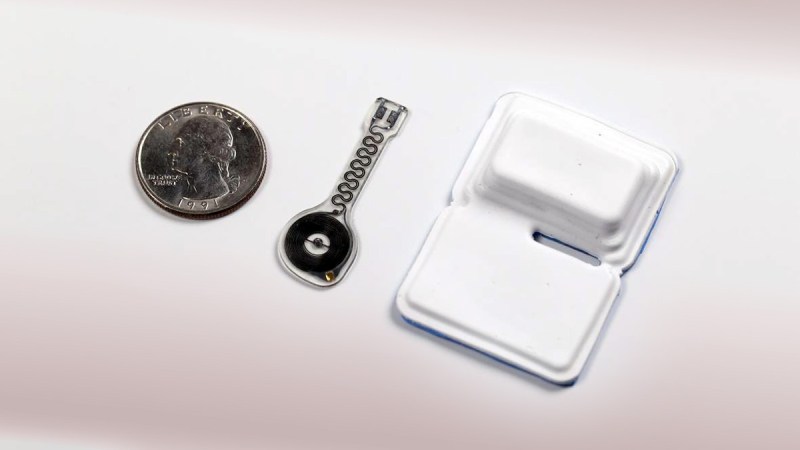
Bioelectronic implants with size reference

Batteries Not Included: Navigating The Implants Of Tomorrow

Tinkerers and tech enthusiasts, brace yourselves: the frontier of biohacking has just expanded. Picture implantable medical devices that don’t need batteries—no more surgeries for replacements or bulky contraptions. Though not all new (see below), ChemistryWorld recently shed new light on these innovations. It’s as exciting as it is unnerving; we, as hackers, know too well that tech and biology blend a fine ethical line. Realising our bodies can be hacked both tickles our excitement and unsettlement, posing deeper questions about human-machine integration.

Since the first pacemaker hit the scene in 1958, powered by rechargeable nickel-cadmium batteries and induction coils, progress has been steady but bound by battery limitations. Now, researchers like Jacob Robinson from Rice University are flipping the script, moving to designs that harvest energy from within. Whether through mechanical heartbeats or lung inflation, these implants are shifting to a network of energy-harvesting nodes.

From triboelectric nanogenerators made of flexible, biodegradable materials to piezoelectric devices tapping body motion is quite a leap. John Rogers at Northwestern University points out that the real challenge is balancing power extraction without harming the body’s natural function. Energy isn’t free-flowing; overharvesting could strain or damage organs. A topic we also addressed in April of this year.

As we edge toward battery-free implants, these breakthroughs could redefine biomedical tech. A good start on diving into this paradigm shift and past innovations is this article from 2023. It’ll get you on track of some prior innovations in this field. Happy tinkering, and: stay critical! For we hackers know that there’s an alternative use for everything!

Disposable Vape Batteries Power EBike

There are a lot of things that get landfilled that have some marginal value, but generally if there’s not a huge amount of money to be made recycling things they won’t get recycled. It might not be surprising to most that this is true of almost all plastic, a substantial portion of glass, and even a lot of paper and metals, but what might come as a shock is that plenty of rechargeable lithium batteries are included in this list as well. It’s cheaper to build lithium batteries into one-time-use items like disposable vape pens and just throw them out after one (or less than one) charge cycle, but if you have some spare time these batteries are plenty useful.

[Chris Doel] found over a hundred disposable vape pens after a local music festival and collected them all to build into a battery powerful enough for an ebike. Granted, this involves a lot of work disassembling each vape which is full of some fairly toxic compounds and which also generally tend to have some sensitive electronics, but once each pen was disassembled the real work of building a battery gets going. He starts with testing each cell and charging them to the same voltage, grouping cells with similar internal resistances. From there he assembles them into a 48V pack with a battery management system and custom 3D printed cell holders to accommodate the wide range of cell sizes. A 3D printed enclosure with charge/discharge ports, a power switch, and a status display round out the build.

With the battery bank completed he straps it to his existing ebike and hits the trails, easily traveling 20 miles with barely any pedal input. These cells are only rated for 300 charge-discharge cycles which is on par for plenty of similar 18650 cells, making this an impressive build for essentially free materials minus the costs of filament, a few parts, and the sweat equity that went into sourcing the cells. If you want to take an ebike to the next level of low-cost, we’d recommend pairing this battery with the drivetrain from the Spin Cycle.

Thanks to [Anton] for the tip!

The FNIRSI HRM-10 Internal Resistance Meter

Occasionally, we find fun new electronic instruments in the wild and can’t resist sharing them with our readers. The item in question is the FNIRSI HRM-10 Internal resistance meter, which we show here being reviewed by [JohnAudioTech].

So what does it do, and why would you want one? The device is designed to measure batteries so you can quickly determine their health. Its operating principle also allows it to do a decent job of measuring low-resistance parts, which is not necessarily as easy to achieve with the garden variety multimeter, especially the low-end ones. We reckon it would be useful in the field for checking the resistance of switches and relays, possibly in automotive or industrial applications. The four-pin connector is needed because there are two wires per probe, making a Kelvin (also known as four-wire) connection.

Likely, the operating principle is to apply a varying load to the battery under test and then measure the voltage drop. The slope of the voltage sag vs load is a reasonable estimate of the resistance of the source, at least for the applied voltage range. The Kelvin connection uses one pair of wires to apply the test current from a relatively low-impedance source and the second pair to measure the voltage with a high input impedance. That way, the resistance of the probe wires can be calibrated out, giving a much more accurate measurement. Many lab-grade measurement equipment works this way.

Circling back to the HRM-10, [John] notes that it also supports limit testing, making it a helpful gauging tool for the workbench when sorting through many batteries. Data logging and the ability to upload to a computer completes the feature set, which is quite typical for this level of product now. Gone are the days of keeping a manual logbook next to the instrument stack and writing everything down by hand!

We’ve touched on measuring battery internal resistance before, but it was a while ago. Regarding Kelvin connections, here’s a quick guide and a hack upgrading a cheap LCR to support 4-wire probes.

Continue reading “The FNIRSI HRM-10 Internal Resistance Meter”

Universal Power Bank Customized To Your Liking

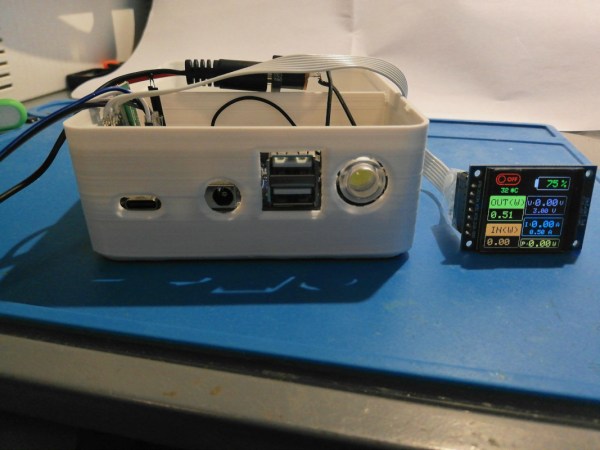
One of the most troubling trends of almost every modern consumer product that uses electricity is that the software that controls the product is likely to be proprietary and closed-source, which could be doing (or not doing) any number of things that its owner has no control over. Whether it’s a computer, kitchen appliance, or even a device that handles the electricity directly, it’s fairly rare to find something with software that’s open and customizable. That’s why [Traditional-Code9728] is working on a power bank with an open-source firmware.

From a hardware perspective the power bank is fairly open as well, with a number of options for connecting this device to anything else that might need power. It sports a bidirectional USB-C port as well as a DC barrel plug, either of which can either charge other devices or receive energy to charge its own battery. These ports can also accept energy from a solar panel and have MPPT built in. There’s also dual USB-A ports which can provide anywhere from five to 12 volts at 25 watts, and a color screen which shows the current status of the device.

While this is a prototype device, it’s still actively being worked on. Some future planned upgrades to the power bank include a slimmer design, charge limiting features to improve battery life, and more fine-tuned control of the output voltage and current on the USB-C port. With all of the software being open-source, as well as the circuit diagram and 3D printing files, it could find itself in plenty of applications as well. This power bank also stays under the energy limits for flying on most commercial airlines as well, but if you don’t plan on taking your power bank on an airplane then you might want to try out this 2000-watt monster instead.

Hardware Reuse: The PMG001 Integrated Power Management Module

Battery management is a tedious but necessary problem that becomes more of a hassle with lithium-ion technology. As we’re all very aware, such batteries need a bit of care to be utilized safely, and as such, a huge plethora of ICs are available to perform the relevant duties. Hackaday.IO user [Erik] clearly spent some time dropping down the same old set of ICs to manage a battery in their applications, so they created a drop-in castellated PCB to manage all this.

Continue reading “Hardware Reuse: The PMG001 Integrated Power Management Module”