Old Prius Gets Upgraded Batteries

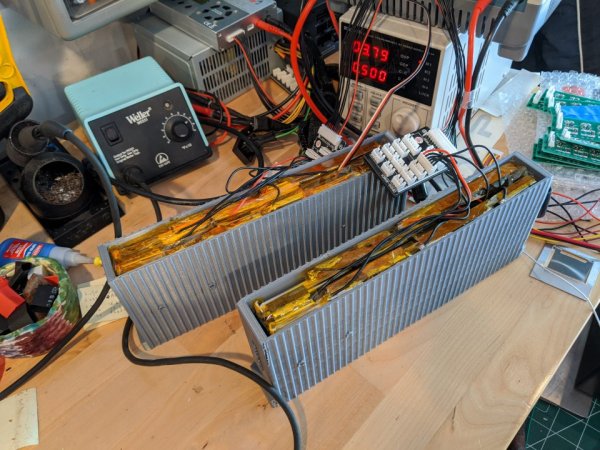
So many of the batteries made today are lithium batteries of some sort, from mobile phones, laptops, and drones to electric cars and grid storage solutions. But this technology is relatively new; even as late as the 90s and early 00s the only widely-available batteries for things like power tools or the new hybrid vehicles coming on the market were nickel-metal hydride (NiMH). While it was good for the time, they don’t hold up to all of the advantages lithium has. There’s still plenty of hybrid vehicles on the road using these batteries, so if you’re driving an older Prius and want to give it a modern refresh, there’s a quick option to swap your old batteries.

Despite lithium technology being available for several decades, the switch to lithium for the Toyota Prius wasn’t instant, with many variants still using NiMH batteries as late as the 2020s largely because the NiMH batteries are less expensive and less maintenance-intensive than lithium batteries are. As these batteries lose capacity, the cars are still driveable but the advantages of the hybrid drivetrain won’t be as accessible anymore. The upgrade, from a company called Project Lithium, replaces these batteries with modern lithium technology that can improve the efficiency and performance of these cars even above their original capabilities since lithium batteries have more power density.

With the Toyota Prius being among the most reliable vehicles on the road thanks to the electric motor in the hybrid drivetrain taking a lot of stress off of the internal combustion engine, it’s often worth upgrading these old batteries to modern ones to squeeze every last mile from these workhorses as possible. With many of the replacement processes being almost as simple as lifting out an old battery and placing a new one in, it can be a no-brainer if that’s the only issue with the vehicle otherwise. This is also true of all-electric vehicles as well, although the process to replace the battery can be a little more involved.

Thanks to [JohnU] for the tip!
Mods Turn Junk UPS Into A Long-Endurance Beast

If you’ve got a so-called uninterruptible power supply (UPS) on your system, you’re probably painfully aware that the “uninterruptible” part has some pretty serious limits. Most consumer units are designed to provide power during a black out only long enough to gracefully shut down your system. But with a few hacks like these, you can stretch that time out and turn it into a long-endurance UPS.

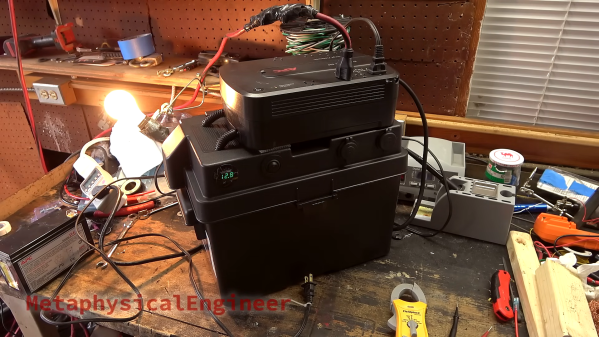
As many good stories do, this one starts in the trash, where [MetaphysicalEngineer] spotted an APC home office-style UPS. It was clearly labeled “broken,” but that just turned out to be a dead battery. While he could have simply replaced it with a 12-volt sealed lead-acid battery, [Meta] knew that his computer setup would quickly deplete the standard battery. A little testing showed him that a car battery would extend the run time significantly, especially if he threw in some extra cooling for the onboard inverter.

His final design uses a marine deep-cycle battery in a plastic battery box with the UPS mounted on top. The vacated battery compartment made a great place to add a cooling fan, along with a clever circuit to turn it on only when the beeper on the UPS sounds, with a bonus volume control for the annoying sound. He also added accessories to the battery box top, including a voltmeter, a USB charger, and a switched 12-volt power outlet. And kudos for the liberal use of fuses in the build; things could get spicy otherwise. The video below shows the entire build along with all the testing. [MetaphysicalEngineer] managed to triple the estimated runtime for the load he’s trying to power, so it seems like a win to us.

If your needs run more toward keeping your networking gear running through a blackout, you might want to check out this inverter-less DC UPS.

Continue reading “Mods Turn Junk UPS Into A Long-Endurance Beast”

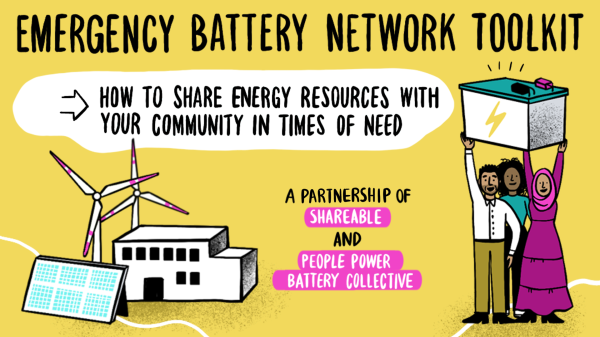
An illustration of a powerplant, solar panel, and two wind turbines is in the bottom left across from an image of three cartoon people holding up a giant battery above their heads. Along the top of the image are the words, "Emergency Battery Network Toolkit." Below in a white bubble on the yellow background, it says, "How to share energy resources with your community in times of need." In the space between the people and the power plant, it says, "A Partnership of Shareable and People Power Battery Collective."

Sneakernet Power Transmission

Power outages in the face of natural disasters or more mundane grid failures can range from a mild inconvenience to a matter of life or death if you depend on electrical medical equipment. [Shareable] and [People Power Battery Collective] have partnered to develop a toolkit for communities looking to share power with each other in these situations.

Battery backup power isn’t exactly a new concept, so the real meat of this guide is how to build a network in your community so these relatively simple devices can be deployed effectively in the event of an emergency. We know that you can already handle your own backup power needs, but it pays to be a good neighbor, especially when those neighbors are deciding what to do when you’re releasing the factory-sealed smoke from your latest build on the community sidewalk.

For those who aren’t as technically-inclined as you, dear reader, there is also a handy Battery Basics (PDF) guide to help in selecting a battery backup solution. It is somewhat simplified, but it covers what most people would need to know. A note on fire safety regarding Li-ion batteries would probably be warranted in the Battery Basics document to balance the information on the risks of topping up lead-acid cells, but it otherwise seems pretty solid.

If you’re not quite ready to bug your neighbors, how about you build a backup battery first? How about repurposing an e-bike battery or this backup power solution for keeping a gas water heater working during a power outage?

Rock Salt May Lead The Way To Better Batteries

The regular refrain here when it comes to announcements of new battery chemistries hailed as potentially miraculous is that if we had a pound, dollar, or Euro for each one we’ve heard, by now we’d be millionaires. But still they keep coming, and it’s inevitable that there will one or two that break through the practicality barrier and really do deliver on their promise. Which brings us tot he story which has come our way today, the suggestion that something as simple as rock salt could triple the energy density of a lithium-ion vehicle battery.

The research led from Lawrence Berkeley National Laboratory started around the use of cobalt in the battery cathode, an expensive and finite resource with the added concern of being in large part a conflict mineral from the Democratic Republic of Congo. Cobalt is used inĀ  the cathodes because its oxide crystals form a stable layered structure into which the lithium ions can percolate. Alternative layered-structure metal oxides perform less well in retaining the lithium ions, making them unsuccessful substitutes. It seems that the three-dimensional structure of a rock salt crystal performs up to three times better than any layered oxide, which is where the excitement comes from.

Of course, if it were that simple we’d all be using three-times-more-powerful, half-price 18650s right now, which of course we aren’t. The challenge comes in making a rock salt cathode which both holds the lithium ions, and keeps that property reliably over the thousands of charge cycles needed for a real-world application. This one may yet be anther dollar on that metaphorical pile, but it just might give us the batteries we’ve been looking for.

Then again, when you’re looking at exciting battery chemistry, why limit yourself to lithium?

Will Nickel-Hydrogen Cells Be The Energy Storage Holy Grail?

You may have heard us here remarking in the past, that if we had a pound, dollar, or Euro for every miracle battery technology story we heard that was going to change the world, we would surely be very wealthy by now. It’s certainly been the case that many such pronouncements refer to promising chemistries that turn out only to be realizable in a lab, but here there’s news of one with a bit of pedigree. Nickel hydrogen batteries have a long history of use in space, and there’s a startup producing them now for use on the ground. Could they deliver the energy storage Holy Grail?

The cathode in a nickel-hydrogen battery is formed by nickel hydroxide, and the anode is formed of hydrogen. If a gas as an anode sounds far fetched, we’re guessing that their structure is similar to the zinc-air battery, in which zinc hydroxide forms in a paste of powdered zinc, and works against oxygen from the air over a porous conductive support. What gives them their exciting potential is their ability to take more than 30,000 charge/discharge cycles, and their relative safety when compared to lithium ion cells. Hydrogen in a pressure vessel might not seem the safest of things to have around, but the chemistry is such that as the pressure increases it reacts to form water. The cost of the whole thing is reduced further as new catalysts have replaced the platinum used by NASA on spacecraft.

We really hope that these batteries will be a success, but as always we’ll wait and see before calling it. They may well be competing by then with the next generation of zinc-air cells.

Aluminum Battery Is Sustainable

If you think of metals in a battery, you probably think of lithium, mercury, lead, nickel, and cadmium. But researchers in Australia and China want you to think about aluminum. Unlike most battery metals, aluminum is abundant and not difficult to dispose of later.

Their battery design uses water-based electrolytes and is air-stable. It is also flame retardant. The battery can provide 1.25V at a capacity of 110 mAh/g over 800 charge cycles. The idea of using aluminum in a battery isn’t new. Aluminum is potentially more efficient since each aluminum ion is equivalent to three lithium ions. The batteries, in theory, have higher energy density compared to lithium-ion, but suffer from short shelf life and, so far, practical devices aren’t that close to the theoretical limits of the technology.

Continue reading “Aluminum Battery Is Sustainable”

Determining The Size Of The New US Lithium Deposit Amidst Exploding Demand

With demand for lithium in the world market projected to increase by 2040 to as much as eight times the demand in 2022, finding new deposits of this metal has become a priority. Currently most of the world’s lithium comes from Australia, Chile, China and Argentina, with potential new mining sites under investigation. One of these sites is the McDermitt caldera in the US, a likely remnant of the Yellowstone hotspot and resulting volcanic activity. According to a recent study (Chemistry World article) by Thomas R. Benson and colleagues in Science Advances, this site may not only contain between 20 to 40 million tons of lithium in the form of the mineral clay illite, but was also formed using a rather unique process.

This particular group of mineral clays can contain a number of other chemicals, which in this particular case is lithium due to the unique way in which the about 40 meter thick layer of sediment was formed. Although lithium is a very common metal, its high reactivity means that it is never found in its elementary form, but instead bound to other elements. Lithium is thinly distributed within the Earth’s crust and oceans. Incidentally, the Earth’s oceans contain by far the largest amount of lithium, at approximately 230 billion tons.

So how much lithium could be extracted from this new area, and how does this compare to the increasing demand?

Continue reading “Determining The Size Of The New US Lithium Deposit Amidst Exploding Demand”