Bits And Pieces Robotic Arm

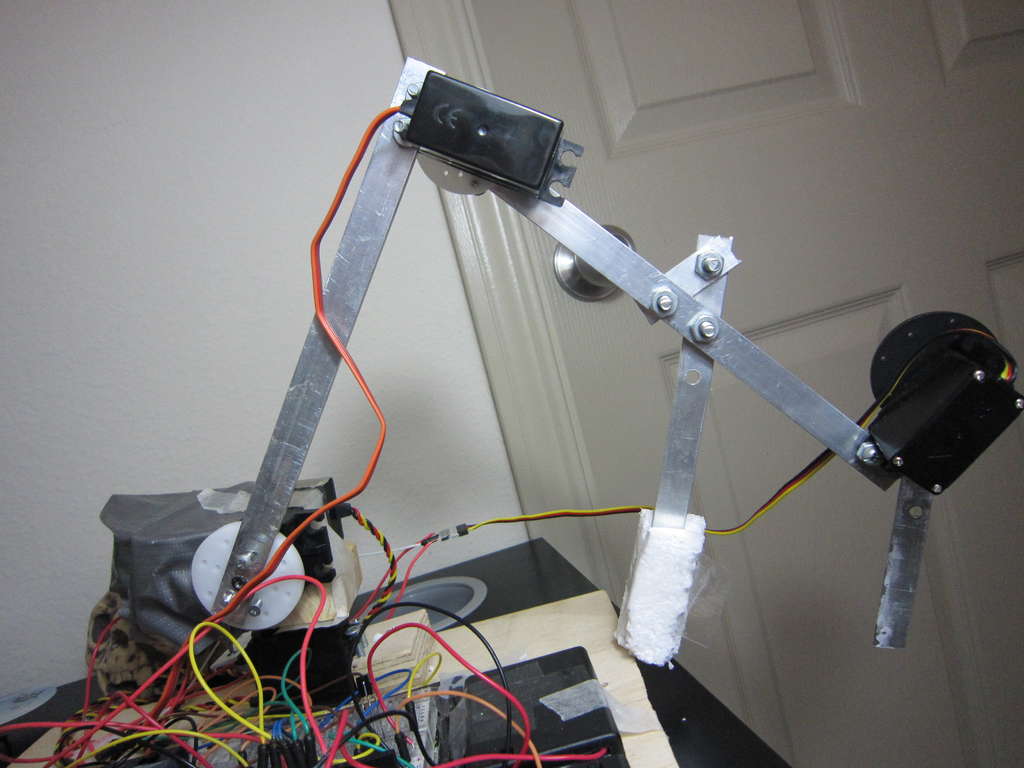
[V0R73X], who is 17  has been working on a project, to build A robotic arm. This project started out as a challenge put forward from one of his school teachers to build a robotic arm for $200.  [VoR73X] accepted, and the challenge began.

He came up with a robotic arm that can be controlled from his mobile phone and other bluetooth enabled devices. He also designed it so that he can control it from the infrared remote control of an old tv set. [VoR73X] decided to kept the design simple, to make it easy for others to build.  [VoR73X] has shared the code and a step by step process of how to build in the hopes that others would also like to take up the challenge.  Watch the video after the break for further details on his project.

via[Instructables]

Continue reading “Bits And Pieces Robotic Arm”

Wireless Stereo Add-on Turns On Receiver And Pipes In Some Music

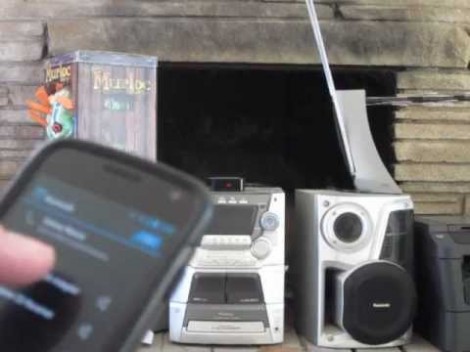
[PC486] wanted to add Bluetooth to a simple shelf stereo system. But if you’re going to go wireless, why not develop an all-in-one solution. His adapter turns on the stereo and feeds it audio all from a smart phone.

This is his roommate’s hardware so cracking it open and grabbing an iron wasn’t really an option. He needed a way to control the system without any permanent alterations. Since the unit has IR remote control capabilities that’s the most obvious way to go. But the original remote is long gone so he had to hit the Internet. Luckily the remote control codes are in the LIRC repository. He grabbed a small microcontroller, an ATtiny25, and wired up an IR led to send commands to the unit.

Next he examined the Bluetooth audio receiver board he planned to used in the project. It’s got an LED that lights up when connected to another Bluetooth device. The microcontroller knows when to turn the stereo on and when to shut it off again by monitoring that LED with a pin interrupt. Check out the final results in the clip after the break.

Continue reading “Wireless Stereo Add-on Turns On Receiver And Pipes In Some Music”

Bluetooth Control In A Power Strip

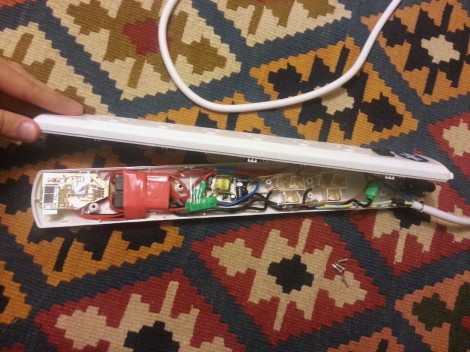
[Mansour] had a ceramic space heater mounted near the ceiling of his room. Since heat rises this is not the best design. He upgraded to an infrared heater which works a lot better, but lacks the timer function he used on the old unit. His solution wasn’t just to add a timer. He ended up building a Bluetooth module into a power strip in order to control the device wirelessly. He ends up losing all but two outlets on the strip, but everything fits inside the original case so we think it’s a reasonable trade-off.

He uses relays on both the live and neutral wires to switch the two outlets. These are driven via MOSFETs to protect the ATmega168 which controls the board. The microcontroller and Bluetooth module both need a regulated DC power source, so he included a transformer and regulator in the mix. After the break you can see him demonstrating the system using two lamps. There’s even a terminal interface which lets you select different control commands by sending the appropriate character. This interface makes script a breeze.

At least this power strip doesn’t spy on you.

Continue reading “Bluetooth Control In A Power Strip”

Another Android Controlled Roving Robot

[Sam] has been working on a cellphone controlled robot for a while now and with the launch of a few similar Kickstarter campaigns he thought it would be good to share his progress so far.

[Sam]’s robot is controlled by an Android device with the help of an IOIO dev board. This setup provides more than enough computational power to send a robot on its merry way, and has the bonus of allowing [Sam] to connect additional sensors.

The case is designed to put the headers on the IOIO board on the outside, just above a little shelf perfect for holding a breadboard or two. With the right hardware and software setup, [Sam]’s bot can rove around the neighborhood collecting data and sending it to a server in real time.

If you’re wondering why a tiny Android/IOIO powered sounds so familiar, it might be because of the Botiful robot we posted a few days ago. Unlike Botiful, [Sam] can only control his treaded Android bot through Bluetooth as the whole ‘programming a web interface’ is a bit over his head. Hopefully [Sam] will meet an enthusiastic coder when he brings his Arduino tank to Dorkbots Boston this evening.

You can check out a prototype of [Sam]’s bot in action after the break.

Continue reading “Another Android Controlled Roving Robot”

NXT Android Telepresence Robot

Here is a telepresence robot that uses an Android device and LEGO NXT parts. [Wolfgang] had an extra phone on hand and decided to put it to good use. The Mindstorm parts make it really easy to produce a small robot, and adding the phone really ups the computing and connectivity options available to him.

The Android device is able to control the NXT bot via Bluetooth. [Wolfgang] didn’t go into detail on that part, but you can get some pointers on the topic from this other Android controlled Mindstorm project. [Wolfgang] wanted the ability to check in at home when he’s travelling. He uses nanohttpd on the Android device to serve up a simple web interface. It uses HTML5 to push a snapshot from the phone’s camera as user feedback, and provides a set of directional arrows which let him drive the bot around.

Obviously this thing is going to run out of juice if he’s away for too long. To combat that problem he included a battery which powers both the NXT parts and the phone. Now he just needs to build an inductive charging station and he’ll really be set.

Continue reading “NXT Android Telepresence Robot”

A Wireless MAME Coffee Table Controller

MAME coffee table plan

Although we’ve featured quite a few MAME controllers here, we thought we’d feature one more. It’s only a well-drawn mechanical plan at this point, but if the results are anything like the model or detail drawing, we will be quite impressed.

One thing that is of particular interest is the planned parts list. Amongst them are the typical joysticks, buttons, and even a trackball. What may be new to some of our readers is the bluetooth arcade controller by [Wayne and Layne] opensource hardware kits. Although they aren’t cheap at just under $80, and requre an Arduino Mega for use, this is nonetheless an interesting control option. The maximum button presses may be another limiting factor at 6, but it should be a cleaner solution than cannibalizing one or more wireless controllers.

Of course, we’d be negligent if we didn’t at least give you a link to a completed MAME controller. Be sure to feast your eyes on these images if you’d like some finished controller eye candy or check out the pic after the break!

Continue reading “A Wireless MAME Coffee Table Controller”

Adding Bluetooth Audio Playback To A Toyota Matrix

In this project [Ryan] shows how he added Bluetooth audio to the stock stereo of his Toyota Matrix. The work he did with his add-on hardware is quite good. And the installation was surprisingly easy. For example, the dashboard bezel which is hanging in the foreground of this picture simply pulls off without the need for any tools. Also, the CD changer input for the stereo is what he uses to patch into the system. It just happened to have a 0.1″ pin header so finding a connector that would work wasn’t a problem.

As for the add-on hardware, he built his own circuit board around an ATmega168 microcontroller and Bluegiga WT32 Bluetooth module. To connect to the car’s data system he went with an RS485 driver chip. It’s not quite the right part but it works well enough for his purposes. So far he can get audio playback working and plans to add support for hands free phone calls and displaying audio track information. Hey, maybe he’ll even add some extra shake-based automation; who knows?

Get a look at the install in the clip after the break.

Continue reading “Adding Bluetooth Audio Playback To A Toyota Matrix”