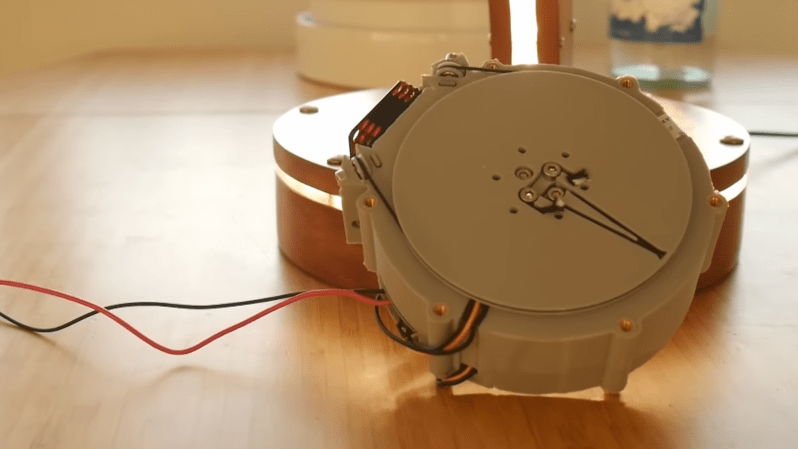
A round, 3D-printed motor housing is shown, with one flattened side holding a fan mount. A circular plate is mounted above the face of the housing, and a cord runs around it and pulleys on the side of the housing.

Tying Up Loose Ends On A Rope-based Robot Actuator

One of the perennial challenges of building robots is minimizing the size and weight of drive systems while preserving power. One established way to do this, at least on robots with joints, is to fit each joint with a quasi-direct-drive motor integrating a brushless motor and gearbox in one device. [The 5439 Workshop] wanted to take this approach with his own robot project, but since commercial drives were beyond his budget, he designed his own powerful, printable actuator.

The motor reducing mechanism was the biggest challenge: most quasi-direct drives use a planetary gearbox, but this would have been difficult to 3D-print without either serious backlash or limited torque. A cycloidal drive was an option, but previous printable cycloidal drives seemed to have low efficiency, and they didn’t want to work with a strain-wave gearing. Instead, he decided to use a rope drive (this seems to be another name for a kind of Capstan drive), which doesn’t require particularly strong materials or high precision. These normally use a rope wound around two side-by-side drums, which are difficult to integrate into a compact actuator, but he solved the issue by putting the drums in-line with the motor, with two pairs of pulleys guiding the rope between them in a “C” shaped path.

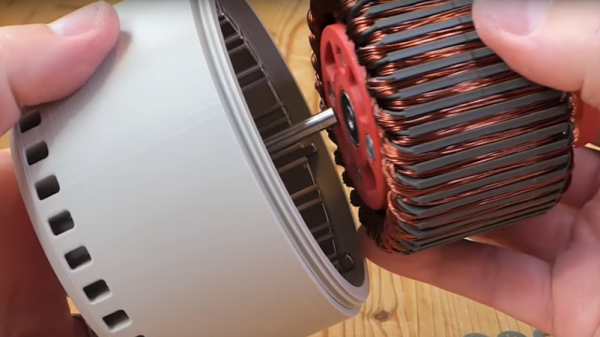
The actual motor is a hand-wound stator inside a 3D-printed rotor with magnets epoxied into it. The printed rotor proved problematic when the attraction between the rotor and magnets caused it to flex and scrape against the housing, and it eventually had to be reinforced with some thin metal sheets. After fixing this, it reached five Newton-meters of torque at one amp and nine Newton-meters at five amps. The diminishing returns seem to be because the 3D-printed pulley wheels broke under higher torque, which should be easy to fix in the future.

This looks like a promising design, but if you don’t need the output shaft inline with the motors, it’s probably easier to build a simple Capstan drive, the mathematics of which we’ve covered before. Both makers we’ve previously seen build Capstan drives used them to make robot dogs, which says something for their speed and responsiveness.
Powerful, Professional Brushless Motor From 3D-Printed Parts

Not satisfied with the specs of off-the-shelf brushless DC motors? Looking to up the difficulty level on your next quadcopter build? Or perhaps you just define “DIY” as rigorously as possible? If any of those are true, you might want to check out this hand-wound, 3D-printed brushless DC motor.

There might be another reason behind [Christoph Laimer]’s build — moar power! The BLDC he created looks more like a ceiling fan motor than something you’d see on a quad, and clocks in at a respectable 600 watts and 80% efficiency. The motor uses 3D-printed parts for the rotor, stator, and stator mount. The rotor is printed from PETG, while the stator uses magnetic PLA to increase the flux and handle the heat better. Neodymium magnets are slipped into slots in the rotor in a Halbach arrangement to increase the magnetic field inside the rotor. Balancing the weights and strengths of the magnets and winding the stator seem like tedious jobs, but [Cristoph] provides detailed instructions that should see you through these processes. The videos below shows an impressive test of the motor. Even limited to 8,000 rpm from its theoretical 15k max, it’s a bit scary.

Looking for a more educational that practical BLDC build? Try one cobbled from PVC pipes, or even this see-through scrap-bin BLDC.

Continue reading “Powerful, Professional Brushless Motor From 3D-Printed Parts”

Intense Brushless DC Stage Brings More E-Bike Power

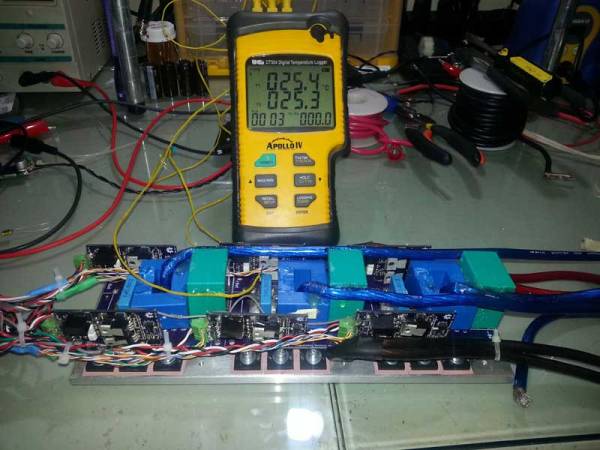
[ZombieSS] wrote in to share the latest iteration of his new open hardware Brushless DC motor high power output stage posted on the Endless-sphere forums. The thread is a gold mine of useful information on designing, building and debugging high power electronics and the whole thing is worth reading. This includes the story of issues he faced with common mode noise picked up by the probe leads on his Rigol, which sidetracked the project for a while.

ebikeWe’ve covered various ebike hacks before, but the guys at endless sphere appear to be developing a number of solid open hardware designs in this area. This includes the Lebowski controller which [ZombieSS] used in conjunction with his design.

He has installed the controller and output stage on his electric bike, and you can see one of the first test runs in the video below. We look forward to hearing more from the awesome hackers at Endless sphere!

Continue reading “Intense Brushless DC Stage Brings More E-Bike Power”

circuit board

Driving A Brushless DC Motor Sloooooooowly

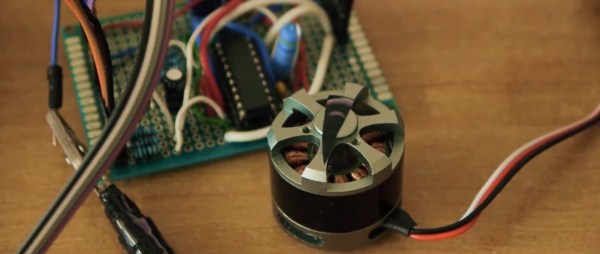
Driving a brushless DC (gimbal) motor can be a pain in the transistors. [Ignas] has written up a nice article not only explaining how to do just this with an Arduino, but also explaining a little bit on how the process works. He uses a L6234 Three Phase Motor Driver, but points out that there are other ways to interface the BLDC motor with the Arduino.

warningA warning is warranted – this is not for the faint of heart. You can easily destroy your microcontroller if you’re not careful. [Ignas] added several current limiting resistors and capacitors as advised in the application note (PDF warning) to keep things safe.
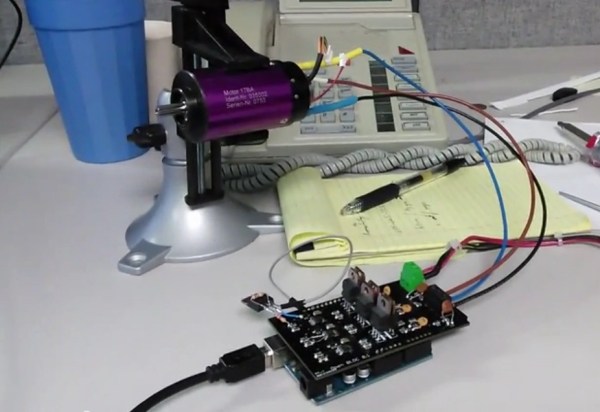
Everything worked well at high speeds, but for slower speeds the motor was choppy. [Ingus] solved this riddle by changing over to a sine wave to drive the motor. Instead of making the Arduino calculate the wave, he used a look up table.

Be sure to check out his blog for full source and schematics. There is also a video demonstrating just how slow he can make the motor move below.

Continue reading “Driving A Brushless DC Motor Sloooooooowly”

Open-source BLDC motor driver

Brushless Motor Controller Shield For Arduino

Brushless motors are ubiquitous in RC applications and robotics, but are usually driven with low-cost motor controllers that have to be controlled with RC-style PWM signals and don’t allow for much customization. While there are a couple of open-source brushless drivers already available, [neuromancer2701] created his own brushless motor controller on an Arduino shield.

[neuromancer2701]’s shield is a sensorless design, which means it uses the back-EMF of the motor for feedback rather than hall effect sensors mounted on the motor. It may seem strange to leave those sensors unused but this allows for less expensive sensorless motors to work with the system. It also uses discrete FETs instead of integrated driver ICs, similar to other designs we have covered. Although he is still working on the back-EMF sensing in his firmware, the shield successfully drives a motor in open-loop mode.

The motor controller is commanded over the Arduino’s serial interface, and will support a serial interface to ROS (Robot Operating System) in the future. This shield could be a good alternative to hobby RC controllers for robots that need a customizable open-source motor controller. The PCB design and source code are available on GitHub.

Continue reading “Brushless Motor Controller Shield For Arduino”

Brushless DC Motor Used For High Speed CNC Spindle

Brushless DC Motor CNC Spindle

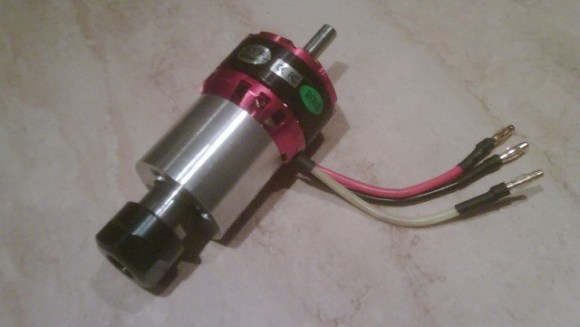
Brushless DC motors are common place in RC Vehicles. They are small, light, fast and can be inexpensive. [Raynerd] wanted a new spindle for his CNC machine and thought that a brushless DC motor would be a great platform to build from.

[Raynerd] started with an off the shelf motor that had an 8mm shaft. This shaft size was important because the motor shaft was to be replaced with an ER16 collet arbor of the same size. A collet is a device used to hold cutting tools by collapsing a segmented ring around the tool. Collets allows for quick tool changes while providing a strong clamping force. ER16 is a designation of one of many collet standards.

The main housing was machined out of aluminum specifically for this project. This housing holds two radial load ball bearings that support the new rotating collet arbor. There’s another bearing in this assembly, a thrust washer this time, that keeps the arbor from moving axially in the housing.

The 12 volt output of a standard ATX power supply was used to power the system for testing purposes. A general RC Vehicle electronic speed control and a servo tester work in conjunction to manually regulate the spindle speed. Check out the bench test video and an exploded photo after the break.

Continue reading “Brushless DC Motor Used For High Speed CNC Spindle”

E-volo VC200 Makes Maiden Flight. Flying Cars Incoming

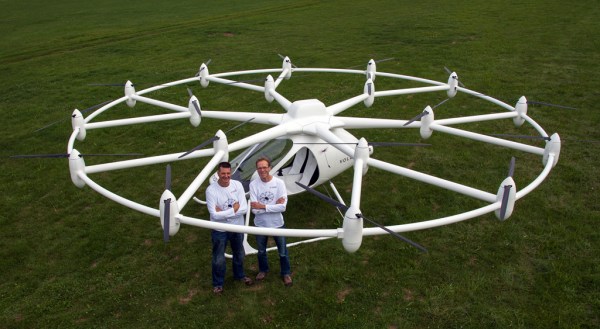
The e-volo VC200 has made it’s maiden unmanned flight. Does the craft above look a bit familiar? We first reported on the e-volo team back in 2011. Things have been going great for the team since then. They’ve created an 18 motor (Octadecacopter?) prototype dubbed the VC200. The group has taken a smart approach to building their craft. Rather than try to keep everything in-house, they’ve created a network by partnering with a number of companies who are experts in their fields. A sailplane company laid up the carbon fiber composite frame for the EC200. Junkers Profly, a German aviation company, developed a ballistic parachute system in case something goes wrong in flight.

From the outside, the VC200 looks like a grown up version of the Quadcopters we’ve seen here on Hackaday. Even the control system used for the test flight looks like a modified Radio Control Transmitter. The motors are outrunner brushless motors. Props are carbon fiber. We’re hoping the control system is a bit more evolved (and redundant) than the systems used in R/C quads though. Just like in smaller scale models, batteries are still the limiting factor. The VC200 will only fly for about 20 minutes on a charge. However, e-volo says that new technology should allow it to extend that time to around an hour. Not very much for a cross country flight, but plenty to pioneer a new type of aircraft. Where do we sign for the beta program?

Continue reading “E-volo VC200 Makes Maiden Flight. Flying Cars Incoming”