How To Build A Ping-pong Ball Display

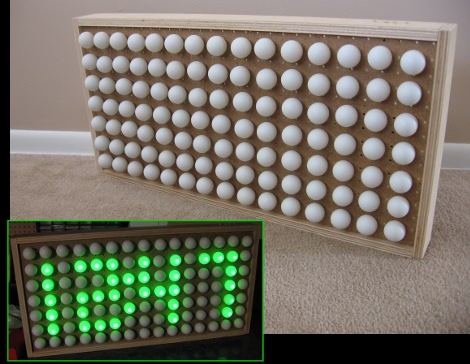
If you’ve been lusting after your own glowing display we’re here to help by sharing some simple building techniques that will result in an interesting project like the one you see above. This is a super-accurate clock That uses ping-pong balls as diffusers for LEDs, but with a little know-how you can turn this into a full marquee display. Join me after break where I’ll share the details of the project and give you everything you need to know to build your own.

Continue reading “How To Build A Ping-pong Ball Display”

The Lunchtime Clock Gives You 12 Extra Minutes

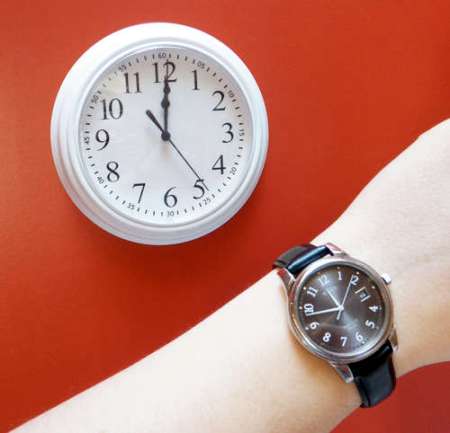
The Lunchtime clock is a hacked clock that pulls a sneaky little trick to get you a longer lunch. In this instructible, [Randofo] shows us how he uses an Atmega168 and a realtime clock kit from Adafruit to slow the clock down 20% starting at 11:00 and then speed it back up at 11:45, gaining you an extra 12 minutes of sweet delicious lunch. Not really sure how noticeable this would be? Check out the video after the break. This is pretty hilarious and we can actually think of a few offices where this might work. However, many offices rely on their main network server for actual time keeping leaving this as just an amusing novelty. Still, those with luddite bosses can rejoice in your new-found extended lunch.

[via Gizmodo]

Continue reading “The Lunchtime Clock Gives You 12 Extra Minutes”

Alarm And Wake Up Light

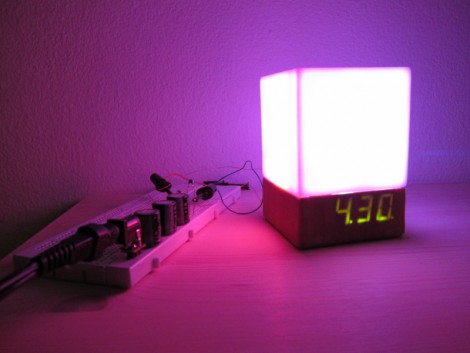
On the shortest day of the year wouldn’t it be nice to wake up to a bright room? This alarm clock with an integrated wake-up light is one way to do just that. It has some nice features, like a wood veneer that allows the seven-segment display to shine through, but hides it when the display is turned off. There’s also a feature to adjust the color based on ambient room temperature (another way to dwell on how cold it is in your bedroom).

A CC1101 RF chip came to the party, but we can’t figure out what it’s purpose is in this circuit. If you can shed some light on its involvement please do so in the comments.

[Thanks Eric]

Hackaday Links: November 28, 2010

The Clock Clock

This digital display is made from several analog clocks with thick hands. Together they make something of a 7-segment display, which can be used to display the time. It reminds us of the “Shared Time” installation we covered previously. [Thanks Drum365 via Anonimiss Files]

Quickly desolder lots of parts

[Rhys Goodwin] is grabbing parts from junk PCBs but he’s not using a rework station. Instead it’s a hot-air gun and a brisk tap on the bench to send the parts flying. Well, at least he’s not using a blow-torch like [Ben Heck] does.

Binary Hero

This bank of 8 toggle switches is the controller for Binary Hero, a geeky take on Guitar Hero. When you see a decimal number come down the screen set your toggle to the binary equivalent in time or the game will be over before you know it. [Thanks Fabien]

Quick fan POV

[GMG] took a small persistence of vision board and slapped onto an oscillating fan blade. Along with a couple of magnets on the safety cage this display is a persistence of vision hack you can pull off in an hour or two.

Speed up laser etching

[James] figured out a way to cut down on the time it takes to etch multiple copies of one item with a laser cutter. It doesn’t run the laser faster, but orients the pieces in a way that means less movement of the head while the laser is not on. Read through his article and see if this method can help you out when doing some CNC work.

Nixie Frequency Counter Gone Timepiece

nixie clock hack

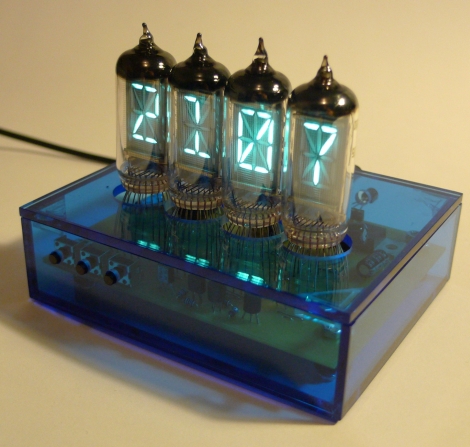
[Windell] of Evil Mad Scientist Laboratories took an ancient Nixie tube based frequency counter and converted it into a clock. The unit he got his hands on is an HP model that was still in great shape. He’s using an internally generated one second pulse as the clock signal, but some modifications are necessary to display time. That’s because the frequency counter is base 10 and clocks use a quirky combination of base 60 and base 12.

It wasn’t too much of a problem to rig up a system to track minutes and seconds. The tens digit for each is monitored by a couple of AND gates that he added to the mix. When they detect a ‘6’ the digit is reset and a pulse increments the next digit as the carry. This is more difficult to accomplish with the hours though. Minutes and seconds count from 0 to 59 but hours don’t start at 0. Instead of over-complicating the logic [Windell] used a bit of slight-of-hand. The Nixie tubes for the hours have been rewired so that when the counter is at 0, the filament in the shape of a 1 lights up. No difference in logic, just a translation that makes them display one digit higher than the actual count.

Master Clock System Uses All Logic, No Microcontrollers

What you see above is a master clock. It is the center of a system that can run an unlimited number of slave clocks, keeping them on-time thanks to its ability to synchronize with an atomic clock. [Brett Oliver] put together the project back in 2005 using digital logic chips, and no programmable microcontrollers. This includes everything from the binary decoders that drive the 7-segment displays, to the radio transceiver board that gathers the atomic clock data, to the various dividers that output 1 second, 2 second, 30 second, 1 minute, 1 hour, and 24 hour signal pulses. It’s  a well document and fascinating read if you’re interested in digital logic clocks.

Spinning POV Clock Done Oh-so-right

[Kizo] built an extraordinary persistence of vision clock. The design uses a PC cooling fan to spin the propeller-like PCB. As it goes around, a hall effect sensor synchronizes the illumination of the LEDs to draw the display. Power for the rotating electronics is transferred wirelessly via a transformer on the base and coil on the spinning board. The final version uses an ATmega324 microcontroller running at 20 MHz and has an IR receiver for changing the settings. The 3000 lines of code bring a lot of bells and whistles, including a menu system with a huge amount of settings from tweaking the clock display, to font selection for scrolling messages. Take a look at the demo after the break. The double-sided board looks like it’s pretty difficult to etch at home, but as you can see from the forum post (translated), [Kizo] did a great job on this build from start to finish. Continue reading “Spinning POV Clock Done Oh-so-right”