Talking Clock Sounds Just Like You

[vimeo=http://www.vimeo.com/10852914]

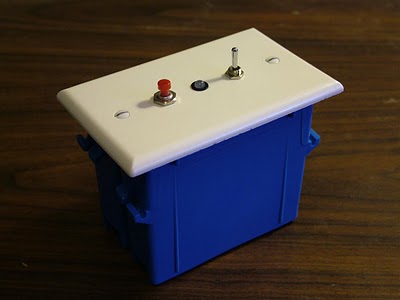
We’d bet a large portion of our readers don’t remember when you could call the phone company and get the time of day. Gadget Gangster is bringing back the tried and true method with this talking clock. Just press the button and the ‘operator’ will read the time of day to you. Record your own voice and place the WAV files on an SD card, from there a Propeller chip takes care of the rest.

As a side note, we’re big fans of the method used to breadboard the power supply using the TO-220 package leads as their own jumpers. We’ve always been partial to using a breadboard regulator on a PCB but this method is simple and takes almost no space at all.

DPAC Put Your Alarm Clock To Shame

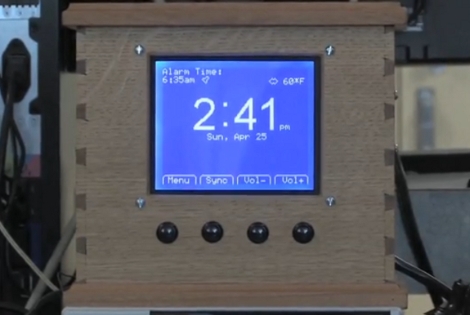
DPAC, the Dynamically Programmable Alarm Clock, goes far beyond what you would expect an alarm clock to do, yet we find all of its features useful. You can see there are four buttons at the bottom that control the menu scrolling. The second from the left currently reads “Sync”, a feature that the clock uses every 10 minutes but can be forced manually. This will check your Google Calendar, schedule an alarm for the next event while factoring in driving distance, traffic, and weather conditions. It’s got an audio system for radio and iPod operation, but also includes some home automation options. Using the X10 communication protocol it can turn on lights, start the coffee maker, and open the blinds as part of a gentle wake-up cycle. All of this is configurable through the clock itself, or via the web interface. The prototyping was done on an Arduino but the final version uses an AVR ATmega324 along with a Roving Networks RN-134 WiFi module (datasheet) for connectivity. Check out the demonstration video that [Eric Gaertner] and his fellow developers filmed after the break.

Continue reading “DPAC Put Your Alarm Clock To Shame”

Using A/C Frequency As A Clock Signal

A while back we saw a logic clock that used the alternating current frequency from the power grid to keep time. We asked for information on your projects that use this method and we got a lot of comments and tips. Today we’re sharing [Doug Jackson’s] method which he used in his word clock.

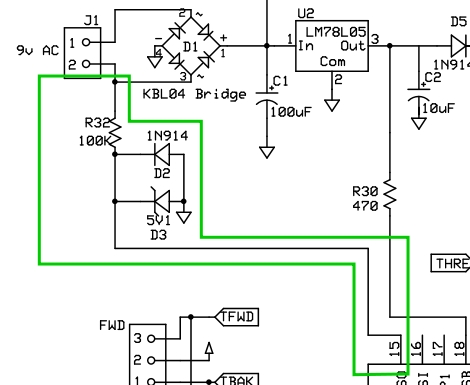
The schematic above is from that project and we’ve outlined the important part in green. [Doug] pulls a signal from the 9V AC power before it hits the bridge rectifier, using a 100K resistor and a zener diode to protect the microcontroller pin. The code for that project comes as a hex file but he sent us the C code pertaining to this timing circuit. It’s written for PIC but you’ll have no trouble adapting it to other microcontroller families. Take a look after the break.

Continue reading “Using A/C Frequency As A Clock Signal”

IEE Clock

The IEE clock looks somewhat un remarkable at first glance. Upon closer inspection though, you’ll find out that there are 12 light bulbs crammed in there for each digit. The bulbs sit behind a curved lens with the numerals on it. When the appropriate one is lit, it projects the number on the front of the clock. While it isn’t new, it is certainly new to us. It is also interesting that you set the time by rotating the little dial on the top right. While it may be easier to set the time that way, it seems that it would be prone to getting nudged on accident.

[via the Hackaday Flickr pool]

Logic Clock Without An On-board Oscillator

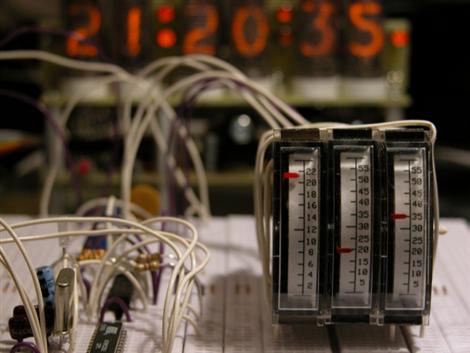
[Lucassiglo21] developed this logic clock without using a crystal oscillator or a resonator. Instead, he’s letting the incoming electricity keep the time for him. The supply is AC at 50 Hz so he’s using some 4017 decade dividers to reduce that down to a 1 Hz signal. From there it keeps track of the ticks just like the last digital logic clock we saw.

If you’ve used AC line frequency as the clock source in your project we’d like to hear about it. Send us a tip and make sure your writeup includes a schematic. We’re especially interested to see if anyone has a good way of using this method with inexpensive microcontrollers.

Clock Sans-microcontroller

This clock requires no microcontroller. It’s actually a digital logic counter that functions as a timepiece. [BlackCow] used six decade counters to track seconds, minutes, and hours. The output is displayed on four 7-segment digits using BCD-7-segment decoders that you can learn about in our binary encoded decimal post. The actual timekeeping is done by a quartz clock circuit he pulled from a Mickey Mouse clock. This would be a perfect circuit to build in a digital logic simulator, just follow the schematic and learn as you go.

POV Clock Inside Acrylic Block

This gorgeous persistence of vision clock was built a couple years back by [mb1988]. The housing is made of acrylic with a hard drive motor mounted in the center of the back panel to spin a PCB. The two-sided circuit board is home-made and includes a battery for power, ATmega32 for the brain, 32 LEDs, four display drivers, and a real time clock module. The spinning hard drive motor is nearly silent and already has threaded mounting holes on it. [mb1988] uses an optoelectric sensor to sync the display with the rate of rotation. The forum post includes download for the code and hardware details. Don’t miss the demonstration after the break.

Continue reading “POV Clock Inside Acrylic Block”