Machined Steadicam, Steadier Than The Rest

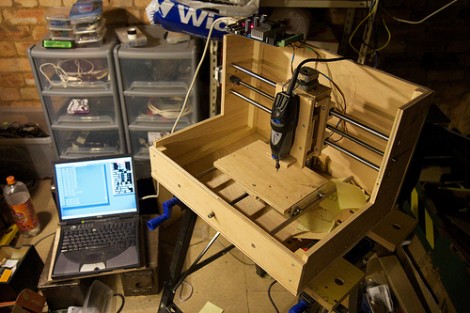
No, the picture above is not a store made steadicam. Rather, a CNC machined one by [Matt]. Interestingly, unlike most steadicams we’ve seen before the gimbal is not the main focus of the design though an aluminum machined gimbal would make us drool. The central idea is allowing for X and Y axis adjustment to get oddly weighted bulky camera’s exact center of gravity. [Matt’s] steadicam is also designed to handle more weight than commercial versions, and (if you already have a CNC) to be much cheaper. There’s no video, but from the skill of craftsmanship we can safely assume it’s as good and level as some of the best.

Constructing A CO2 Laser Cutter

angler

[Owen] contacted us to show us his site dedicated to his CO2 laser cutter build. He spent about 2 years and roughly $15,000 putting it together, so this is not small build. The laser and optics alone were $9,000. This site isn’t necessarily meant to be a template to build your own, but he shares so much information that we would certainly suggest you read it before digging into a build. He does have some downloadables, like the tool paths and the emc2 configuration files as well as a copy of the entire website. Great job [Owen].

Building A Laser Cutter From A Weak Laser

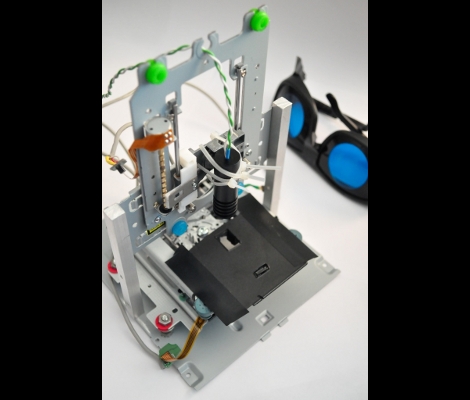
We covet laser cutters and this diy model with a 1 Watt IR diode may be well within our price range. Most commercially available laser cutters, and some homemade ones, work in the 20-100 Watt ranges, using a CO2 laser. They have more than enough power to cut right through a lot of materials so how can a 1W diode compare? It seems that the weaker laser is still quite powerful right at its focal length, so moving that point along the Z axis will let you burn away a larger depth of material. The test rig seen above uses optical drive components for the three axes and managed to cut a rectangular piece out of the black plastic from a CD case.

This isn’t [Peter’s] first try with CNC lasers. He’s the one that’s be working on an open source selective laser sintering platform.

[Thanks Osgeld and Vesanies]

CNC Hardware: Stream G-code To An Arduino

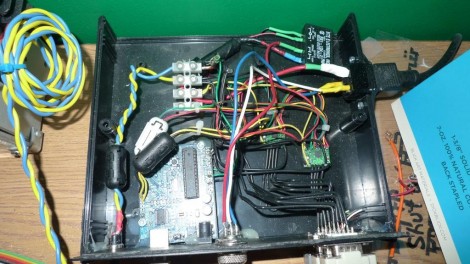
[Reza Naima] has been using an Arduino as the center of his CNC setup for quite some time now. It handles three stepper motors, limiting switches, e-stop, and spindle control. The sketch he’s using allows him to stream g-code to the popular prototyping platform, freeing him from needing a dedicated PC. It’s worked so well that he’s decided to clean up the code and develop a shield to help others get up and running. If you want to see his progress or lend a hand, check out the google group he started for the schematics, code, and forum discussions. There is already a CNC project for Arduino called Grbl but [Reza’s] approach uses the Arduino libraries in an effort to make the sketch more customizable for the average user.

Rapid Furniture Prototyping

SketchChair is a piece of software that takes the engineer out of engineering furniture. In a child’s-dream-come-true you draw the outlines you’d like to have, add some legs, and the software pops out a design ready to be laser-cut. The finishing touch of adding palm fiber and felt produces what we imagine is a moderately comfortable place to sit. Now the hard part will be convincing your spouse that you should spend the money building an industrial grade laser cutter because of all the money you’ll save on furniture.

We’re still holding out for furniture that is 3d-printed from rock to match our Flintstone’s motif.

Oh, and as always, video after the break.

Continue reading “Rapid Furniture Prototyping”

3D Printed MakerBot

[Webca] has made a 3D printed MakerBot with his MakerBot. Using five pounds of plastic, the design replaces all of the plywood used to create a regular MakerBot. This complements the existing designs for the 3D printed extruders, dinos, and other parts already on Thingiverse. An interesting mile marker in the history of 3D printing. We might make one after we make a Mendel and tons of Hack a Day Badges. We also look forward to improvements people will contribute to the design such as using less plastic or a parameterized design to make a really big (or small) MakerBot.

CNC Plotter From Old Parts

[vimeo=http://vimeo.com/10479779]

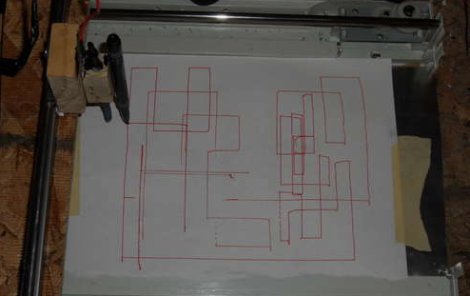
Get a quick fix of CNC for the day with this plotter. [Francisco Dulanto] grabbed the cartridge carriage from an old inkjet printer and turned it into a gantry by mounting it on two drawer sliders. The optical head assembly from a cd-rom provides the Z-axis movement with the whole thing controlled by three RepRap boards. [Francisco] called his project a joke compared to the Turing Machine, but we like it and we’re glad he tipped us off. There’s something zen-like about the projects that are thrown together with what you have available. After all, he’s certainly achieve a clean-looking build that does what it’s intended to do.