Giving An Old Atari Computer A Much Needed Upgrade

As a kid, [Boisy] cut his teeth on the TRS-80 Color Computer. It was a wonderful machine for its day, featuring a relatively powerful Motorola 6809 CPU. Although his CoCo was theoretically more powerful than its Commodore and Apple contemporaries, the graphics and sound capabilities of [Boisy]’s first love paled in comparison to his friends 6502-based machines. A little jealously and thirty years go a long way, because now [Boisy] is adding a 6809 microprocessor to the 6502-based machines Atari put out.

[Boisy]’s goal for his Liber809 project was simple: Put a 6809 CPU in an Atari XEGS and get NitrOS-9, the Unix-like OS for the TRS-80 CoCo running on his Frankenputer. After a few months of work, [Boisy] completed his goal and more so: the Liber809 also works on the Atari 1200XL.

To put [Boisy]’s work in perspective, it’s like he took a Macintosh from 1993 and made it run on an Intel 486. While that’s not a terribly accurate analogy, we hope our readers will understand the fortitude needed to make a computer run on a completely different processor.

After the break, you can check out a neat demo app written by [SLOR] from the AtariAge forums showcasing a 6809 running in a machine designed for a 6502. Awesome work for all involved

Continue reading “Giving An Old Atari Computer A Much Needed Upgrade”
Recreating The Commodore PET With An FPGA

commodore_pet_fpga_clone

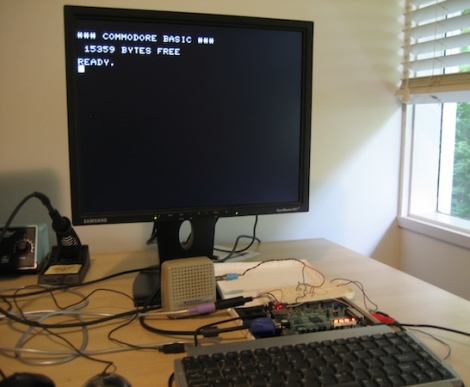
[Thomas’] love affair with Commodore computers spans well over 30 years, and not too long ago he decided to recreate one of his favorite Commodore offerings, the PET. As we have seen with similar undertakings, this sort of project is no easy task, but [Thomas] seems to be making his way along nicely.

Using a Xilinx Spartan-6 FPGA on the Digilent Nexys3 dev board, he has implemented the Pet in Verilog. Like the original, his clone contains 16K of both ROM and RAM, utilizing the same simulated 6502 microprocessor he used on a previous Apple ][+ project. The FPGA version of the computer sports a 640×400 resolution which is twice that of the original, so [Thomas] simply doubled the size of each of the PET’s pixels to fill in the extra space.

[Thomas] has made some great progress so far, including the ability to load games and other programs from cassette images over a serial connection. He says that there are still a few loose ends to tie up, but it all looks good from here!

Continue reading to see a short video of Space Invaders running on he PET recreation.

Continue reading “Recreating The Commodore PET With An FPGA”

Commodore 64 USB Controller Adapter For Your PC

commodore_64_controller_usb_interface

[Frank], like many people, has a soft spot in his heart for the Commodore 64. He prefers to play his C64 games on his computer nowadays, but likes using his old school Competition Pro rather than some modern controller with remapped buttons. The only problem with using the controller is that his new computer doesn’t have any ports that accommodate its 9-pin D-sub connector.

The VICE emulator maps keyboard inputs to controller actions, so he decided to build himself a D-sub to USB adapter that implements a virtual USB keyboard. He wrote a firmware package for the Freescale MC9S08JS16L microcontroller that allows him to send keypresses to his emulator whenever he performs an action with his Competition Pro joystick.

The circuit looks easier to duplicate than some other C64 interfaces we have seen before, and as you can see in the video below, it works quite well. We imagine that this setup can be used to connect all sorts of old input devices to modern PCs with little to no tweaking.

Continue reading “Commodore 64 USB Controller Adapter For Your PC”

Modded C64 Eye Candy

“Everyone needs a hobby,” they tell us. For the blogger mysteriously identified only as “R,” that hobby would be an almost fanatical nostalgia for the Commodore 64 computer.

At first we thought this was a fan community site, but apparently it’s all the work of a single person. [R] has tweaked, extended, repackaged and resurfaced this 1980’s icon in nearly every imaginable way. They tend to gloss over the technical aspects of these mods, but that’s okay – the C64 is such an exhaustively documented system now that the site dwells mainly on the aesthetics and meaning of these reborn devices.

The 64 has made an indelible impression on electronic music, and the machines are still sought after by collectors, composers and circuit-benders. [R] pays homage by housing these vintage systems in styles reminiscent of even vintage-er synthesizers. Any one of these would warrant a post here, yet there’s a whole collection to browse. Check it out!

[via Retro Thing]

C64 Interface For Your Computer

Before we get started, lets just point out that this C64 was broken. He did not take a functional C64 out of operation for this. What he did do, was to build a hardware interface for for his VICE system. For those unfamiliar, VICE is a cross platform C64 emulator. [Simon] points out that the old games just weren’t as much fun without the original hardware. Having a broken C64 lying around, he put it to good use. It now acts as the interface for all the original fun stuff.

If you are a fan of the hardware, but just want to interface it as a normal USB keyboard, that is possible as well.

Commodore SQ1000 Twitter Wall: The Twypper

[youtube=http://www.youtube.com/watch?v=CV9_25N21eM]

Before we begin, let us soothe those first dreaded thoughts. No, the commodore was not destroyed in the process. They can simply clip the 16 wires they added to interface the keyboard and be back to stock. Breathe a sigh of relief, and enjoy the twypper, a twitter wall made from a commodore SQ1000.

[Alex] needed to make an interesting project for his companies Openspace/hack day.  A friend, suggested a twitter wall, and that’s when [Alex] got the idea for a typewriter. After a quick search, he found oomlaut’s typewriter.  They didn’t let that deter them from making their own version though. They found a nice fully functional commodore SQ1000 and began hacking. Ultimately they simply decided to use an Arduino to short the key switches to simulate typing. There are all kinds of details on the necessary steps to get the typing to function absolutely correct on the project page. Over all it was well done and we’re happy to see that it can be undone just as easily.

[M]ouse: A PS/2 To C64 Adapter

4100951630_8cb9dc6164 (Custom)

[svofski] has a friend who is a pixel artist. They really wanted to try out their skills on a c64, but were missing a mouse. The original mouse for the c64 was not only serial, but used a different method of communication than more modern mice. [svofski] built this adapter to translate the ps/2 data to something the c64 can use. The writeup describes the build in detail and even has the PCB and source code available for download.


[via flickr]