Global Status Board Keeps Eye On COVID-19 Situation

When it comes to keeping abreast of the COVID-19 pandemic, there are basically two schools of thought. Some people would rather not hear the number of confirmed cases or deaths, and just want to focus on those who recovered. That’s fair enough. But others want to have all of the available data at their disposal so they can form their own conclusions about what’s happening with this virus on a global scale. Looking at this incredible COVID-19 status board, we’ll give you one guess which category [Reuben] falls into.
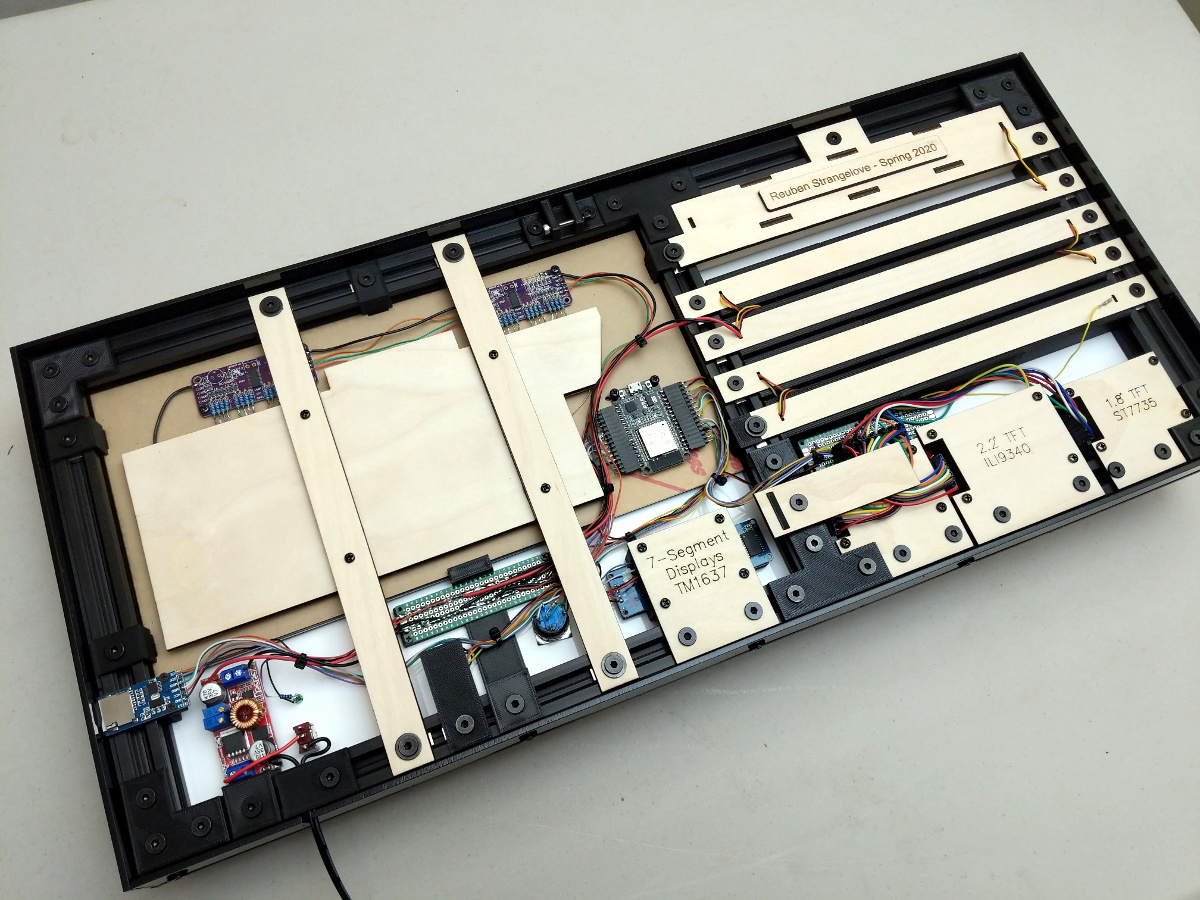
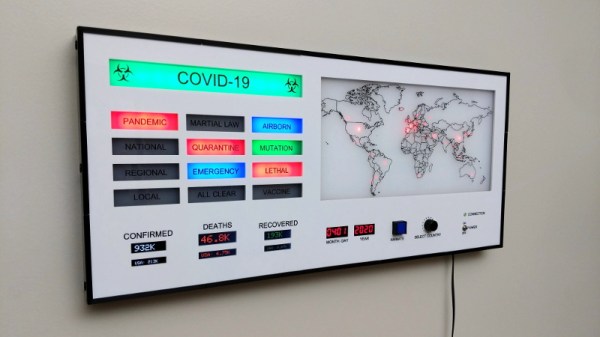
Note the laser engraved component labels

Constructed out of 2020 extrusion with both 3D printed and laser cut parts, this wall-mounted display is built to last. Clearly [Reuben] believes we’re in this one for the long haul, and taking a peek at the plethora of data points this device can show at once, it’s not hard to see why.

Stats are pulled down every hour from a JSON API by an ESP32 and stored on an SD card. A running total of confirmed cases, deaths, and recoveries are shown on several TFT displays located behind the face of the display. On the right, the relative severity of the infection in 32 different countries is visualized with LEDs of varying brightness.

Perhaps the most visually striking element of the display is the large annunciator panel on the left side, which lights up to show various conditions all over the world. We appreciate that [Reuben] has thought ahead and added a light that can be used once a vaccine is deployed for COVID-19, but the inclusion of a “MARTIAL LAW” indicator certainly doesn’t help us shake the feeling we’ve all found ourselves in a proper dystopia.

For those who’d would rather get their information from the source rather than have it filtered through the media, we’ve recently covered a few APIs that will allow you to pull your own up-to-date COVID-19 stats. Whether you’re looking to build something as elaborate as this display, or just want to echo it out to the terminal, making sure you’re seeing accurate data is key to identifying the turning point.

Continue reading “Global Status Board Keeps Eye On COVID-19 Situation”

Hackaday Links Column Banner

Hackaday Links: April 5, 2020

Git is powerful, but with great power comes the ability to really bork things up. When you find yourself looking at an inscrutable error message after an ill-advised late-night commit, it can be a maximum pucker-factor moment, and keeping a clear enough head to fix the problem can be challenging. A little proactive social engineering may be in order, which is why Jonathan Bisson wrote git-undo, a simple shell script that displays the most common un-borking commands he’s likely to need. There are other ways to prompt yourself through Git emergencies, like Oh Shit, Git (or for the scatologically sensitive, Dangit Git), but git-undo has the advantage of working without an Internet connection.

Suddenly find yourself with a bunch of time on your hands and nothing to challenge your skills? Why not try to write a program in a single Tweet? The brainchild of Dominic Pajak, the BBC Micro Bot Twitter account accepts tweets and attempts to run them as BASIC programs on a BBC Microcomputer emulator, replying with the results of the program. It would seem that 280 characters would make it difficult to do anything interesting, but check out some of the results. Most are graphic displays, some animated, and with an unsurprising number of nods to 1980s pop culture. Some are truly impressive, though, like Conway’s Game of Life written by none other than Eben Upton.

The COVID-19 pandemic is causing all sorts of cultural shifts, but we didn’t expect to see much change in the culture of a community that’s been notoriously resistant to change for over a century: amateur radio. One of the most basic facts of life in the amateur radio world is that you need a license to participate, with governments regulating the process. But as a response to the pandemic, Spain has temporarily lifted licensing requirements for amateur radio operators. Normally, an unlicensed person is only allowed to operate on amateur bands under the direct supervision of a licensed amateur. The rules change allows unlicensed operators to use a station without supervision and is intended to give schoolchildren trapped at home an educational experience. In another change, some countries are allowing special callsign suffixes, like “STAYHOME,” to raise awareness during the pandemic. And the boom in interest in amateur radio since the pandemic started is remarkable; unfortunately, finding a way to take your test in a socially distant world is quite a trick. Our friend Josh Nass (KI6NAZ) has some thoughts about testing under these conditions that you might find interesting.

And finally, life goes on during all this societal disruption, and every new life deserves to be celebrated. And when Lauren Devinck made her appearance last month, her proud parents decided to send out unique birth announcement cards with a printed circuit board feature. The board is decorative, not functional, but adds a distinctive look to the card. The process of getting the boards printed was non-trivial; it turns out that free-form script won’t pass most design rule tests, and that panelizing them required making some compromises. We think the finished product is classy, but can’t help but think that a functional board would have really made a statement. Regardless, we welcome Lauren and congratulate her proud parents.

Making An Arduino Ventilator? Read This First

Thanks to the virus crisis, lots of people are designing makeshift ventilator designs in the hopes of saving people’s lives. Many of these are based around some sort of Arduino-powered CPU. [Armstrong Subero] things that’s a great idea, but cautions that making an electronic pair of dice is a different proposition than creating a machine to breathe for someone. But he isn’t just complaining. He talks about considerations when building a real-time and safety-critical system.

[Armstrong] has a lot of good points, although we aren’t sure you need the complexity of a real-time operating system just to squeeze a bag. If anything, that seems like it might make it more susceptible to unexpected operation. However, we agree with his comments that you should have closed-loop control to make sure the device is working, alarming when the device isn’t working, and watchdog timers to guard against lockup.

Continue reading “Making An Arduino Ventilator? Read This First”

A Touchless Handwashing Timer Comes In Handy

In 2020, it’s no longer enough to simply wash your hands. You’ve got to do it right. Proper process involves rubbing soap and water over every surface of your hands, and taking a full 20 seconds to do the job. While many recommend singing various popular songs to keep time, that can be more than a little embarassing in shared spaces. [Alex Glow] instead created this simple timer to help out.

The timer is built on the Adafruit Circuit Playground Express, a devboard that features 10 RGB LEDs already onboard, making the project a cinch. It also comes with a MEMS microphone and a light sensor all ready to go. Thus, with a bit of code, [Alex] was able to create a timer activated by a loud noise, such as clapping. Once detected, the timer starts, flashing its LEDs to indicate time remaining. There’s also a nightlight feature, which activates when light levels decrease, making it easier to navigate the bathroom in the dark.

It’s a useful little project for these troubled times, and one that makes great use of everything onboard the Circuit Playground Express. Having everything included certainly does make projects come together quickly. You can even program it from your phone! Video after the break.

Continue reading “A Touchless Handwashing Timer Comes In Handy”

Cellular Tracking Used During COVID-19 Pandemic

As most in the technology community know, nation states have a suite of powerful tools that can be used to trace and monitor mobile phones. By and large, this comes up in discussions of privacy and legislation now and then, before fading out of the public eye once more. In the face of a global pandemic, however, governments are now using these tools in the way many have long feared – for social control. Here’s what’s happening on the ground.

The Current Situation

With COVID-19 sweeping the globe, its high level of contagiousness and rate of hospitalizations has left authorities scrambling to contain the spread. Unprecedented lockdowns have been put in place in an attempt to flatten the curve of new cases to give medical systems the capacity to respond. A key part of this effort is making sure that confirmed cases respect quarantine rules, and isolate themselves to avoid spreading the disease. Rules have also been put in place in several countries where all overseas arrivals must quarantine, regardless of symptoms or status. Continue reading “Cellular Tracking Used During COVID-19 Pandemic”

FDA Says PPE Can Be Reused After Trip Through Shipping Container Decontamination System

We are hearing so much in the news about shortages of personal protective equipment, or PPE, for healthcare workers. Factories are being asked to perform the impossible when it comes to production be the need is so real, so immediate, and so widespread.

The problem with rapid consumption of PPE is that once it has been exposed to infection, it’s contaminated and can’t be used again. Physically it may be fine, but it retains the capability to infect other people. If there were some way it could be effectively cleaned and decontaminated for re-use, it would reduce the strain on the supply chain and result in a greater availability of PPE for all those who require it.

This is the promise of Battelle’s Critical Care Decontamination System, a shipping-container-sized unit which has received approval from the FDA at break-neck speed.

Continue reading “FDA Says PPE Can Be Reused After Trip Through Shipping Container Decontamination System”

Accurate Dispensing Of Toilet Paper Will Get Us Through The Crisis

As we enter our second week of official COVID-19-related lockdown where this is being written, it’s evident that there are some resources we will have to conserve to help get us through all this. Instead of just using all of something because we can nip out to the store and buy more, we have to look at what we’ve got and treat it as though it will have to get us through the next three months. It’s not always certain that on our infrequent trips to the supermarket they’ll have stocks of what we want.

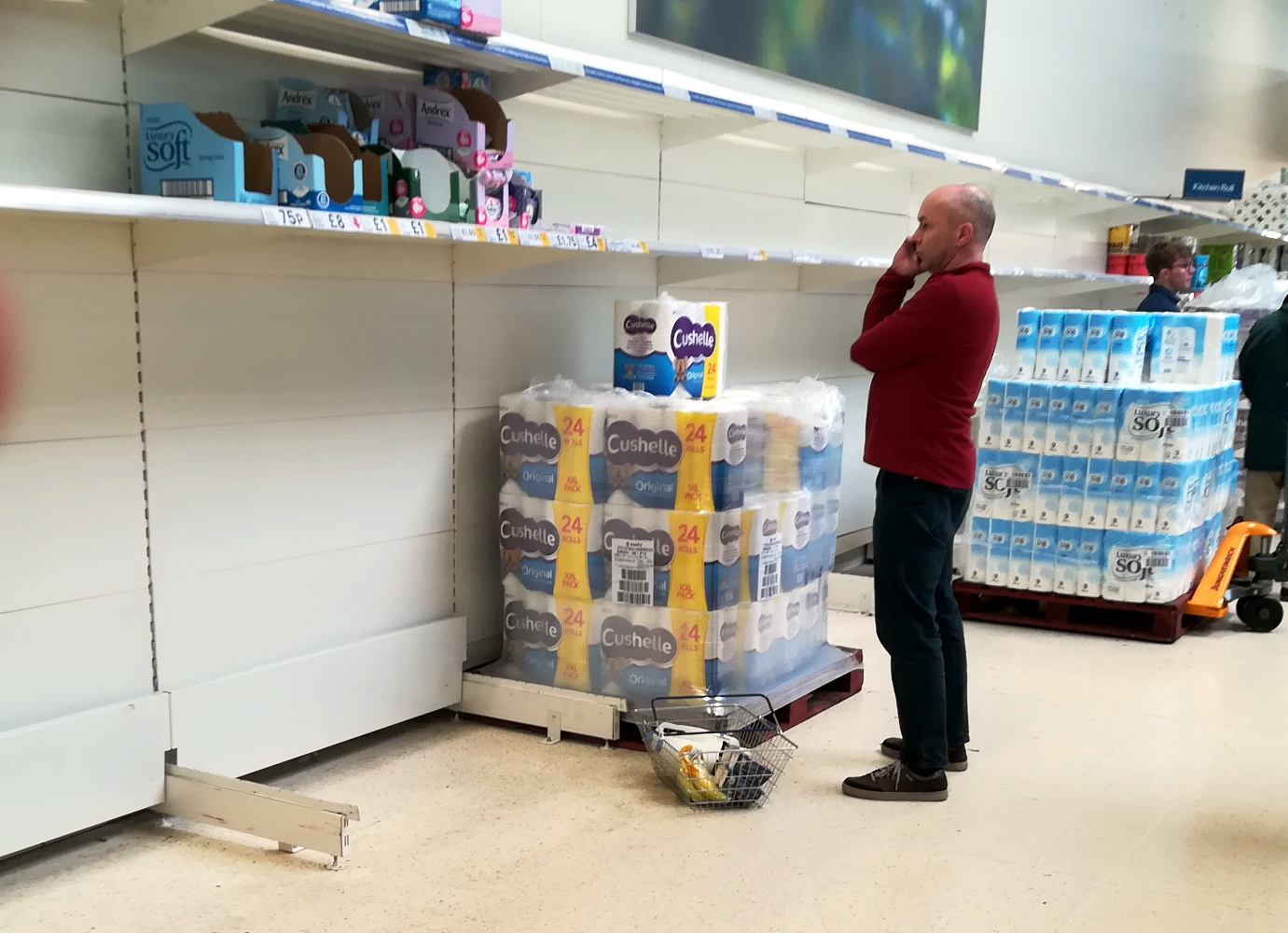
This is the very last of the toilet paper in my local supermarket, on the 8th of March.

A particular shortage has been of toilet paper. The news was full of footage showing people fighting for the last twelve-pack, and since early last month there has been none to be had for love nor money. To conserve stocks and save us from the desperate measures of having to cut the Daily Mail into squares and hang them on the wall, a technical solution is required. To this end I’ve created a computerised toilet roll dispenser which carefully controls the quantity of the precious sanitary product, in the hope of curbing its consumption to see us through the crisis.

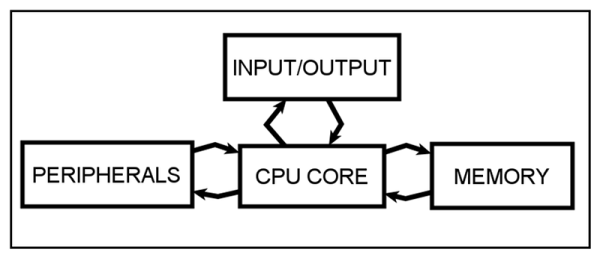
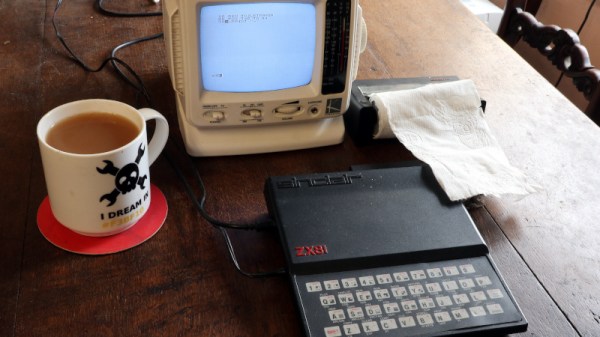
In the midst of a full lockdown it’s difficult to secure immediate delivery of our usual maker essentials, so rather than send off for the controller boards I might have liked it has been necessary to make do with what I had. In the end I selected an older single board computer I had in a box under my bench. The Sinclair ZX81 has a single-core Z80 processor running at 3.25 MHz, dual-channel memory, a Ferranti GPU, and plenty of expansion possibilities from its black plastic case. I chose it because I could repurpose its thermal printer peripheral as a toilet paper printer, and because it has an easily wiped and hygienic membrane keyboard rather than a conventional one that could harbour germs.

Hardware wise I found I was fairly easily able to adapt a standard roll of Cushelle to the ZX printer, and was soon dispensing sheets with the following BASIC code.

10 REM TOILET PAPER PRINTER
20 FOR T=0 TO 44
30 LPRINT ""
40 NEXT T
50 LPRINT "---------- TEAR HERE -----------"

For now it’s working on the bench, but it will soon be mounted with a small portable TV as a monitor on the wall next to the toilet. Dispensing toilet paper will be as simple as typing RUN and hitting the ZX’s NEW LINE key, before watching as a sheet of toilet paper emerges magically from the printer. It’s the little hacks like this one that will be so useful in getting us through the crisis. After all, this Sinclair always has a square to spare.