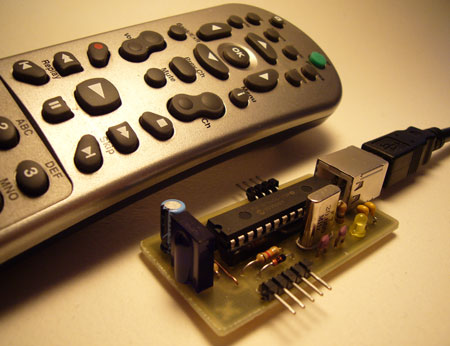
Now that we listen to MP3s, and watch XVIDs or x264s, a computer is the entertainment center in at least one room of most homes. Unless you have a special HTPC, though, you’re probably stuck using the keyboard to pause, change the volume, and fast-forward through annoying Mythbusters recaps. PC remote control receivers range from ancient serial port designs (who has one?) to USB devices not supported by popular software. In this how-to we design a USB infrared receiver that imitates a common protocol supported by software for Windows, Linux, and Mac. We’ve got a full guide to the protocol plus schematics and a parts list.
electronics177 Articles
Parts: 3.5mm Stereo Audio Jacks

3.5mm stereo connectors for headphones and microphones are almost mandatory for audio projects. X1 (left) is a simple plug with connections for the audio channels (pin 2,3), and ground (pin 1). X2 (right) has pass-through contacts (pin 2,3) that divert audio to an internal speaker when headphones aren’t connected.
Here’s a breakdown of the audio connectors illustrated above. Continue reading “Parts: 3.5mm Stereo Audio Jacks”
Parts: MicroSD Memory Card Holders

SD cards add cheap persistent memory to your project, but the holder takes a lot of board space. A smaller option is the microSD flash format. MicroSD cards are compatible with regular SD cards, and most come with a free adapter. We looked at four holders for our mini web server. Which should you choose? Read about our experience below. Continue reading “Parts: MicroSD Memory Card Holders”
How-to: Networked Graffiti Wall
[youtube=http://www.youtube.com/watch?v=G8KprTVbHD4]
Wondering what we did with our web server on a business card project from last week? It’s powering a giant LED graffiti wall. Animations can be user-submitted using the online designer. You can watch a live feed of user animations as well. The online interface runs on the Google App Engine for maximum scalability and resilience.
In today’s How-to we cover all the ins and outs of building your own networked graffiti wall. Continue reading “How-to: Networked Graffiti Wall”
Parts: 0.1uF Decoupling Capacitors

Most ICs need to be decoupled from their power supply, usually with a 0.1uF capacitor between each power pin and ground. Decoupling is usually used to remove noise and to smooth power fluctuations. Every project will need a few decoupling capacitors; our mini web server project has three ICs that require a total of 11. This can be an expensive part to buy in singles, so it’s crucial to stock up online. Read more about our favorite bulk through-hole and surface mount decoupling capacitors after the break. Continue reading “Parts: 0.1uF Decoupling Capacitors”
Arduino Solenoid Concert
[youtube=http://www.youtube.com/watch?v=g_hiz-Kx0kM]
[jay] reminded us of this old video of solenoids banging rhythms on furniture and household objects. There’s no schematic, but in the video it looks like an Arduino drives a bunch of solenoids through relays. The PC interface is run on Pure Data, an open source programming environment for audio, video, and graphic processing. Thanks [Jay].
How-To: Web Server On A Business Card (Part 1)

For years, Microchip PIC microcontrollers dominated; PIC16F84 hacks and projects are everywhere. The 8-bit 16F and 18F lines are supported by several coding environments and easy-to-build serial port programmers. Microchip’s 16-bit PIC24F is cheaper, faster, and easier to work with, but largely absent from hacks and projects.
We recently used a Microchip PIC24F microcontroller in a mini web server project, but didn’t find many introductory references to link to. In this article we’ll cover some PIC 24F basics: support circuitry and programming options. We’ll also talk about our favorite features, and how we figured them out. Our next article will outline a web server on a business card based on the PIC 24F.
Continue reading “How-To: Web Server On A Business Card (Part 1)”