Arduino Solenoid Concert

[youtube=http://www.youtube.com/watch?v=g_hiz-Kx0kM]

[jay] reminded us of this old video of solenoids banging rhythms on furniture and household objects. There’s no schematic, but in the video it looks like an Arduino drives a bunch of solenoids through relays. The PC interface is run on Pure Data, an open source programming environment for audio, video, and graphic processing. Thanks [Jay].
How-To: Web Server On A Business Card (Part 1)

For years, Microchip PIC microcontrollers dominated; PIC16F84 hacks and projects are everywhere. The 8-bit 16F and 18F lines are supported by several coding environments and easy-to-build serial port programmers. Microchip’s 16-bit PIC24F is cheaper, faster, and easier to work with, but largely absent from hacks and projects.

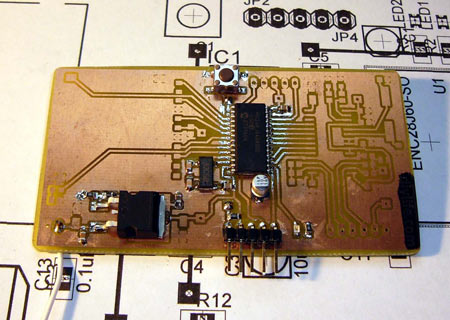
We recently used a Microchip PIC24F microcontroller in a mini web server project, but didn’t find many introductory references to link to. In this article we’ll cover some PIC 24F basics: support circuitry and programming options. We’ll also talk about our favorite features, and how we figured them out. Our next article will outline a web server on a business card based on the PIC 24F.

Continue reading “How-To: Web Server On A Business Card (Part 1)”

Parts: Tactile Switches For Your Next Project

Electronics parts can be a pain to choose. It’s often hard to tell from manufacturers’ datasheets if a part will fit your design. We auditioned six different tactile switches to find a cheap button to use in upcoming projects. A tactile switch, also called a momentary button or push-to-make switch, is commonly used for input and microcontroller resets. This type of button creates a temporary electrical connection when pressed.

Footprints for most of these buttons are available in the Cadsoft Eagle library switch-tac, or in the Sparkfun parts library under TAC_SWITCH. Buttons in the image above are discussed from left to right. Continue reading “Parts: Tactile Switches For Your Next Project”

Miniature Balancing Robot


It might not be as elegant or technologically-advanced as a Segway or a motorized unicycle, but this easily constructed 2-wheeled robot might be a fun project for a free afternoon. The heart of the balancing mechanism is an SPDT switch with a button cell attached that reverses the motor when the robot begins to tip in one direction. It’s not controllable and it tends to fall over quite a bit, but it’s a good starting point and could be refined by lowering the center of gravity or figuring out a simple way to change the motor speed based on how far the robot has tipped over. There are no accelerometers or tilt switches so the components could be sourced from a parts bin, and its simple design definitely leaves a lot of room for improvement.

NYC Soldering Championships


[Matt] let us know about the New York City Soldering Championships. They’ll be happening during the Ignite talks on July 29th at 7pm. 25 people will race head to head to assemble a fully functional electronics kit. Participants have to register in advance and are encouraged to bring their own iron. The kit hasn’t been chosen yet so people can’t practice. We hope they at least consider using a few SMD parts just to keep things interesting. Shout out if you’re planning to attend or compete!

[photo: Nick Bilton]