Turntable photography has seen a rise in popularity driven by online shopping. If you can’t hold it in your hand at least you can see what it looks like from all angles. From the still image, [Petteri Aimonen’s] roll-your-own turntable looks great. It’s completely enclosed and has a very nice paint job. But when you see it in action it appears to suffer from a stutter.
fail of the week102 Articles
Fail Of The Week: EPROM Reading And Erasing
It may be a failure but it sure does look cool. [Scott Lawrence] had a fair number of EPROM chips on hand and decided to get rid of the traditional eraser and programmer in order to play around with the concepts using his own hardware. He was met with disappointment at several steps in the process. No worries though, each of these upsets sent him back to the drawing board and he learned way more than he ever would have if it had actually worked. It’s fair to say this failure was highly successful.
Continue reading “Fail Of The Week: EPROM Reading And Erasing”
Fail Of The Week: Capturing Data From A Laser Rangefinder

We’re changing it up this week with a reverse engineering fail which [Itay] pointed out to us. A couple of years ago [Nate] over at Sparkfun agreed to help a friend with a project that required precise distance measurement. He knew that laser rangefinders are a good way to go and mentions their use in golfing and the building trades. He picked up this handheld version billed as a laser tape measure. He put up a valiant effort to reverse engineer the PCB in hopes of finding a hook for the measurement data.
Obviously his endeavor failed or we wouldn’t be talking about it in this column. But there’s a lot to learn about his methods, and a few of the comments associated with his original post help to shed light on a couple of extra things to try.
Continue reading “Fail Of The Week: Capturing Data From A Laser Rangefinder”
Fail Of The Week: Smoking Pulse Sensor And BLE Disappointment

We think [Thomas Brittain] is onto something. We often post to our personal blogs so that we have a reference to how we did something. But he also keeps a long post that documents his abandoned projects. It ends up serving as a quick start if he ever decides to pick up the torch once again. Lucky for us he’s included his failures in the write up. This Fail of the Week features the top two posts on his Incomplete Works page. The first is an attempt to make his own pulse sensor. The second is a miserable experience with a cheap Bluetooth Low Energy module.
Continue reading “Fail Of The Week: Smoking Pulse Sensor And BLE Disappointment”
Fail Of The Week: Laser Cutter That Makes Jagged Edges
This Fail of the Week is really only a failure because of the standards to which [eLabz] holds himself. The rig pictured above is a laser cutter built out of DVD drive parts. It goes above and beyond most of the optical drive CNC projects we see around here — it actually makes cuts! But [eLabz] looks on it as a failure because the steps of the driver motors are visible as jagged edges in those cuts. We see this more as a pausing point in the development process before the next refinement is made.
Continue reading “Fail Of The Week: Laser Cutter That Makes Jagged Edges”
Fail Of The Week: GPS Module Design
GPS is really fun to play with in your projects. But when [Trax] decided to build a GPS chip into his design the fun ended abruptly. Above you can see the section of the board devoted to the hardware. Unfortunately this PCB fails to provide any GPS location data whatsoever.
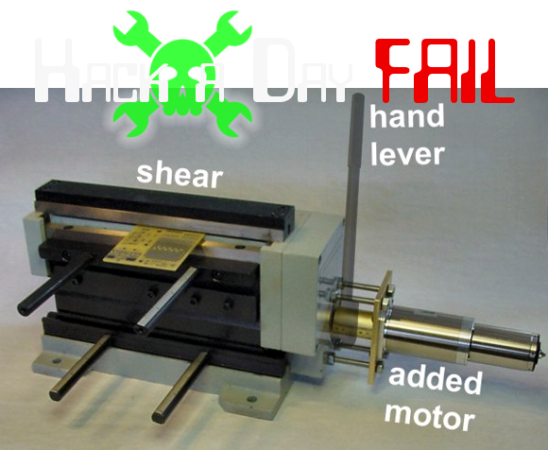
Fail Of The Week: Motorizing A PCB Cutting Shear
This week’s fail is an attempt to retrofit a PCB cutting shear with a geared motor. The project was undertaken by [David Cook]. Incidentally he’s very near and dear to us as his book Robot Building for Beginners got us started with hacking in the first place.
This $200 shearing tool is hand-operated and can cut through boards up to 1/16″ thick. But [David] really had to crank on the thing to make a cut. This often resulted in crooked board edges. He decided to do the retrofit in order to achieve higher precision. He sourced a high-torque motor from eBay for around $50 delivered.
Continue reading “Fail Of The Week: Motorizing A PCB Cutting Shear”