Autonomous Cars Already Drive The Roads Among Us

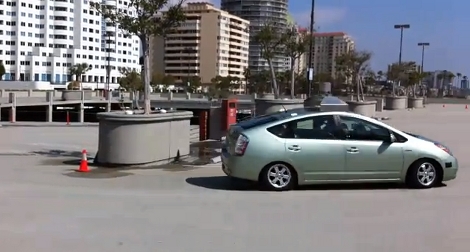
Google’s showing off this autonomous car at the TED convention right now, but the hardware has already made automated trips from San Fransisco to Los Angeles. According to the commentary in the video after the break, the scene above shows the car “hauling Prius ass” on a closed course. The car learned this route while being driven by a person and now the vehicle is set to take riders through an aggressively driven loop in the cone-adorned parking ramp. But on the open road you do not need to teach it anything. It has no problem taking a GPS route and following the rules of the road while traveling from one waypoint to another.

The link above doesn’t include hardware information but they did point to a Times article which includes an infographic. The spinning box on the top of the car is 3D-mapping LIDAR with a 200 foot radius. There’s a rotary encoder on one of the wheels for precise movement data, radar sensors on the front and back bumpers, and a rear-view-mirror-mounted camera for image processing. It makes us wonder how the system performs when the car is coated in road-muck? Maybe you just add a dedicated wiper for each sensor.

Continue reading “Autonomous Cars Already Drive The Roads Among Us”

Google Two-factor Authentication In A Wristwatch

chronos_two_factor_authentication

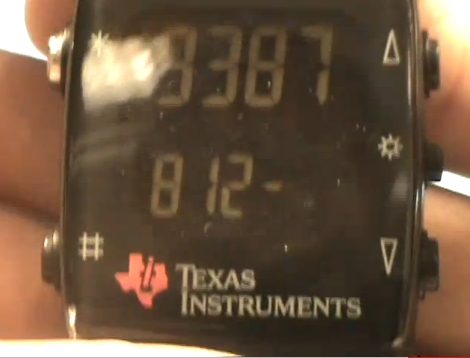
The Chronos watch from Texas Instruments is a handy little piece of hardware if placed in the right hands. If you are not familiar with the platform, it is marketed as a “wearable wireless development system that comes in a sports watch”. In plain English, it’s a wearable wireless MCU mated with a 96 segment LCD, that boasts an integrated pressure sensor and 3-axis accelerometer. It is capable of running custom firmware, which allows it to do just about anything you would like.

[Huan Trong] wanted to take advantage of Google’s new two-factor authentication, and decided his Chronos would make a great fob, since he would likely be wearing the watch most of the time anyhow. He put together some custom firmware that allows the watch to function as an authentication fob, providing the user with a valid Google passcode on command.

He does warn that the software is alpha code at best, stating that it doesn’t even allow the watch to keep time at the moment. We are definitely looking forward to seeing more code in the near future, keep up the great work!

Be sure to stick around to see a video of his watch in action.

Continue reading “Google Two-factor Authentication In A Wristwatch”

Chrome In The Pwn2Own Contest

Google has announced that it will be sponsoring a $20,000 prize at the 2011 CanSecWest Pwn2Own Contest. $20,ooo will be given to the first person to escape Chrome’s sandbox through Google-written code in the first day. If researchers are unsuccessful on the first day, then days two and three will be opened up to non-Google-written code. In addition to the cash, there is also a Google CR-48 running ChromeOS offered as a prize, but it will not be the actual platform used to hack Chrome. We look forward to seeing what comes out of this contest.

[via GearLog]

Google Takes Science Fairs Global

Teen hackers get ready to compete for cash and prizes. Google, the big G itself, is sponsoring a Science Fair but it’s not in a town near you, it’s online (no surprise there). Project entries will populate the content of a new corner of the Googleverse, with contestants 13-18 competing alone or as a team. The grand prize is a trip to the Galapagos Islands for ten days, but there are also cash scholarships for all of the winners. Check out their promo video for the event after the break.

If you’re a college student who’s too old to be eligible don’t forget to keep your eyes open for details about 2011 Google Summer of Code. Last year’s information is still up, but they usually release the details sometime in the first quarter.

Continue reading “Google Takes Science Fairs Global”

Quick And Easy Street View Treadmill

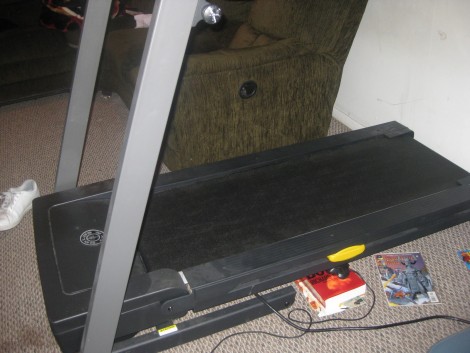
This is [Thomas Clauser’s] Google Street View enabled treadmill. He points out that most of the Street View hacks use a measurement of rotational movement to interface with a computer. He respects that but didn’t want to take the time to make it work with his treadmill. Instead, he used a stealth switch propped up on a book below the treadmill frame, but any switch can be used as long as you know how to connect it to the computer. When you stand on the treadmill the frame flexes and almost clicks the button, but when you start running it moves the rest of the ways and closes the switch. From there an autohotkey script is used to advance Street View.

Smart Power Meter Interface For The Linux Crowd

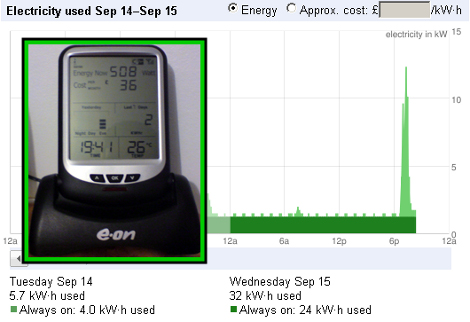
[Graham Auld] got his hands on an energy monitor for free from his utility company. The device seen in the insert provides a nice LCD display but he wanted a way to graph the data over time. There was an included cable and a method of using Google PowerMeter but only for Windows computers. He did a little poking around and came up with a Perl script to interface the meter with Google’s tools.

The hardware module is known as the Current Cost CC128 and the developer was nice enough to publish an XML output description which [Graham] used in his script. From there it’s just a matter of registering and authenticating through the Google PowerMeter API. The script is not fully polished yet but it serves as a road map for your own implementation.

Google Maps Wristlet Navigator

This on-wrist navigation system uses Google Maps and something called… paper. This is a throwback to scroll-based directions from the 1920’s and 30’s that [Simon] built. He soldered a couple of brass tubes to a brass back plate, then added sides and a face crystal. Now he prints out step by step direction from the popular mapping website and winds them onto scrolls. We’re not sure that we’d take the time to do this, but hey, at least the screen resolution is fantastic and you don’t have to worry about battery life.