Putting 300 Watts Of LEDs On An RC Plane

Being a member of the FPVlab forums, [HugeOne] is really in to strapping a video camera to RC airplanes and flying around by the seat of his pants. He’s also in to flying his plane at night. Combine these two interests, and you’ve got 300 watts of LEDs flying around at night, most likely causing a spike in UFO reports in [HugeOne]’s native Quebec.

The main issue with putting 16 CREE XM-L LEDs in such a confined space is the issue of heat; even though these LEDs are amazingly efficient, they still produce a good amount of heat. [HugeOne] solved this problem by soldering these LEDs to a piece of copper pipe and connecting two radiators to his plane for liquid cooling.

The result is a small, lightweight LED array capable of producing more than 20,000 lumens flying around the wilds of Quebec. This greatly improves [HugeOne]’s night flying ability (video after the break), and has surely annoyed the local police department with an increase in UFO reports.

Does anyone know how bright the nav and landing lights on single-engine passenger airplanes are?
Continue reading “Putting 300 Watts Of LEDs On An RC Plane”

A Desktop Binary Clock

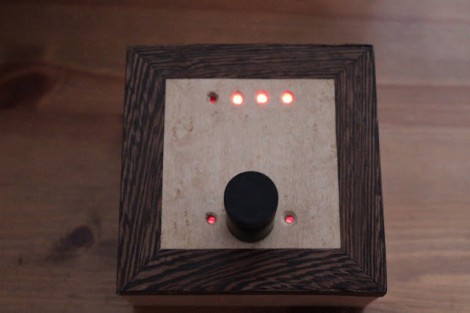
This is the desktop binary clock which [Tim the Floating Wombat] recently finished building. He calls it the Obfuscating Chronoscope since it’s a bit more difficult to read than your traditional analog or digital timepieces. But the simple design looks neat and it’s a great way to learn about board layout and microcontroller code.

He started by solving a few questions about the display technique. He wanted to use as few LEDs as possible. He settled on just four, and to prevent unnecessary confusion, decided to make sure each type of display (seconds, minutes, hours) would have at least one LED on at a time. Hours are easy enough to display, but with just four bits how can minutes be shown? He uses a 5-minute resolution, always rounding up to the next division of five. This way the first bit will be illuminated on the hour.

A PIC 24F16KA102 microcontroller keeps time using its built-in RTC and a clock crystal. It puts itself into deep sleep mode after displaying the time. The black knob at the bottom is a push-button which resets the chip, waking it up just long enough show the time once again.

10bitworks Shows Us How To Light Up A Synchronized Swarm Of LED Jellyfish

10bitworks-led-tshirts

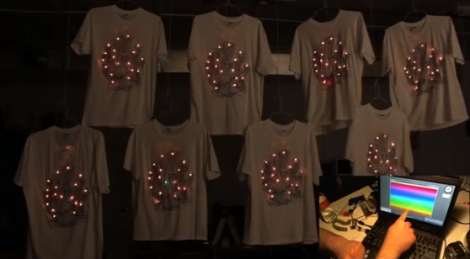
[Jeremy Zunker] from 10bitworks recently wrote in to share a cool build the group put together for the Luminaria 2012 festival which took place in March of this year. As you might have guessed, the fest is home to a wide array of light-themed projects, so the team at 10bitworks thought long and hard to come up with a design which would help them stand out from the other 79 featured artists.

At the core of their project is a t-shirt which features a deep-sea diver surrounded by swarm of jellyfish. Each of the jellyfish is backlit by an LED module, allowing the group to create intricate light patterns on the shirt.

10bitworks brought 8 shirts to the show, each fitted with a small control pack that contained a set of batteries and a Jeenode wireless board. A ninth Jeenode and a large antenna were used as the master control unit, sending signals to each of the t-shirts in order to synchronize the light display.

The final result turned out very nicely as you can see in the video below, where [Jeremy] walks through all of the project’s finer details.

Continue reading “10bitworks Shows Us How To Light Up A Synchronized Swarm Of LED Jellyfish”

Cloning A Water-based Light Wall Project

A few weeks ago, we featured this water-based LED graffiti art installation that allows anyone to paint in light using only a bottle of water. When one of [Chris]’ friends saw the video of this build, he immediately asked him how it worked. One thing led to another, and now [Chris] and a few other members at the BUILDS hackerspace at Boston University are building their own water LED installation.

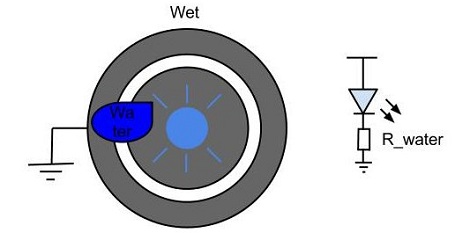
The basic premise of this build is allowing water to serve as a conductor between the anode and cathode of a LED. Without spraying or painting water on the circuit [Chris] whipped up, there is an infinite resistance between the two pins of the LED and current cannot flow. After applying water to the anode and cathode pads, a small amount of current is conducted through the water and the LED lights up.

Right now, [Chris] is working on a test board with different sizes of pads and spacing to get the best water graffiti LED effect for his future build. The plan is to build a single one-meter panel out of one hundred 10 cm x 10 cm boards connected together with jumpers.

All of [Chris]’ work is up on GitHub, and even though [Chris] hasn’t begun designing the production boards, it’s more than enough to get you started if you’d like your own water LED painting panel.

One Dimensional PONG Is A Great Use For LED Strips

[Jason] has had a five meter addressable RGB LED strip lying around for a while, and only recently came up with a good idea of what to use it for. He came up with One Dimensional PONG, and it looks like it’s a blast to play. Instead of moving a paddle up and down, [Jason]’s 1D PONG game requires the players to stomp on a switch to send the ball back to the other player.

The LED strip [Jason] used has an SPI interface, but needed to be PWM clocked to a microcontroller to operate. After whipping up an Arduino library for his LED strip, [Jason] built an ATMega328-based controller board and a pair of seven segment display boards to keep track of the score. There’s a technical overview in another one of [Jason]’s videos.

[Jason] will be taking his 1D PONG game to the Brighton Mini Maker Faire on September 8th. We’re sure his game will be very popular there, so if you see him, tell him Hackaday sent you.

Continue reading “One Dimensional PONG Is A Great Use For LED Strips”

Lite Brites Fade, But LED Clocks Are Forever

litebrite-clock

Ahh, the Lite Brite.

What could be more fun than pushing dozens of little plastic pegs through a piece of black paper in order to create a pixelated, though colorful image? Well, I can think of quite a few things more engaging than that, and luckily so can [Lonnie Honeycutt] over at MeanPC.

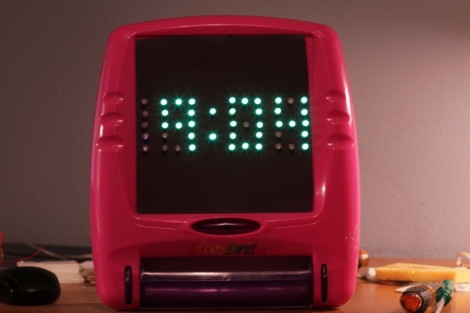
While contemplating what to build with a pile of LEDs, his daughter came into the room with her portable Lite Brite. He thought that the pegs she was using looked awfully similar to the LEDs on his desk, so he did some test fitting and was surprised to see that they fit almost perfectly.

[Lonnie] thought that the toy would make an excellent clock, and his daughter happily agreed to let Dad do some tinkering. A few hours, an Arduino, and some Charlieplexing later, he had a nice looking clock that his kids were sure to enjoy.

If you’re interested in seeing more about how constructed, be sure to check out his YouTube channel and Instructable, where he happily provides all of the build details.

Building An LED Suit

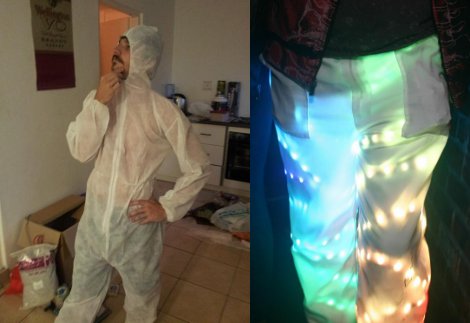
[Rob] has been hard at work designing and building this LED suit which he can wear to parties. He’s got it working, although right now it’s just a pair of pants. It reacts to sound, and has the potential to be controlled from a smartphone via Bluetooth. You’ll find a video description of the build embedded after the break.

The planning started off by selecting driver hardware for the LEDs. [Rob] wanted the suit to pulse to the music in the room so he grabbed an MSGEQ7 chip. When connected to a microphone and opamp this chip will output a signal which can be used as a VU meter. He built the hardware into an Arduino shield, then got to work on the LED driver board. He’s using LED strips, but they’re not individually addressable. Instead he cut loops which wrap around the wearer’s legs. Each loop connects the pins of a TLC5947 LED driver chip which sinks a constant current and offers PWM abilities. He’s using PNP transistors on the high side.

For anyone that’s ever worked in a Tyvek suit before you’ll know they don’t breathe. Sweat will literally be pouring off of you. And we’d bet that’s what cause the short that burned the back of [Rob’s] leg at a recent party. Then again, your light-up pimp coats are going to be hot to wear too.

Continue reading “Building An LED Suit”