Triggering A DSLR Shutter With An Audio Clip

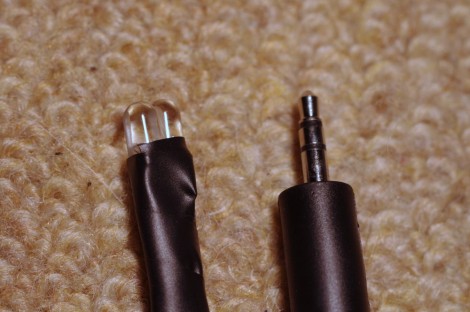
Apparently Pentax DSLR cameras have a remote shutter option that used infrared signals. [Pies for you] gathered up several different hacks and built a method of triggering the camera using custom audio. He put together the dongle above, just a headphone extension cord and two IR LEDs, which plugs into the headphone jack of any audio device like an iPod or an Android phone. When you play back a file the audio signals drive the IR LEDs. This is completely worthless unless you craft your own audio file using the correct frequency, duty cycle, and bit encoding. [Pies for you] did just that and got things up and running. Looks like the system doesn’t do so well with MP3 compression, but take a look at the waveform analysis that he posted and then make sure you’re using a lossless format.
See-through LED Display

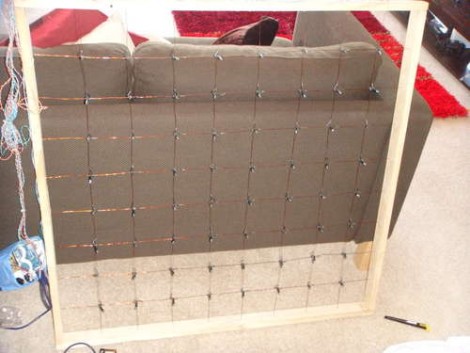
[Ndsit] is having a party and wanted to liven up the place with some blinky lights. He’s a bit new when it comes to hobby electronics, and although we’d highly recommend inviting some resistors to participate, the LED matrix that he built is very nice. It’s 8×8, it’s big, and (as shown in the clip after the break) the lights seem to hover in midair. That’s because he didn’t use a substrate to make the display. A grid of enameled wire is strung between the four sides of the wooden frame. LEDs were gathered from a string of Christmas lights which means they’re in a holder and have insulated wires already connected. Each one was tied on at a junction point of the grid, then connected to a portion of the wire where enamel had been scraped off.

It works but there’s already one light that is out. We hope some current protection is added so that this can be used again and again.

Continue reading “See-through LED Display”

Out Engineering A Sneaky Cat

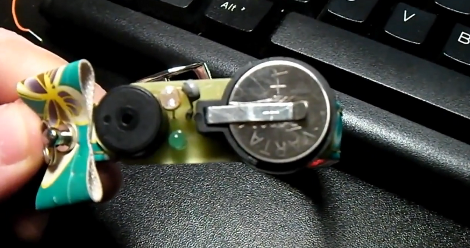
Cats do what they want, which rarely coincides with what their owner wants them to do. In [Dumitru]’s case, his girlfriend’s cat [Pufu] tended to make it outside into the cold more often than desired. Rather than settle with the normal bell which gets obnoxious even when the cat isn’t misbehaving, he decided to put together a custom Cat Finding collar. He used a PIC microcontroller as the brains, and temperature and light sensors to decide whether the cat had snuck into the cold, dark night. Once the cat has been marked as being outside, a buzzer and LED are set to go off at regular intervals until returned into the safety of the indoors.

[Dumitru]’s website along with his YouTube videos are in Romanian, though the schematics and source code provided speak for themselves. He does a wonderful job walking through the entire design process, including time spend in the IDE as well as EAGLE designing the board. YouTube has managed to subtitle the majority of the details, but we imagine this post will be a real treat to any Romanian speaking hobbyists out there. Be sure to catch both videos after the break.

Continue reading “Out Engineering A Sneaky Cat”

How To Build A Ping-pong Ball Display

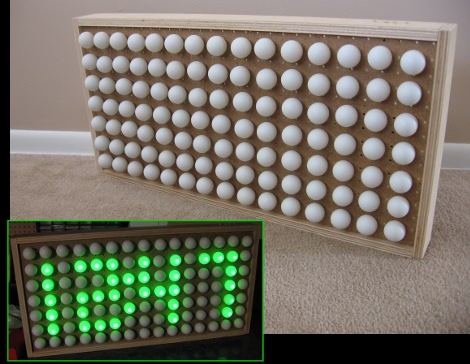
If you’ve been lusting after your own glowing display we’re here to help by sharing some simple building techniques that will result in an interesting project like the one you see above. This is a super-accurate clock That uses ping-pong balls as diffusers for LEDs, but with a little know-how you can turn this into a full marquee display. Join me after break where I’ll share the details of the project and give you everything you need to know to build your own.

Continue reading “How To Build A Ping-pong Ball Display”

Insane Covert IR Illumination

[Onironaut] over at lucidscience sent us a link to his latest project, some IR illumination panels. At first, we were mildly enticed by his usual high standard of photography and description. It was just an array of LEDs though. Still, we kept hitting the “next page” button because he goes into such great detail. Then we saw version two. Instead of simply being an array of IR LEDs mounted outside for his security camera, he has mounted 1536 IR LEDs inside an old flat panel monitor. That’s a fake monitor producing 180 watts of IR light, and we think that’s even at half power!  He replaced the screen of the display with one way mirror, so you would have no idea that it isn’t just a normal screen sitting on his desk.  Great job as usual [Onironaut].

Rovio Headlight Hack Looks Stock

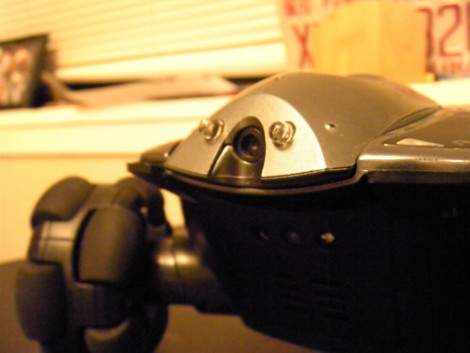
Even the most thorough inspection may not raise the alarm that this Rovio has been hacked to include LED headlights. [Adam Outler’s] super clean work puts the two light sources on either side of the camera for maximum effect. It may not provide as many Lumens as our external headlight hack, but we were never all that excited about the black project box that housed it. [Adam] built the circuit on a scrap of perfboard, using a transistor to connect the LED pair to the battery, with the original LED power wire going to the base in order to switch the transistor.

Controlling Real Objects Using Minecraft

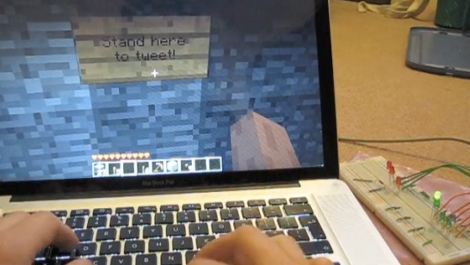
Most augmented reality takes images of the real world and superimposes virtual data on top of them. [Michael Winston Dales] went a different direction, using the virtual world of Minecraft to control objects in the physical world. In the video after the break you can see him use switches that he built inside the game to turn the LEDs pictured above on and off. You’ll also notice that in-game sign instructing a player to stand in one spot to Tweet. Since Minecraft is written in Java there are some mods that allow you to hook onto in-game events. [Michael] does just that, triggering his own scripts to send data to an Arduino, or use a Twitter API. Now this something that should be used with the Minecraft ALU. It takes the sandbox method of gaming to a new place, doesn’t it?

Continue reading “Controlling Real Objects Using Minecraft”