Lunar Ark Boldly Goes

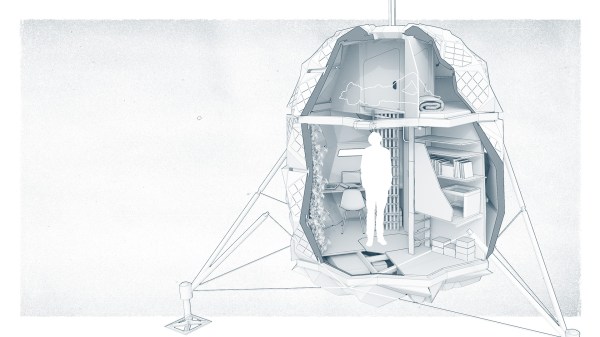
[Sebastian and Karl-Johan] are two award-winning Danish Space Architects who are subjecting themselves to harsh, seemingly uninhabitable conditions, for science. The pair set out to build a lunar base that could land with the manned Moon missions in 2024. Like any good engineering problem, what good is a solution without testing? So the pair have placed their habitat in a Moon Analogue habitat and are staying in their habitat for two months. They want to really feel the remoteness, the bitter cold, and the fatigue of actually being on the moon. So far they are about halfway through their journey and expect to return home in December 2020.

When asking themselves where on Earth is it most like the Moon, they came up with Moriusaq, Greenland. It’s cold, remote, in constant sunlight this time of year, and it is a vast white monochrome landscape just like the moon. The first moon settlement missions are expected to be at the South Pole of the Moon, as known as the Peak of Eternal Light.
The habitat itself is a testament to the duo’s ingenuity. The whole structure folds to fit the tight space and weight requirements of rockets. Taking 2.9m3 (102 ft3) when stored, it expands 560% in volume to 17.2m3 (607 ft3). In Greenland, the structure needs to withstand -30ºC (-22ºF) and 90 km/h winds.


Because the South Pole is in constant sunlight, the temperature varies much less there than on the rest of the Moon, which makes Greenland a very good analogue temperature-wise. The foldable skin is covered in solar panels, both on the top of the bottom. The highly reflective nature of the Moon’s surface makes it easy to capture the light bouncing up onto the bottom of the habitat.

Several other bits of technology have been included onboard, like a 3D printer, a circadian light stimulation system, an algae reactor, and a weather simulation. Since both the Moon and Greenland are in constant sunlight, the pod helps regulate the circadian rhythms of the occupants by changing the hue and brightness throughout the day. The weather simulation tries to break up the monotony of space by introducing weather like a stormy day or rainbow colours.

Their expedition is still ongoing and they post daily mission updates. While some might call their foray into the unknown madness, we call it bold. Currently, NASA is planning its Artemis mission in 2024 and we hope that the lessons learning from the Lunark and other experiments culminate in a better experience for all astronauts.

Apollo Missions Get Upgraded Video

July 20th marked the anniversary of the first human setting foot on the moon. If you were alive back then, you probably remember being glued to the TV watching the high-tech images of Armstrong taking that first step. But if you go back and watch the video today, it doesn’t look the way you remember it. We’ve been spoiled by high-density video with incredible frame rates. [Dutchsteammachine] has taken a great deal of old NASA footage and used their tools to update them to higher frame rates that look a lot better, as you can see below.

The original film from the moon landing ran between 12 frames per second and as low as 1 frame per second. The new video is interpolated to 24 frames per second. Some of the later Apollo mission film is jacked up to 60 frames per second. The results are great.

Continue reading “Apollo Missions Get Upgraded Video”

Hackaday Links Column Banner

Hackaday Links: June 28, 2020

You can imagine how stressful life is for high-power CEOs of billion-dollar companies in these trying times; one is tempted to shed a tear for them as they jet around the world and plan their next big move. But now someone has gone and upset the applecart by coming up with a way to track executive private jets as they travel across North America. This may sound trivial, but then you realize that hedge fund managers pay big money for the exact same data in order to get an idea of who is meeting with whom and possibly get an idea of upcoming mergers and acquisitions. It’s also not easy, as the elites go to great lengths to guard their privacy. Luckily, the OpenSky Network lists all ADS-B traffic its web of ground stations receives, unlike other flight monitoring sites which weed out “sensitive” traffic. Python programs scrape the OpenSky API and cross-reference plane registrations with the FAA database to see which company jets are doing what. There are plenty of trips to Aspen and Jackson Hole to filter out, but with everyone and his little brother fancying themselves a day trader lately, it’s another tool in the toolbox.

We got a nice note from Michelle Thompson this week thanking us for mentioning the GNU Radio Conference in last week’s Links article, and in particular for mentioning the virtual CTF challenge that they’re planning. It turns out that Michelle is deeply involved in designing the virtual CTF challenge, after having worked on the IRL challenges at previous conferences. She shared a few details of how the conference team made the decision to go forward with the virtual challenge, inspired in part by the success of the Hack-A-Sat qualifying rounds, which were also held remotely. It sounds like the GNU Radio CTF challenge will be pretty amazing, with IQ files being distributed to participants in lieu of actually setting up receivers. We wish Michelle and the other challenge coordinators the best of luck with the virtual con, and we really hope a Hackaday reader wins.

Amateur radio is often derided as a hobby, earning the epithet “Discord for Boomers” according to my son. There’s more than a grain of truth to that, but there are actually plenty of examples where a ham radio operator has been able to make a big difference in an emergency. Case in point is this story from the Western Massachusetts ARRL. Alden Jones (KC1JWR) was hiking along a section of the Appalachian Trail in southern Vermont last week when he suddenly got light-headed and collapsed. A passing hiker who happened to be an emergency medical technician rendered aid and attempt to contact 911 on his cell phone, but coverage was spotty and the dispatcher couldn’t hear him. So Alden, by this point feeling a little better, pulled out his handy talkie and made an emergency call to the local repeater. Luckily the Western Massachusetts Traffic Net was just about to start, so they went into emergency mode and coordinated the response. One of the hams even went to the rescue staging area and rigged up a quick antenna to improve the signal so that rescuers could finally get a helicopter to give Alden a ride to the hospital. He’s fine now, and hats off to everyone who pitched in on the eight-hour rescue effort.

And finally, there are obviously a lot of details to be worked out before anyone is going to set foot on the Moon again. We’ve got Top People™ working on all the big questions, of course, but apparently NASA needs a little help figuring out how and where the next men and first women on the Moon are going to do their business. The Lunar Loo Challenge seeks innovative designs for toilets that can be used in both microgravity and on the lunar surface. There is $35,000 in prize money for entrants in the Technical division; NASA is also accepting entries in a Junior division, which could prove to be highly entertaining.

Masten Moon Rocket Has Landing Pad, Will Travel

Because of the architecture used for the Apollo missions, extended stays on the surface of the Moon weren’t possible. The spartan Lunar Module simply wasn’t large enough to support excursions of more than a few days in length, and even that would be pushing the edge of the envelope. But then the Apollo program was never intended to be anything more than a proof of concept, to demonstrate that humans could make a controlled landing on the Moon and return to Earth safely. It was always assumed that more detailed explorations would happen on later missions with more advanced equipment and spacecraft.

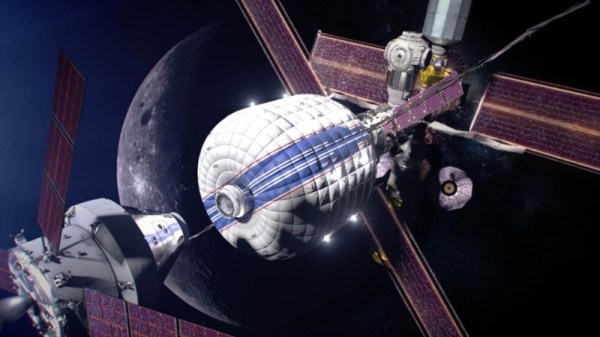
Now NASA hopes that’s finally going to happen in the 2020s as part of its Artemis program. These missions won’t just be sightseeing trips, the agency says they’re returning with the goal of building a sustainable infrastructure on and around our nearest celestial neighbor. With a space station in lunar orbit and a permanent outpost on the surface, personnel could be regularly shuttled between the Earth and Moon similar to how crew rotations are currently handled on the International Space Station.

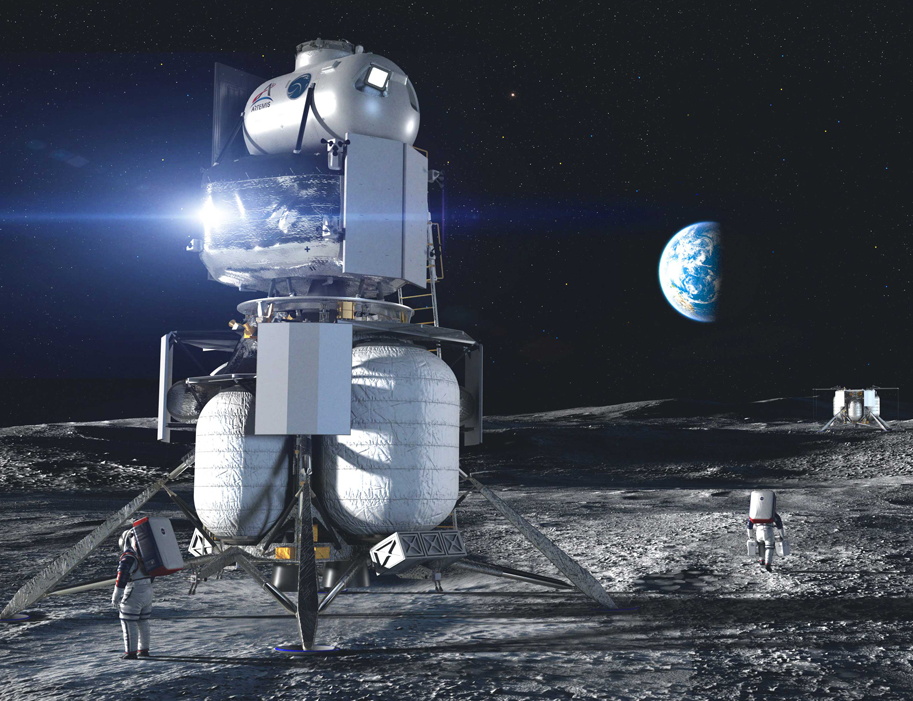
Artemis lander concept

Naturally, there are quite a few technical challenges that need to be addressed before that can happen. A major one is finding ways to safely and accurately deliver multiple payloads to the lunar surface. Building a Moon outpost will be a lot harder if all of its principle modules land several kilometers away from each other, so NASA is partnering with commercial companies to develop crew and cargo vehicles that are capable of high precision landings.

But bringing them down accurately is only half the problem. The Apollo Lunar Module is by far the largest and heaviest object that humanity has ever landed on another celestial body, but it’s absolutely dwarfed by some of the vehicles and components that NASA is considering for the Artemis program. There’s a very real concern that the powerful rocket engines required to gracefully lower these massive craft to the lunar surface might kick up a dangerous cloud of high-velocity dust and debris. In extreme cases, the lander could even find itself touching down at the bottom of a freshly dug crater.

Of course, the logical solution is to build hardened landing pads around the Artemis Base Camp that can support these heavyweight vehicles. But that leads to something of a “Chicken and Egg” problem: how do you build a suitable landing pad if you can’t transport large amounts of material to the surface in the first place? There are a few different approaches being considered to solve this problem, but certainly one of the most interesting among them is the idea proposed by Masten Space Systems. Their experimental technique would allow a rocket engine to literally build its own landing pad by spraying molten aluminum as it approaches the lunar surface.

Continue reading “Masten Moon Rocket Has Landing Pad, Will Travel”

NASA’s Plan For Sustained Lunar Exploration

The Apollo program proved that humans could land on the Moon and do useful work, but due to logistical and technical limitations, individual missions were kept short. For the $28 billion ($283 billion adjusted) spent on the entire program, astronauts only clocked in around 16 days total on the lunar surface. For comparison, the International Space Station has cost an estimated $150 billion to build, and has remained continuously occupied since November 2000. Apollo was an incredible technical achievement, but not a particularly cost-effective way to explore our nearest celestial neighbor.

Leveraging lessons learned from the Apollo program, modern technology, and cooperation with international and commercial partners, NASA has recently published their plans to establish a sustained presence on the Moon within the next decade. The Artemis program, named for the twin sister of Apollo, won’t just be a series of one-off missions. Fully realized, it would consist not only of a permanent outpost where astronauts will work and live on the surface of the Moon for months at a time, but a space station in lunar orbit that provides logistical support and offers a proving ground for the deep-space technologies that will eventually be required for a human mission to Mars.

It’s an ambitious program on a short timeline, but NASA believes it reflects the incredible technological strides that have been made since humans last left the relative safety of low Earth orbit. Operating the International Space Station for 20 years has given the countries involved practical experience in assembling and maintaining a large orbital complex, and decades of robotic missions have honed the technology required for precision powered landings. By combining all of the knowledge gained since the end of Apollo, the Artemis program hopes to finally establish a continuous human presence on and around the Moon.

Continue reading “NASA’s Plan For Sustained Lunar Exploration”

As A Matter Of Fact, It’s All Dark

While the dark side of the moon wasn’t seen by humans until the middle of the 20th century, that side of the moon isn’t always dark, just hidden from view of Earth by a quirk of gravity. The more appropriate name for the other half of the moon is the “far side”, but while it gets just as much sunshine as the near side does it is dark to one thing in particular: man-made radio waves. That, along with the lack of an atmosphere and ionosphere on the moon, makes it a perfect place for a new telescope.

This telescope isn’t like something you’d set up in your back yard, either. It’s more similar to the Aricebo Observatory in Puerto Rico which uses natural topography to help form the telescope. The proposed telescope on the far side of the moon would use a robot to deploy a net along a fairly large crater to act as a parabolic dish, while another robot would suspend the receiver above the crater. The large size is necessary for viewing deep into space, but is also because of the low-frequency radio signals they hope to capture.

Building a dish like this on the moon is sure to be no easy task, especially since remote control on the far side of the moon is difficult for precisely the reasons that make this a good location for a telescope. But with an appropriate amount of funding and some sufficiently autonomous robots it should be possible. Plus, you never know what you’ll find when looking deep into space.

SpaceX Offers NASA A Custom Moon Freighter

Under the current Administration, NASA has been tasked with returning American astronauts to the Moon as quickly as possible. The Artemis program would launch a crewed mission to our nearest celestial neighbor as soon as 2024, and establish a system for sustainable exploration and habitation by 2028. It’s an extremely aggressive timeline, to put it mildly.

To have any chance of meeting these goals, NASA will have to enlist the help of not only its international partners, but private industry. There simply isn’t enough time for the agency to design, build, and test all of the hardware that will eventually be required for any sort of sustained presence on or around the Moon. By awarding a series of contracts, NASA plans to offload some of the logistical components of the Artemis program to qualified companies and agencies.

Artist’s Rendering of the Dragon XL

For anyone who’s been following the New Space race these last few years, it should come as no surprise to hear that SpaceX has already been awarded one of these lucrative logistics contracts. They’ve been selected as the first commercial provider for cargo deliveries to Gateway, a small space station that NASA intendeds to operate in lunar orbit. Considering SpaceX already has a contract to resupply the International Space Station, they were the ideal candidate to offer similar services for a future lunar outpost.

But that certainly doesn’t mean it will be easy. The so-called “Gateway Logistics Services” contract stipulates that providers must be able to deliver at least 3,400 kilograms (7,500 pounds) of pressurized cargo and 1,000 kilograms (2,200 pounds) of unpressurized cargo to lunar orbit. That’s beyond the capabilities of SpaceX’s Dragon spacecraft, which was only designed to service low Earth orbit.

To complete this new mission, the company is proposing a new vehicle they’re calling the Dragon XL that would ride to orbit on the Falcon Heavy booster. But even for this New Space darling, there’s not a lot of time to design, test, and build a brand-new spacecraft. To get the Dragon XL flying as quickly as possible, SpaceX is going to need to strip the craft down to the bare minimum.

Continue reading “SpaceX Offers NASA A Custom Moon Freighter”