While not a Cabinet position, the NASA Administrator is nominated by the president of the United States and tasked with enacting their overall space policy. As such, a new occupant in the White House has historically resulted in a different long-term directive for the agency. Some presidents have wanted bold programs of exploration, while others have directed NASA to follow a more reserved and economical path, with the largest shifts traditionally happening when the administration changes hands between the parties.
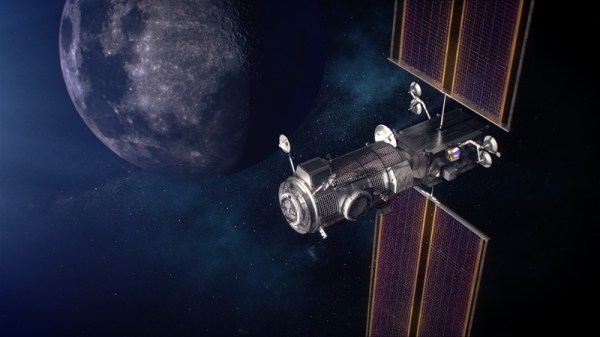
So it’s no surprise that the fate of Artemis, a bold program initiated by the previous administration that aims to establish a sustainable human presence on the Moon, has been considered uncertain since the November election. But the recent announcement that SpaceX has been awarded a $331.8 million contract to launch the first two modules of the lunar Gateway station, an orbital outpost that will serve as a rallying point for astronauts coming and going to the Moon’s surface, should help quell some concerns. While the components still aren’t slated to fly until 2024 at the earliest, it’s a step in the right direction and strong indicator that the new administration plans on seeing Artemis through.
One of the easiest ways to get into hardware hacking is by piecing together a few modules and shoehorning them into a really cool home. For example, why buy a commercial moon lamp when you can spend 30+ hours printing your own, and a few more hours hacking the guts together?
[Amit] freed the controller board from its plastic box and soldered the LED strip’s wires directly to it. For power, [Amit] taped the board to the battery from an old cell phone and stepped it up to 12 V with a boost converter. We think this looks quite nice and professional, especially with the stand. A brief demo is on the rise after the break.
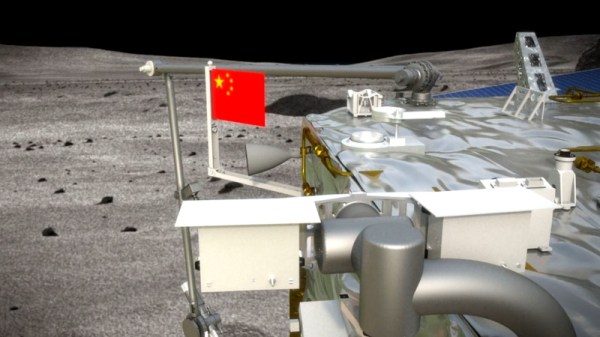
If everything goes according to plan, China will soon become the third country behind the United States and the Soviet Union to successfully return a sample of lunar material. Their Chang’e 5 mission, which was designed to collect 2 kilograms (4.4 pounds) of soil and rock from the Moon’s surface, has so far gone off without a hitch. Assuming the returning spacecraft successfully renters the Earth’s atmosphere and lands safely on December 16th, China will officially be inducted into a very exclusive club of Moon explorers.
Of course, spaceflight is exceedingly difficult and atmospheric reentry is particularly challenging. Anything could happen in the next few days, so it would be premature to celebrate the Chang’e 5 mission as a complete success. But even if ground controllers lose contact with the vehicle on its return to Earth, or it burns up in the atmosphere, China will come away from this mission with a wealth of valuable experience that will guide its lunar program for years to come.
In fact, one could argue that was always the real goal of the mission. While there’s plenty of scientific knowledge and not an inconsequential amount of national pride to be gained from bringing a few pounds of Moon rocks back to Earth, it’s no secret that China has greater aspirations when it comes to our nearest celestial neighbor. Starting with the launch of the Chang’e 1 in 2007, the Chinese Lunar Exploration Program has progressed through several operational phases, each more technically challenging than the last. Chang’e 5 represents the third phase of the plan, with only the establishment of robotic research station to go before the country says they’ll proceed with a crewed landing in the 2030s.
Which helps explain why, even for a sample return from the Moon, Chang’e 5 is such an extremely complex mission. A close look at the hardware and techniques involved shows a mission profile considerably more difficult than was strictly necessary. The logical conclusion is that China intentionally took the long way around so they could use it as a dry run for the more challenging missions that still lay ahead.
Sure, the SpaceX crew made it safely to the ISS, but there’s plenty happening beyond just that particular horizon. The Chinese National Space Administration have launched their Chang’e 5 mission to collect and return lunar rock samples, a collaboration between NASA and ESA to do the same with samples from Mars has passed its review, and a pair of satellites came uncomfortably close to each other in a near-miss that could have had significant orbital debris consequences. It’s time for Spacing Out!
Bringing Alien Rocks to Earth
The Chang’e 5 mission on the launch pad. China News Service, CC BY 3.0.
Ever since the NASA and Soviet lunar launches at the height of the Space Race, there have been no new missions to collect material from the Lunar surface and return it to Earth. That changed last week.
Not to be outdone in the field of ambitious sample return missions, NASA and ESA’s joint plan to collect and return rock core samples from Mars has met with the approval of the independent review board set up to examine it. This will involve multiple craft from both agencies, with NASA’s already launched Perseverance rover collecting and containing the samples before leaving them on the surface for eventual collection by a future ESA rover. This will then pass them to a NASA ascent craft which will take them to Martian orbit and rendezvous with an ESA craft that will return them to Earth. We space-watchers are in for an exciting decade.
That Was a Close One!
Anyone who has seen the film Gravity will be familiar with the Kessler syndrome, in which collisions between spacecraft and or debris could create a chain reaction of further collisions and render entire orbital spheres unusable to future craft because of the collision hazard presented by the resulting cloud of space debris. Because of this, spacecraft operators devote considerable resources towards avoiding such collisions, and it is not uncommon for slight orbital adjustments to be made to avoid proximity with other orbiting man-made objects.
On the 27th of November it seems that these efforts failed, with a terse announcement from Roscosmos of a near-miss between their Kanopus-V craft and the Indian CARTOSAT 2F. The two remote-imaging satellites passed as close as 224 metres from each other, which in space terms given their likely closing speeds would have been significantly too close for comfort. The announcement appears worded to suggest that the Indian craft was at fault, however it’s probably a fairer conclusion that both space agencies should have seen the other’s satellite coming. Fortunately we escaped a catastrophe this time, but it is to be hoped that all operators of such satellites will take note.
RocketLab Joins the Reusable Booster Club
Other recent launches that might excite the interest of readers are the New Zealand-based RocketLab launching their Electron rocket with 30 small satellites on board before for the first time retrieving their booster stage, and the Japanese Mitsubish Electric sending their JDRS-1 satellite to geosynchronous orbit. This last craft is of interest because it carries an optical data link rather than the more usual RF, and could prove the technology for future launches.
The coming weeks should be full of news from China on Chang’e 5’s progress. Getting a craft to the moon and returning it will be a huge achievement, and we hope nothing fails and we’ll see pictures of the first new Moon rocks on Earth since the 1970s. We don’t know how to say “Good luck and a successful mission!” in Chinese, so we’ll say it in English.
After a couple of months away we’re returning with our periodic roundup of happenings in orbit, as we tear you away from Star Trek: Discovery and The Mandalorian, and bring you up to date with some highlights from the real world of space. We’ve got a launch to look forward to this week, as well as a significant anniversary.
[Sebastian and Karl-Johan] are two award-winning Danish Space Architects who are subjecting themselves to harsh, seemingly uninhabitable conditions, for science. The pair set out to build a lunar base that could land with the manned Moon missions in 2024. Like any good engineering problem, what good is a solution without testing? So the pair have placed their habitat in a Moon Analogue habitat and are staying in their habitat for two months. They want to really feel the remoteness, the bitter cold, and the fatigue of actually being on the moon. So far they are about halfway through their journey and expect to return home in December 2020.
When asking themselves where on Earth is it most like the Moon, they came up with Moriusaq, Greenland. It’s cold, remote, in constant sunlight this time of year, and it is a vast white monochrome landscape just like the moon. The first moon settlement missions are expected to be at the South Pole of the Moon, as known as the Peak of Eternal Light. The habitat itself is a testament to the duo’s ingenuity. The whole structure folds to fit the tight space and weight requirements of rockets. Taking 2.9m3 (102 ft3) when stored, it expands 560% in volume to 17.2m3 (607 ft3). In Greenland, the structure needs to withstand -30ºC (-22ºF) and 90 km/h winds.
Because the South Pole is in constant sunlight, the temperature varies much less there than on the rest of the Moon, which makes Greenland a very good analogue temperature-wise. The foldable skin is covered in solar panels, both on the top of the bottom. The highly reflective nature of the Moon’s surface makes it easy to capture the light bouncing up onto the bottom of the habitat.
Several other bits of technology have been included onboard, like a 3D printer, a circadian light stimulation system, an algae reactor, and a weather simulation. Since both the Moon and Greenland are in constant sunlight, the pod helps regulate the circadian rhythms of the occupants by changing the hue and brightness throughout the day. The weather simulation tries to break up the monotony of space by introducing weather like a stormy day or rainbow colours.
Their expedition is still ongoing and they post daily mission updates. While some might call their foray into the unknown madness, we call it bold. Currently, NASA is planning its Artemis mission in 2024 and we hope that the lessons learning from the Lunark and other experiments culminate in a better experience for all astronauts.
July 20th marked the anniversary of the first human setting foot on the moon. If you were alive back then, you probably remember being glued to the TV watching the high-tech images of Armstrong taking that first step. But if you go back and watch the video today, it doesn’t look the way you remember it. We’ve been spoiled by high-density video with incredible frame rates. [Dutchsteammachine] has taken a great deal of old NASA footage and used their tools to update them to higher frame rates that look a lot better, as you can see below.
The original film from the moon landing ran between 12 frames per second and as low as 1 frame per second. The new video is interpolated to 24 frames per second. Some of the later Apollo mission film is jacked up to 60 frames per second. The results are great.