Solenoid Motor From A VCR Head

[youtube=http://www.youtube.com/watch?v=3nHX-66PGN0]

Here’s a solenoid motor you can build from a VCR head and some common components. It uses an LED and a light sensor, paired with an LM311 comparator to manage the switching of the motor. As the head turns, the LED shines on the sensor through a hole and triggers a TIP120 transistor to turn on the motor during the power stroke. Once the beam of light is broken, the transistor turns off the motor and the momentum carries it through its revolution until the next power stroke is activated.

We often say that “why” is the wrong question. [Bd5940] must feel the same way because he ends the video by saying: “it has no use, but definitely a conversation piece”. Yep, we’ve seen that before.

[Thanks James]
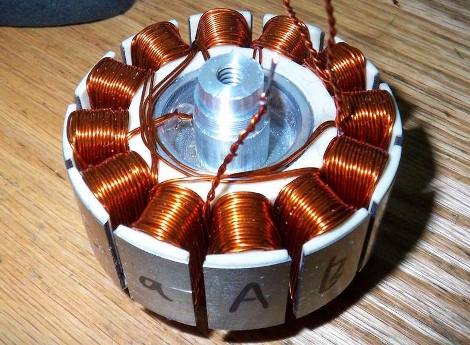
Build Your Own Hub Motor

Hub motors put the power inside of the wheel. [Teamtestbot] goes deep into the hows and whys of building these motors, from parts, to windings, to the math behind the power ratios. The working example puts an electric motor inside the rear wheel of a Razor scooter. Past projects used belts to transfer the work of the motor to the wheel of the scooter. By integrating the motor and the wheel you end up with a much cleaner looking product. Check out the motor testing and the scooter test drive after the break.

For more tips on building your own electric motors take a peek at the Fly Electric page we covered back in November.

Continue reading “Build Your Own Hub Motor”

Servo Hacked Linear Actuator

[AntonB] has modified a servo into a powerful linear actuator (think: changing rotational motion into linear motion). The process is simple enough, modify a servo for continuous rotation and then add the custom built actuating shaft. You do of course lose the precision of the servo, but a small price to pay to be able to lift ~20 pounds straight up. Inspiration for such a cheap solution came from his Planetary Surface Exploration Rover. Check out a video of both after the break.

[Thanks Eric]

Continue reading “Servo Hacked Linear Actuator”

Cheap Toy Yields Good Parts

We’ve spent some serious time building robot chassis and motor controllers. [Whamodyne] does the smart thing and scavenges what he needs form cheap sources. He picked up an RC car from the local pharmacy for just $10, tore the body off and behold, a bounty of robot-friendly parts.

We’re not talking precision parts here, but we don’t scoff at two geared motors, four wheels, a driver board, and steering. There’s no great way to attach your own stuff but that’s half the fun of hacking. [Whamodyne] used the 9v battery that came with the toy to power his boarduino and quickly patched in to produce a miracle of automated locomotion.

Homopolar Motor

homopolar-motor

Slow day at the office?  Here’s a trick that’ll make your coworkers smile. Dangerously Fun has a guide to build a homopolar motor from a battery, copper wire, and magnet. A homopolor motor doesn’t rely on electromagnets in an armature changing their polarity to force a rotation movement compared to stationary magnets. Instead, they use an electrical current’s orientation to a magnetic field to provide a repulsive or rotational force.  In this implementation, the current moves through a loops of copper wire from one pole of a battery to the other.  A rare-earth magnet on one pole of the battery provides the magnetic field.

After the break we’ve embedded video of this simple example as well as a few more complex homopolar examples such as a five speed version.  The motor in action certainly brings a smile to our faces and places this firmly in the useless machines family of hacks.

Continue reading “Homopolar Motor”

Gear Clock

[youtube http://www.youtube.com/watch?v=zkLIKfdYW3I&feature=player_embedded%5D

Analog clocks now a days get no respect. Everyone is digital this, or binary that, and we admit it is nice to look over and see the time promptly displayed. But there’s something about the quiet ticking and ominous feeling you get when around a large intricate clock that you know some serious time has been invested.

Nostalgia feelings aside, [Alan] from Hacked Gadgets introduced us to his Gear Clock. While it’s not a new idea, and in fact we have a few around the office, his concept really inspired us. His clock is driven via stepper motor and a PIC, allowing for the time to be fairly accurate. The only small problem he mentions is the poor paint job, but we think it looks amazing regardless.

Batcave-style Entrance (on A Budget)

buttonhead

Want to enter your hidden lair in style? Well [Jimmy] simply wanted to create a cool prop for his school’s homecoming dance. This project includes some obvious inspiration from Wayne Manor. [Jimmy] wired up the automated entrance with a 12VDC motor. In order for it to be able to push the door , the motor had to be attached to a gearbox, which directly powered a wheel. Current consumption issues were solved by using a wall-wart. Because a real bookshelf would still be too heavy, [Jimmy] dressed up a regular door with some patterned wallpaper to give it the right look. Coupled with a Shakespearean bust concealing the button, and some other cosmetic touches, this project was sure to impress any student who knew its secret.