Something’s Up In Switzerland: Explaining The B Meson News From The Large Hadron Collider

Particle physics is a field of extremes. Scales always have 10really big number associated. Some results from the Large Hadron Collider Beauty (LHCb) experiment have recently been reported that are statistically significant, and they may have profound implications for the Standard Model, but it might also just be a numbers anomaly, and we won’t get to find out for a while. Let’s dive into the basics of quantum particles, in case your elementary school education is a little rusty.

It all starts when one particle loves another particle very much and they are attracted to each other, but then things move too fast, and all of a sudden they’re going in circles in opposite directions, and then they break up catastrophically…

Continue reading “Something’s Up In Switzerland: Explaining The B Meson News From The Large Hadron Collider”

The Fine Structure Constant In A Blink

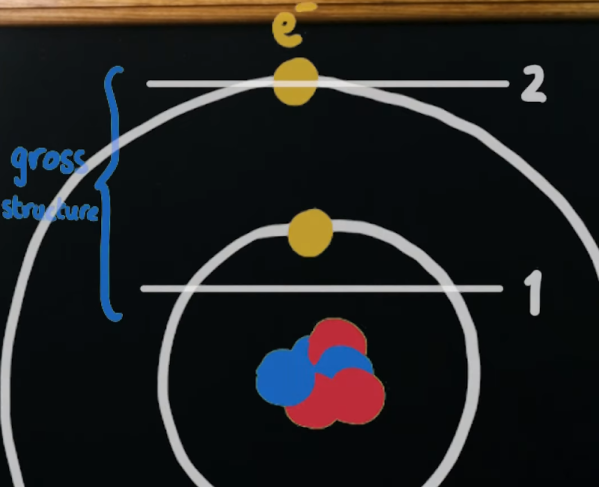
Electronics is really an applied branch of physics, so it isn’t surprising that if you are serious about your electronics, you probably know a little physics, too. If you’ve ever heard the term “fine structure constant” and weren’t entirely sure what it means, [Parth G] wants to explain it to you in about a minute. His video explanation appears below.

You may know that the constant, often represented by α, is approximately 1/137, but what does that mean? The answer relates to the orbit of electrons. You might remember from school that electrons orbit in shells around the nucleus.  That is, an atom might have some electrons in the innermost shell, and more electrons in an outer shell.

Continue reading “The Fine Structure Constant In A Blink”

Julius Sumner Miller Made Physics Fun For Everyone

Let’s face it — for the average person, math and formulas are not the most attractive side of physics. The fun is in the hands-on learning, the lab work, the live action demonstrations of Mother Nature’s power and prowess. And while it’s true that the student must be willing to learn, having a good teacher helps immensely.

Professor Julius Sumner Miller was energetic and enthusiastic about physics to the point of contagiousness. In pictures, his stern face commands respect. But in action, he becomes lovable. His demonstrations are dramatic, delightful, and about as far away from boring old math as possible. Imagine if Cosmo Kramer were a physics professor, or if that doesn’t give you an idea, just picture Doc Brown from Back to the Future (1985) with a thick New England accent and slightly darker eyebrows. Professor Miller’s was a shouting, leaping, arm-waving, whole-bodied approach to physics demonstrations. He was completely fascinated by physics, and deeply desired to understand it as best he could so that he could share the magic with people of all ages.

Professor Miller reached thousands of students in the course of his nearly 40-year teaching career, and inspired millions more throughout North America and Australia via television programs like The Mickey Mouse Club and Miller’s own show entitled Why Is It So? His love for science is indeed infectious, as you can see in this segment about the shock value of capacitors.

Continue reading “Julius Sumner Miller Made Physics Fun For Everyone”

Why Pendulums Sync Up, And Other Mysteries Explained

If you’ve ever seen fireflies flashing together at night, you’ve witnessed the glory of synchronisation. In a new video, [Veritasium] examines some of the mechanisms in nature that help create order out of chaos. 

The story begins back in 1665, when [Christiaan Huygens] discovered that two pendulum clocks hanging from the same wooden beam would spontaneously synchronise over a period of time. The same principle is then demonstrated with metronomes – an experiment readily recreated in the home. Other systems that show this same eerie coordiation are then explored – from tidally locked moons orbiting around planets (like ours!), to chemical oscillators discovered by Soviet scientists during the cold war. There’s also a great explanation of the problems faced by the London Millennium Bridge, which swayed wildly under heavy foot traffic as it induced pedestrians to walk in sync.

Overall, it’s a look at some of the action behind the scenes that ties seemingly independent systems together. Learning about such things can prove useful too – it might even help you solve real world problems in your machine shop! Video after the break.

Continue reading “Why Pendulums Sync Up, And Other Mysteries Explained”

Physics Of Lightning Hack Chat

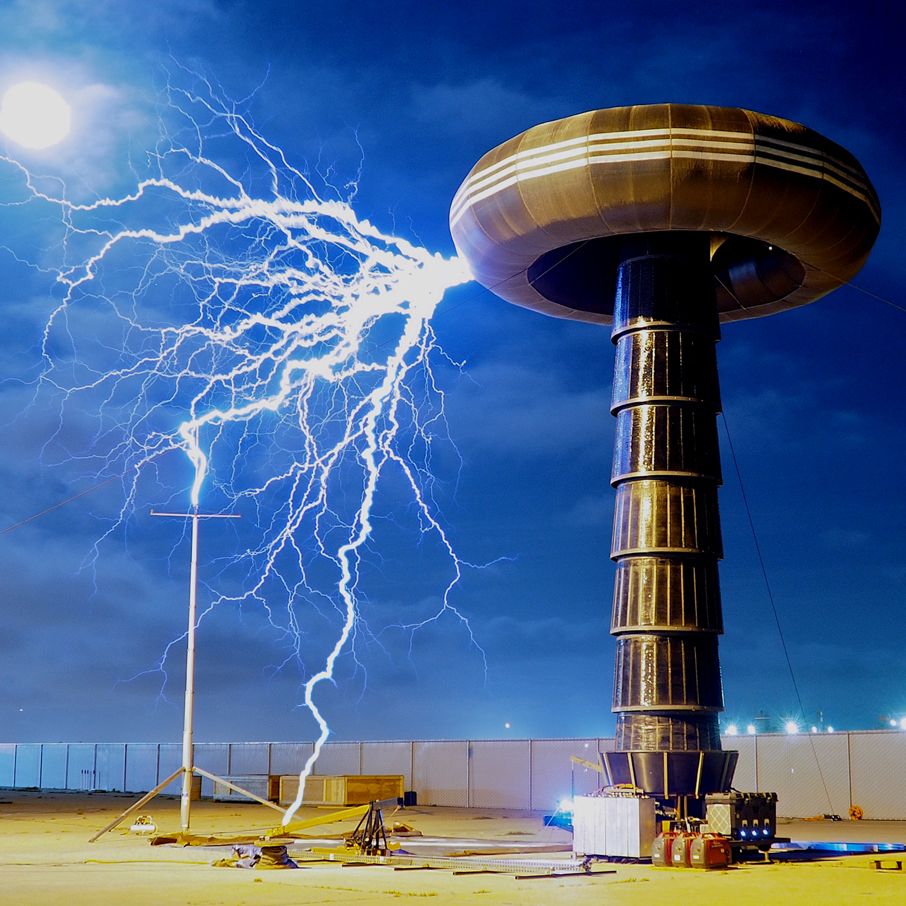
Join us on Wednesday, March 31 at noon Pacific for the Physics of Lightning Hack Chat with Greg Leyh!

Of all the things that were around to terrify our ancestors, lightning must have been right up there on the list. Sure, the savannahs were teeming with things that wanted to make lunch out of you, but to see a streak of searing blue-white light emerge from a cloud to smite a tree out of existence must have been a source of dread to everyone. Even now, knowing much more about how lightning happens and how to protect ourselves from it, it’s still pretty scary stuff to be around.

But for as much as we know about lightning, there are plenty of unanswered questions about its nature. To get to the bottom of this, Greg Leyh wants to build a lightning machine of gargantuan proportions: a pair of 120 foot (36 m) tall Tesla towers. Each 10-story tower will generate 8.8 million volts and recreate the conditions inside storm clouds. It’s an ambitious goal, but Greg and his team at Lightning on Demand have already built and demonstrated a 1/3-scale prototype Tesla tower, which is impressively powerful in its own right.

As you can imagine, there are a ton of engineering details that have to be addressed to make a Tesla tower work, not to mention the fascinating physics going on inside a machine like this. Greg will stop by the Hack Chat to answer our questions about the physics of lightning, as well as the engineering needed to harness these forces and call the lightning down from the sky.

join-hack-chatOur Hack Chats are live community events in the Hackaday.io Hack Chat group messaging. This week we’ll be sitting down on Wednesday, March 31 at 12:00 PM Pacific time. If time zones have you tied up, we have a handy time zone converter.

Click that speech bubble to the right, and you’ll be taken directly to the Hack Chat group on Hackaday.io. You don’t have to wait until Wednesday; join whenever you want and you can see what the community is talking about.
Continue reading “Physics Of Lightning Hack Chat”

How The LIGO Observatory Detects Gravitational Waves

Gravity is one of the more obvious forces in the universe, generally regarded as easily noticeable by the way apples fall from trees. However, the underlying mechanisms behind gravity are inordinately complex, and the subject of much study to this day.

A major component of this study is around the concept of gravitational waves. First posited by Henri Poincaré in 1905, and later a major component of Einstein’s general theory of relativity, they’re a phenomena hunted for by generations of physicists ever since. For the team at the Laser Interferometer Gravitational-wave Observatory, or LIGO, finding direct evidence of gravitational waves is all in a day’s work.

Continue reading “How The LIGO Observatory Detects Gravitational Waves”

Duality Of Light Explored By Revisiting The Double-Slit Experiment

We’ve all seen recreations of the famous double-slit experiment, which showed that light can behave both as a wave and as a particle. Or rather, it’s likely that what we’ve seen is the results of the double-slit experiment, that barcode-looking pattern of light and dark stripes, accompanied by some handwaving about classical versus quantum mechanics. But if you’ve got 20 minutes to invest, this video of the whole double-slit experiment cuts through the handwaving and opens your eyes to the quantum world.

For anyone unfamiliar with the double-slit experiment,  [Huygens Optics] actually doesn’t spend that much time explaining the background. Our explainer does a great job on the topic, but suffice it to say that when coherent light passes through two closely spaced, extremely fine openings, a characteristic pattern of alternating light and dark bands can be observed. On the one hand, this demonstrates the wave nature of light, just as waves on the ocean or sound waves interfere constructively and destructively. On the other hand, the varying intensity across the interference pattern suggests a particle nature to light.

To resolve this conundrum, [Huygens] jumps right into the experiment, which he claims can be done with simple, easily sourced equipment. This is belied a little by the fact that he used photolithography to create his slits, but it should still be possible to reproduce with slits made in more traditional ways. The most fascinating bit of this for us was the demonstration of single-photon self-interference using nothing but neutral density filters and a CCD camera. The explanation that follows of how it can be that a single photon can pass through both slits at the same time is one of the most approachable expositions on quantum mechanics we’ve ever heard.

[Huygens Optics] has done some really fascinating stuff lately, from variable profile mirrors to precision spirit levels. This one, though, really helped scratch our quantum itch.