Minimal Mighty Mite

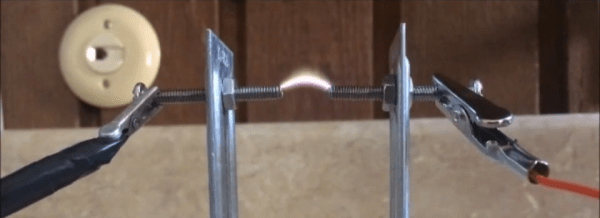
If you’re getting started building your own ham radio gear, it’s hard to imagine a more low-tech transmitter than the Mighty Mite, but [Paul Hodges, KA5WPL] took it one step further and rolled his own variable capacitor. (That’s the beer can with tape and alligator clips that you see on the left.)

A Mighty Mite is barely a radio at all. One transistor, capacitor, crystal and inductor in the form of a bunch of wire wrapped around a pill bottle form a minimalist oscillator, and then by keying this on and off with a switch, you’re sending Morse code. [Bill Meara], of the Soldersmoke Podcast, has been a passionate advocate of the Mighty Mite, suggesting that it can be made by scrounging the 3.57954 MHz colorburst crystal from an old analog TV set, which tunes the radio to a legal frequency for ham radio operators. (It will also probably work with other low-MHz crystals from your junkbox, but it won’t necessarily be legal.)

michigan_mighty_mite_schematicIf the crystal is “easily” scavengeable, and the rest of the radio is easily home-made, the tuning capacitor (obtainable from old AM/FM radios) can become the sticking point. So [Paul] cut up two aluminum “beverage” cans, wrapped the inner one in electrical tape, hooked up wires and made his own variable capacitor. By sliding the cans in or out so that more or less of them overlap, he can tune the radio to exactly the crystal’s natural frequency.

If you’re interested in building a Mighty Mite, you should definitely look at the topic on Soldersmoke. There are more build instructions online as well as plans for an optional filter to take off the harmonics if you’re feeling ambitious.

If you’re not a Morse code wiz, we can’t help but note that you could replace the key with a simple FET (we’d use a 2N7000, but whatever) and then you’ve got the radio under microcontroller control. Scavenge through Hackaday’s recent Morse code projects for ideas, and we’re sure you’ll come up with something good.

Continue reading “Minimal Mighty Mite”

Deep Sweep: A Home Made SigInt Platform

Signals Intelligence (SigInt) isn’t something that you normally associate with home hackers, but the Deep Sweep project is looking to change that: it is a balloon platform that captures radio signals in the stratosphere, particularly conversations between drones and satellites. Created by three students at the Frank Ratchye Studio for Creative Inquiry at Carnegie-Mellon, Deep Sweep is a platform that is attached to a balloon and which captures signals over a wide range of frequencies, logging them for later analysis. The current version captures data on three frequency bands: LF/HF (10KHz-30KHz), UHF (650 – 1650MHz) and SHF (10-20GHz). The latter are often the bands used for satellite links between drones and satellites. They are difficult to intercept from the ground, as the signals are directed upwards towards the satellite. By creating a platform that can fly several kilometers above the earth, they are hoping to be able to capture some of this elusive traffic.

So far, the team has made two flights in Europe, both of which encountered technical issues. The first had a battery fault and only captured 10 minutes of data, and the second flew further than expected and ended up in Belarus, a country that isn’t likely to welcome this kind of thing. Fortunately, they were able to recover the balloon and are working on future launches in Europe and the USA. It will be interesting to see how the Department of Homeland Security feels about this.

Reverse Engineering Traffic Lights With Software Defined Radio

Construction crews tearing up the street to lay new internet fiber optic cable created a unique opportunity for [Bastian Bloessl]. The workers brought two mobile traffic lights to help keep the road safe while they worked. [Bastian] had heard that these lights use the 2 meter band radios, so he grabbed his RTL-SDR USB stick and started hacking. Mobile traffic lights are becoming more common in Europe. They can be controlled by a clock, traffic volume via an on-board camera, wire or radio. They also transmit status data, which is what [Bastian] was hoping to receive.

A quick scan with GQRX revealed a strong signal on 170.760 MHz. Using baudline and audacity, [Bastian] was able to determine that Audio Frequency Shift Keying was used to modulate the data. He created a simple receiver chain in GNU radio, and was greeted with a solid data stream from the lights. By watching the lights and looking at the data frames, [Bastian] was able to determine which bits contained the current light status. A quickly knocked up web interface allowed him to display the traffic light status in real-time.

It’s a bit scary that the data was sent in plaintext, however this is just status data. We hope that any command data is sent encrypted through a more secure channel.

Continue reading “Reverse Engineering Traffic Lights With Software Defined Radio”

Reverse Engineering An Obsolete Security System

[Veghead] recently went to a surplus warehouse filled with VHS editing studios, IBM keyboards, electronic paraphernalia from 40 years ago, and a lot of useless crap. His haul included a wooden keypad from an old alarm system that exuded 1980s futurism, and he figured it would be cool to hook this up to an alarm system from 2015. How did he do that? With software defined radio.

After pulling apart the alarm panel, [Veghead] found only a single-sided board with a 9V battery connector. There were no screw terminals for an alarm loop, meaning this entire system was wireless – an impressive achievement for the mid-80s hardware. A quick search of the FCC website showed this alarm panel was registered to two bands, 319MHz and 340MHz, well within the range of an RTL-SDR USB TV tuner dongle.

After capturing some of the raw data and playing it back in Audacity, [Veghead] found a simple OOK protocol that sends two identical binary patterns for each key. A simple program takes the raw bit patterns for each key press and codes them into a map for each of the twelve buttons.

Although the radio still works, [Veghead] found the waveforms captured by his RTL-SDR were an abomination to RF. All the components in this security system are more than 30 years old at this point, and surely some of the components must be out of spec by now. Still, [Veghead] was able to get the thing working again, a testament to the usefulness of a $20 USB TV tuner.

Thanks [Jose] for sending this one in

Strange Signals? Sigidwiki!

If you’ve gotten into software-defined radio (SDR) in the last five years, you’re not alone. A lot of hackers out there are listening in to the previously unheard. But what do you do when you find an interesting signal and you don’t know what it is? Head on over to the Signal Identification Wiki! You’ll find recordings and waterfall plots for a ton of radio signals categorized by frequency band as well as their use.

Or, conversely, maybe you’ve just got a new radio and you want to test it out. What would be a fun challenge to receive? Signals in the catalog range from the mundane, like this smart home energy meter from California, or a Chrysler tire-pressure monitoring system to (probably) secret military or intelligence transmissions.

If you’re looking at a waterfall plot and you’re not sure what to make of it, the sigidwiki is worth a look. And it’s a wiki, so if you’ve got a cool signal and you want to add it, create an account and get to it!

Thanks to [mkie] for the tip!

Crystal Radio: It’s A Match!

A crystal radio is often a kid’s first introduction to building something electronic. [Billy Cheung] is a crystal radio builder who wants to “make crystal radios as easy to use as regular radios.” He’s built many sets, but his latest is one that not only fits in a matchbox, but uses the matchbox as a variable tuning inductor.

There’s no oatmeal box in this design and just a few components. The matchbox contains some ferrite rods and two different windings. By moving the inner part of the matchbox, you can tune different stations. Although the design calls for two fixed capacitors [Billy] found he had enough self resonance (presumably from stray capacitance) that omitting them didn’t hurt his reception of strong signals.

Continue reading “Crystal Radio: It’s A Match!”

RTLSDR

Decoding Satellite-based Text Messages With RTL-SDR And Hacked GPS Antenna

[Carl] just found a yet another use for the RTL-SDR. He’s been decoding Inmarsat STD-C EGC messages with it. Inmarsat is a British satellite telecommunications company. They provide communications all over the world to places that do not have a reliable terrestrial communications network. STD-C is a text message communications channel used mostly by maritime operators. This channel contains Enhanced Group Call (EGC) messages which include information such as search and rescue, coast guard, weather, and more.

Not much equipment is required for this, just the RTL-SDR dongle, an antenna, a computer, and the cables to hook them all up together. Once all of the gear was collected, [Carl] used an Android app called Satellite AR to locate his nearest Inmarsat satellite. Since these satellites are geostationary, he won’t have to move his antenna once it’s pointed in the right direction.

Hacked GPS antenna
Hacked GPS antenna

As far as antennas go, [Carl] recommends a dish or helix antenna. If you don’t want to fork over the money for something that fancy, he also explains how you can modify a $10 GPS antenna to work for this purpose. He admits that it’s not the best antenna for this, but it will get the job done. A typical GPS antenna will be tuned for 1575 MHz and will contain a band pass filter that prevents the antenna from picking up signals 1-2MHz away from that frequency.

To remove the filter, the plastic case must first be removed. Then a metal reflector needs to be removed from the bottom of the antenna using a soldering iron. The actual antenna circuit is hiding under the reflector. The filter is typically the largest component on the board. After desoldering, the IN and OUT pads are bridged together. The whole thing can then be put back together for use with this project.

Once everything was hooked up and the antenna was pointed in the right place, the audio output from the dongle was piped into the SDR# tuner software. After tuning to the correct frequency and setting all of the audio parameters, the audio was then decoded with another program called tdma-demo.exe. If everything is tuned just right, the software will be able to decode the audio signal and it will start to display messages. [Carl] posted some interesting examples including a couple of pirate warnings.

If you can’t get enough RTL-SDR hacks, be sure to check out some of the others we’ve featured in the past. And don’t forget to send in links to your own hacking!