One Sailing Pulley To Rule Them All

When thinking of humanity’s ability to harness wind energy, many people will conjure images of windmills from places like The Netherlands or Persia. But people have been using wind energy for far longer than that in the form of sailing ships. Using the wind for transportation goes back another four thousand years or so, but despite our vast experience navigating the seas with wind alone there is still some room for improvement. Many modern sailboats use a number of different pulleys to manage all of the rigging, but this new, open-source pulley can replace many of them.

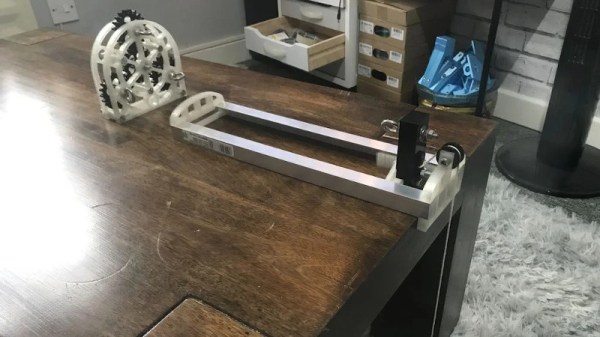
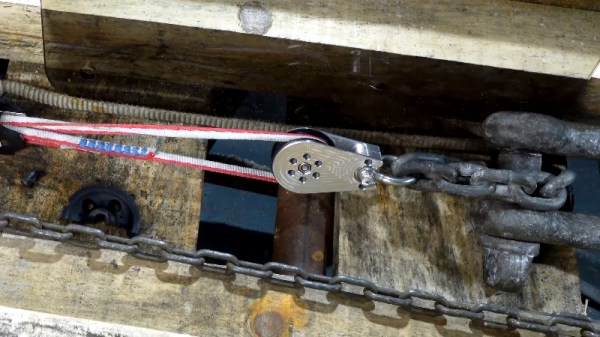
The pulley, or “block” as they are sometimes called, is built with a polymer roller made out of a type of nylon, which has the benefit of being extremely durable and self-lubricating but is a bit expensive. Durability and lack of squeakiness is important in sailing applications, though. The body is made from CNC-machined aluminum and is composed of two parts, which pivot around the pulley’s axis to allow various ropes (or “lines”) to be inserted without freeing one end of the rope. In testing, this design outperformed some proprietary stainless steel pulleys of similar size.

Another perk of this design is that it can be set up to work in many different applications on a sailboat, whether that’s for hoisting a mainsail or pulling in a jib or any other task a pulley could be used for. It can also be stacked with others in many different configurations to build custom pulleys of almost any type, and can support up to 14 mm lines. For a sailor this could be extremely valuable, because as it stands each pulley on a ship tends to be used in only certain applications, and might also be proprietary from a specific company. This pulley is being released into the open-source world, allowing anyone to create them who wants one.

Thanks to [Keith] for the tip!

Continue reading “One Sailing Pulley To Rule Them All”

South Korea Brought High-Rise Fire Escape Solutions To The Masses

When a fire breaks out in a high-rise building, conventional wisdom is that stairwells are the only way out. Lifts are verboten in such scenarios, while sheer height typically prevents any other viable route of egress from tall modern buildings. If the stairs are impassable, or you can’t reach them, you’re in dire peril.

In South Korea, though, there’s another option for escape. The answer involves strapping on a harness and descending down ropes hanging off the side of the building, just like in an action movie. It might sound terrifying, but these descending lifeline devices have become a common part of fire safety infrastructure across the country.

Continue reading “South Korea Brought High-Rise Fire Escape Solutions To The Masses”

students overlooking their rope-traversing robots

Crawler Challenge: Building Rope-Traversing Robots

Rope-climbing robots are the stuff of engineering dreams. As kids, didn’t we all clutter our family home with constructions of towers and strings – Meccano, or Lego – to have ziplines spanning entire rooms? Good for the youngsters of today, this has been included in school curricula. At the University of Illinois, the ME 370 students have been given the task of building a robot that can hang from a rope and walk across it—without damaging the rope. The final projects show not only how to approach tricky design problems, but also the creative solutions they stumbled upon.

Imagine a tiny, rope-climbing walker in your workshop—what could you create?

The project is full of opportunities for those thinking out of the box. It’s all about the balance between innovation and practicality: the students have to come up with a solution that can move at least 2 meters per minute, fits in a shoebox, and has some creative flair—no wheels allowed! The constraints provide an extra layer of challenge, but that’s where the fun lies. Some students use inverted walkers, others take on a more creature-like approach. The clever use of motors and batteries shows just how far simple tech can go when combined with a bit of engineering magic.

This project is a fantastic reminder that even small, seemingly simple design challenges can lead to fascinating creations. It invites us adults to play, and by that, we learn: a win-win situation. You can find the original article here, or grab some popcorn and watch the video below.

Continue reading “Crawler Challenge: Building Rope-Traversing Robots”

When Your Rope Is Your Life

Climbers care a lot about their ropes because their lives literally depend on them. And while there’s been tremendous progress in climbing rope tech since people first started falling onto hemp fibers, there are still accidents where rope failure is to blame.

This long, detailed, and interesting video from [Hard is Easy] follows him on a trip to the Mammut test labs to see what’s up with their relatively new abrasion-resistant rope. His visit was full of cool engineering test rigs that pushed the ropes to breaking in numerous ways. If you climb, though, be warned that some of the scenes are gut-wrenchingly fascinating, watching the ropes fail horribly in well-shot slow-mo.

Continue reading “When Your Rope Is Your Life”

A Rope Maker You Can 3D Print At Home

Ropes are one of those things that, while possible to make by hand, having a little mechanical help goes a long way in their manufacture. [b33ma247] wanted just such a rig, so set about building one from scratch.

It’s a simple device, but one that makes the task much easier. A series of gears are printed, which assemble on to a frame to form the winding mechanism that weaves the rope. There’s also a slide, a rope separator, and a weight carriage to ensure proper tension is kept on the string during the weaving process. The mechanism is driven by a power drill, though this could be easily replaced with a hand crank if full manual operation was desired.

It’s a project which shows if you have a 3D printer, you can make a lot of other useful tools for your workshop too. We see similar approaches taken when it comes time to wind coils, too. Video after the break.

Continue reading “A Rope Maker You Can 3D Print At Home”

Magnets And Printed Parts Make Quick-Disconnect Terminals

The Apple MagSafe power connector is long gone from their product line, but that doesn’t mean that magnetic connectors aren’t without their charms. It just takes the right application, and finding one might be easier with these homebrew magnetic connectors.

We’ll admit that the application that [Wesley Lee] found for his magnetic connectors is perhaps a little odd. He’s building something called Linobyte, a hybrid art and electronics project that pays homage to computing history with very high-style, interactive core memory modules. The connectors are for the sense wire that is weaved through the eight toroids on each module, to program it with a single byte. Each connector has a 3D-printed boot that holds a small, gold-plated neodymium magnet with the sense wire soldered to it. A socket holds another magnet to the underside of a PCB. The magnet in the boot sticks to the PCB and makes contact with pads, completing the circuit. We know what you’re thinking: heating a magnet past the Curie point is a great way to ruin it. [Wesley] admits that happens, but it just makes the connection a little weaker, which works for his application. The short video below shows how he puts them together.

We can think of a couple of ways these connectors would be useful, and we really like the look of the whole project. It’ll be interesting to see where it goes, but in the meantime, brushing up on how magnets work could be fun. Continue reading “Magnets And Printed Parts Make Quick-Disconnect Terminals”

Lawn From Hell Saved By Mower From Heaven

It’s that time of year again, at least in the northern hemisphere. Everything is alive and growing, especially that narrow-leafed non-commodity that so many of us farm without tangible reward. [sonofdodie] has a particularly hard row to hoe—his backyard is one big, 30° slope of knee-ruining agony. After 30 years of trudging up and down the hill, his body was telling him to find a better way. But no lawn service would touch it, so he waited for divine inspiration.

And lo, the answer came to [sonofdodie] in a trio of string trimmers. These Whirling Dervishes of grass grazing are mounted on a wheeled plywood base so that their strings overlap slightly for full coverage. Now he can sit in the shade and sip lemonade as he mows via rope and extension cord using a mower that cost about $100 to build.

These heavenly trimmers have been modified to use heavy nylon line, which means they can whip two weeks’ worth of rain-fueled growth with no problem. You can watch the mower shimmy down what looks like the world’s greatest Slip ‘n Slide hill after the break.

Yeah, this video is two years old, but somehow we missed it back then. Ideas this fresh that tackle age-old problems are evergreen, unlike these plots of grass we must maintain. There’s more than one way to skin this ecological cat, and we’ve seen everything from solar mowers to robotic mowers to mowers tied up to wind themselves around a stake like an enthusiastic dog.

Continue reading “Lawn From Hell Saved By Mower From Heaven”