3D-Printed Rover Rolls Light And Looks Right

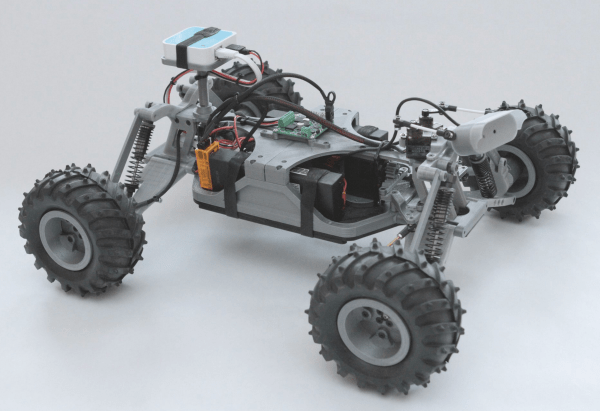
[Rick Winscott]’s RO-V Remotely Operated Vehicle instructable shows you how to make this cool-looking and capable robot. The rover, a 1/10th scale truggy, sports a chassis printed in silver and black PLA. It’s got a wireless router mounted on the back, and a webcam in a 2-servo gimbal up front. [Rick] made his own steering rack and pinion out of 3D printed parts and brass M3-threaded rods which he tapped himself.

The simplified drive system nixes the front, rear, and center differentials, thereby saving [Rick] on printing time, complexity, and weight — he was able to include a second 4000 mAH battery. A TReX Jr motor controller runs a pair of Pololu gear motors. All of this is controlled by a Beaglebone Black alongside a Spektrum DX6i 2.4Ghz transmitter and an OrangeRx 6-channel receiver. The DX6i [Rick] employs typically finds use as an airplane/quad controller, but he reconfigured it to steer the rover—the left stick controls direction and the right stick (elevator and aileron) control the webcam servos.

Enough talking technicals. We think this rover is pretty in the face. Much of this attraction owes to the set of Dagu Wild Thumper wheels (an entirely reasonable name) and the awe-inspiring 100mm shocks that jack up this whip so pleasingly. However, [Rick]’s elegant chassis and the silver-and-black color scheme doesn’t hurt one bit. The wheels are mostly for the cool factor, however—[Rick] recommends swapping out the relatively modest Pololu 20D gear motors in favor of higher-torque models if you’re planning any actual off-road extremeness. If you’re interested in making your own you can download the chassis files from Tinkercad or the BeagleBone code from Github.

If it’s other drone projects you’re after, check out the duct rover and solar wifi rover we published recently.

Arpeggio – The Piano SuperDroid

I never had the musical talent in me. Every now and then I would try to pick up a guitar or try and learn the piano, romanticising a glamorous career out of it at some point. Arpeggio – the Piano SuperDroid (YouTube, embedded below) sure makes me glad I chose a different career path. This remarkable machine is the brain child of [Nick Morris], who spent two years building it.

Although there are no detailed technical descriptions yet, at its heart this handsome robot consists of a set of machined ‘fingers’ connected to a set of actuators — most likely solenoids . The solenoids are controlled by proprietary software that combines traditional musical data with additional parameters to accurately mimic performances by your favourite pianists, right in your living room. Professional pianists, who were otherwise assuming excellent job security under Skynet, clearly have to reconsider now.

Continue reading “Arpeggio – The Piano SuperDroid”

Robotic Farming, Aussie Style

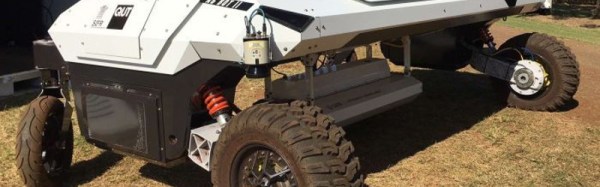
Australian roboticists from the Queensland University of Technology have developed a prototype agricultural robot that uses machine vision to identify both weed and crop plants before either uprooting or poisoning the weeds or applying fertiliser to the crop.

The machine is a wide platform designed to straddle a strip of the field upon which it is working, with electric wheel motors for propulsion. It is solar-powered, and it is envisaged that a farm could have several of them continuously at work.

At a superficial level there is nothing new in the robot, its propulsion, or even the plant husbandry and weeding equipment. The really clever technology lies in the identification and classification of the plants it will encounter. It is on the success or failure of this in real farm environments that the robot’s future will hinge. The university’s next step will be to take it on-farm, and the ABC report linked above has a wonderfully pithy quote from a farmer on the subject. You can see the machine in action in the video below the break.

Farming robots have a significant following among the hardware hacker community, but it is possible that the machine-vision and plant-identifying abilities of this one would be beyond most hackers. However it is still an interesting project to watch, marking as it does a determined attempt to take the robot out of the lab and into real farm settings.

Continue reading “Robotic Farming, Aussie Style”

Hackaday Prize Entry: Solar WiFi Rover Roves At Night

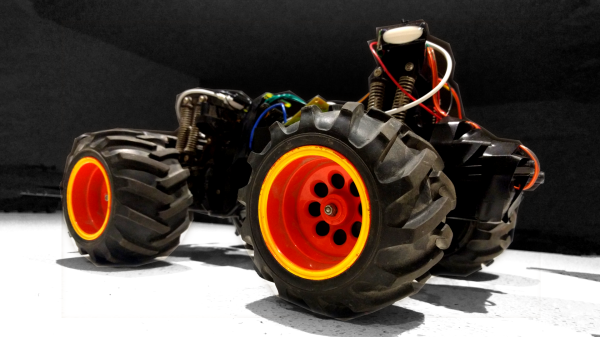
[TK] has a stretch goal for his RC car project — enabling it to recharge on solar power during the day and roam around under remote Internet control at night. It’s like a miniature, backyard version of NASA’s Curiosity rover.

Right now, he’s gotten a Raspberry Pi Zero and a camera on board, and has them controlling the robot over WiFi. He looks like he’s having a great time piloting it around his house. Check out the video down below for (crashy) remote-controlled operation.

We can’t wait to see if solar power is remotely possible (tee-hee!) as an option for this vehicle. The eventual plan to connect it via 3G cellular modem is still off in the future, and will probably demand more of the smarts of the Raspberry Pi than at present. But we love the idea of a long-running autonomous vehicle, so we’re pulling for you, [TK]!

Continue reading “Hackaday Prize Entry: Solar WiFi Rover Roves At Night”

DTMF Robot Makes Rube Goldberg Proud

Sometimes you start building, and the project evolves. Layers upon layers of functionality accrue, accrete, and otherwise just pile up. Or at least we’re guessing that’s what happened with [Varun Kumar]’s sweet “Surveillance Car Controlled by DTMF“.

In case you haven’t ever dug into not-so-ancient telephony, Dual-tone, multi-frequency signalling is what made old touch-tone phones work. DTMF, as you’d guess, encodes data in audio by playing two pitches at once. Eight tones are mapped to sixteen numbers by using a matrix that looks not coincidentally like the old phone keypad (but with an extra column). One pitch corresponds to a column, and one to a row. Figure out which tones are playing, and you’ve decoded the signal.

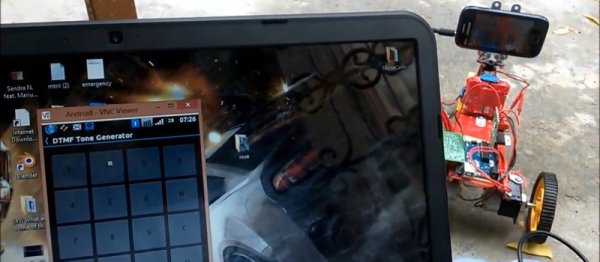
Anyway, you can get DTMF decoder chips for pennies on eBay, and they make a great remote-control interface for a simple robot, which is presumably how [Varun] got started. And then he decided that he needed a cell phone on the robot to send back video over WiFi, and realized that he could also use the phone as a remote controller. So he downloaded a DTMF-tone-generator app to the phone, which he then controls over VNC. Details on GitHub.

Continue reading “DTMF Robot Makes Rube Goldberg Proud”

Smartphone-based Robotic Rover Project Goes Open Source

[Aldric Négrier] wrote in to let us know that his DriveMyPhone project has been open sourced. The project is a part telepresence, part remote-controlled vehicle, part robotic rover concept on which he says “I spent more time […] than I should have.” He has shared not just the CAD files, but every detail including tips on assembly. He admits that maybe a robotic chassis for a smartphone might not seem like a particularly new idea today, but it was “an idea with more potential” back in 2010 when he first started.

The chassis is made to cradle a smartphone. Fire up your favorite videoconferencing software and you have a way to see where you’re going as well as hear (and speak to) your surroundings. Bluetooth communications between the phone and the chassis provides wireless control. That being said, this unit is clearly designed to be able to deal with far more challenging terrain than the average office environment, and has been designed to not only be attractive, but to be as accessible and open to repurposing and modification as possible.

Continue reading “Smartphone-based Robotic Rover Project Goes Open Source”

Hacklet 106 – Robots That Teach

One of the best ways to teach electronics and programming is with hands-on learning. Get the concepts off the computer screen and out into the real world. Students of all ages have been learning with robots for decades. Many older Hackaday readers will remember the turtle robots. These little ‘bots would drive around drawing shapes created in the logo programming language. This week’s Hacklet is all about the next generation of robots that teach electronics, mechanics, programming, and of course, hacking. So let’s check out some of the best educational robot projects on Hackaday.io!

edubotWe start with [Tom Van den Bon] and Edubot Controller (Benny). Buying one or two robots can get expensive. Equipping a classroom full of them can break the bank. [Tom] is hoping to make robots cheaper and more accessible with Edubot, his entry in the 2016 Hackaday prize. Edubot rides on a 3D printed frame with low-cost gear motors for a drive system. Edubot’s brain is an STM32F042, a low-cost ARM processor from ST micro. The micro and motor drives are integrated into a custom board [Tom] designed. He’s has even begun creating lesson plans so students of various ages and skill levels can participate and learn.

microbotNext up is [Joshua Elsdon] with Micro Robots for Education. Big robots can be intimidating. They can also cause some damage when hardware and software created by budding engineers doesn’t operate as expected. Tiny robots though, are much easier to wrangle. [Joshua ] may have taken tiny to an extreme with these robots. Each robot is under 2 cm square. The goal is for each one to cost less than  £10 to produce. These micro bots have big brains with their ATmega328P micro controllers. [Joshua] is currently trying to figure out a low-cost way to produce wheels for these robots.

Next we have [shamylmansoor] with 3D printed mobile robot for STEM education. Robots are expensive, and international shipping can make them even more expensive. [Shamyl] is shooting for a robot which can be made locally in Pakistan. 3D printing is the answer. The robot’s chassis can be printed on any FDM printer. Wheels,and tires are low-cost units. Motors are RC servos modified for continuous rotation. The brains of the robot is an Arduino Mega 2560, which should provide plenty of inputs for sensors. [Shamyl] even included a solderless breadboard so students can prototype circuits and sensors right on the robot’s body.


plobotFinally we have [Rodolfo] with Plobot. Plobot is a robot designed for the youngest hackers – those from four to seven years old. [Rodolfo] designed Plobot to be programmed with RFID cards. Each card contains a command such as move forward, turn, start, and reset. Many of the language mechanics are inspired by the Scratch programming language. Plobot’s processor is a Sanguino, running [Rodolfo’s] custom code. An ESP8266 allows Plobot to be connected to the outside world via WiFi. [Rodolfo] has even created a custom over the air update system for Plobot’s firmware. Plobot has already been tested with students, where it made a great showing. We’re hoping both [Rodolfo] and Plobot do well in the 2016 Hackaday Prize!

If you want more mind hacking goodness, check out our brand new educational robot list! Did I miss your project? Don’t be shy, just drop me a message on Hackaday.io. That’s it for this week’s Hacklet, As always, see you next week. Same hack time, same hack channel, bringing you the best of Hackaday.io!