Final Project For Better Sleep

It’s that time of year again, and students around the world are scrambling (or have already scrambled) to finish their final projects for the semester. And, while studying for finals prevents many from sleeping an adequate amount, [Julia] and [Nick] are seeking to maximize “what little sleep the [Electrical and Computer Engineering] major allows” them by using their final project to measure sleep quality.

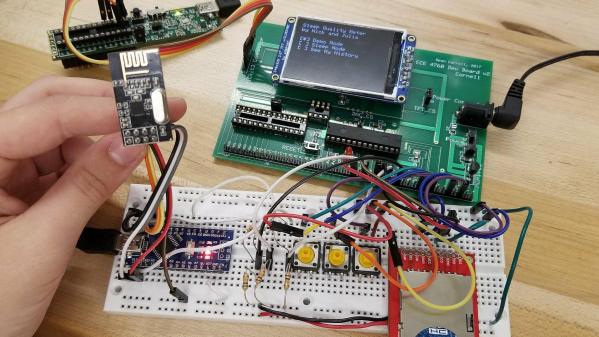
To produce a metric for sleep quality, [Julia] and [Nick] set out to measure various sleep-related activities, specifically heart rate, motion and breath frequency. During the night, an Arduino Nano mounted to a glove collects data from the various sensors mounted to the user, all the while beaming the data to a stationary PIC for analysis and storage. When the user awakes, they can view their sleep report on a TFT display at the PIC base station. Ideally, users would use this data to test different habits in order to get the best nights sleep possible.

Interestingly, the group chose to implement their own heart rate sensor. With an IR transmitter, IR phototransistor and an OP amp, the group illuminates user’s fingers and measure reflection to detect heartbeats. This works because the amount of IR reflected from the user’s finger changes with blood pressure and blood oxygen level, which also happen to change when the heart is beating. There were some bumps along the road when it came to the heartbeat sensor (the need to use a finger instead of the wrist forced them to use a glove instead of a wristband), but we think it’s super cool and totally worth it. In addition to heart rate, motion is measured by an accelerometer and breath is measured by a flex sensor wrapped around the user’s chest.

With all of their data beamed back by a pair of nRF24L01s, the PIC computes the sleep “chaos” which is exactly what it sounds like: it describes just how chaotic the user slept by looking for acyclic and sudden movement. Using this metric, combined with information from breathing and heart rate, the PIC computes a percentage for good sleep where 100% is a great night and 0% means you might have been just as well off pulling an all-nighter. And, to top it all off, the PIC saves your data to an SD card for easy after-the-fact review.

The commented code that powers the project can be found here along with a parts list in their project write-up.

This device assumes that sleeping is the issue, but if waking up if your problem, we’ve already got you covered, aggressive alarm clock style. For those already on top of their sleep, you might want some help with lucid dreaming.

Video of the project explained by [Julia] and [Nick] after the break.
Continue reading “Final Project For Better Sleep”

Students Build Electromagnetic Egg Drop Stand

The Egg Drop is a classic way to get students into engineering, fabrication, and experimentation. It’s a challenge to build a container to protect a raw egg from cracking when dropped from various heights.

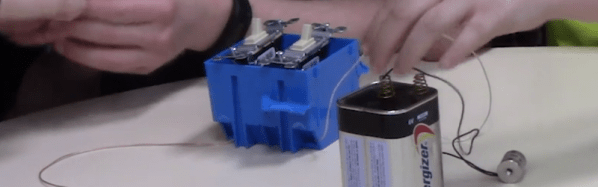
Here’s a way to add some extra hardware to use when testing each entry. It’s an  electromagnetic drop stand built by several students along with [Tom Jenkins]. The stand doesn’t require anything too exotic, and it allows students to drop their eggs in a controlled manner for a fair competition. Along the way, they learn about circuits, electromagnets, and some other electronic concepts.

If this sounds familiar, it is because it builds on the egg drop project from the Teaching Channel we talked about before. The materials for that lesson have the basic outline of the drop stand, but the video really helps kids visualize it and build it.

Continue reading “Students Build Electromagnetic Egg Drop Stand”

Coding As A Foreign Language

How many of you speak more than one language? Since Hackaday is an English-language site whose readership is world-wide, we are guessing quite a lot of you are not monoglots. Did you learn your second or third languages at school, and was it an experience you found valuable? How about your path into software? If you are a coder, were you self-taught or was your school responsible for that as well?

It’s been a constant of the last few decades, officials and politicians in charge of education worrying that tech-illiterate children are being churned out of schools ill-equipped for the Jobs Of Tomorrow, and instituting schemes to address the issue. One of the latest of these ideas has come our way from Florida, and it’s one that has sparked some controversy. It sounds simple enough, make coding equivalent to language learning when it comes to credits in Floridian high schools.

You might think that this idea would be welcome, but instead it has attracted criticism from those concerned that it will become an either-or choice in cash-strapped school districts. This could lead to kids without an extra language being at a disadvantage when it comes to applying for higher education. There are also concerns that the two subjects are not equivalent, and should not be conflated.

It’s difficult from the perspective of an adult technical journalist without a background in education to speculate on the relative benefits to young minds of either approach. It is very likely though that just as with previous generations the schools will discover that there is limited benefit in pushing coding at kids with little aptitude or interest in it, and that the benefits in terms of broader outlook and intellectual exercise gained by learning another language might be lost.

Which was more valuable to you at school, coding or learning a language? Were you of the generation that learned coding through BASIC from the manual that came with your home computer, and should today’s kids be doing the same with Scratch and Python on boards like the Raspberry Pi? Let us know in the comments.

Child at computer image: Nevit Dilmen [CC-BY-SA-3.0], via Wikimedia Commons.

Electric Train Demonstrator

If you ever want to pique a kid’s interest in technology, it is best to bring out something simple, yet cool. There was a time that showing a kid how a crystal radio could pull in a radio station from all the way across town fit the bill. Now, that’s a yawner as the kid probably carries a high-tech cell phone with a formidable radio already. Your latest FPGA project is probably too complicated to grasp, and your Arduino capacitance meter is–no offense–too boring to meet the cool factor criterion.

There’s an old school project usually called an “electromagnetic train” that works well (Ohio State has a good write up about it as a PDF file). You coil some bare copper wire around a tubular form to make a tunnel. Then a AAA battery with some magnets make the train. When you put the train in the tunnel, the magnetic forces propel the train through the tunnel. Well, either that or it shoots it out. If that happens, turn the train around and try again. There’s a few of these in Internet videos and you can see one of them (from [BeardedScienceGuy]) below.

Continue reading “Electric Train Demonstrator”

Unary Clock For The Binary-Challenged

If binary clocks have you confused by all the math required to figure out what time it is, we have the solution for you: a unary clock. After all, what’s simpler than summing up powers of two? Powers of one! To figure out the time, you start with the ones digit. If it’s on, you add one to the total. Then move on to the next digit. Since 12 equals one, you add another one if it’s lit. Then on to the third LED. 13 = 1, so if it’s lit, you add another one, and so on.

OK, we’re messing around. Calling this a “unary” clock is ridiculous. When it’s seven o’clock, there are seven LEDs lit. Nice and easy to read. Sixty minute LEDs is silly, so here each minute LED stands for five minutes. Good enough.

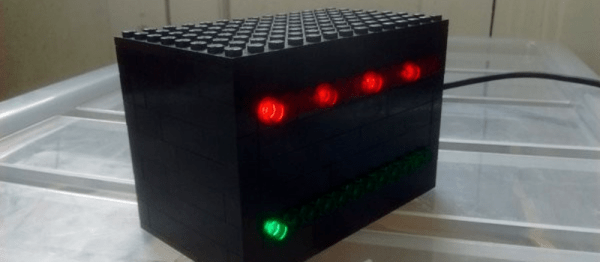
What we really like about this clock is the build. It’s intended as educational for school kids, so it has to be simple to build and easy to personalize. Building the body out of Lego bricks fits the specs nicely. Transparent Lego bricks are used to give the white LEDs some color. That was too bright, so [Shrimping It] added paper cutouts from a hole punch as diffusers.

Clock builds are a great intro to electronics because they offer so many possibilities. Whether you want to go geary, use the clock as an excuse to try out fabrication techniques, or showcase a neat display technology, your imagination has a lot of room to wander. Show us yours?

Kids And Hacking: The One Hour Egg Drop

In the last Hacking and Kids post, I talked about an activity you can do with kids when you don’t have a lot of time or resources. The key idea was to have fun and learn a little bit about open and closed loop control. One of the things I usually briefly mention when I do that is the idea of a design trade: Why, for example, a robot might use wheels instead of legs, or treads instead of wheels.

Engineers and makers perform trades like this all the time. Suppose you are building a data logging system. You want precise samples, large storage capacity, and many channels. But you also want a low cost and low power drain. You might also want high reliability. All of these requirements will lead to different trades. A hard drive would provide a lot of space, but is more expensive, less reliable, larger, and more power hungry than, say, an SD card. So there isn’t a right choice. It depends on which of the factors are most important for this particular design. A data logger in a well-powered rack might be well served to have a terrabyte hard drive, while a battery powered logger in a matchbox that will be up on the side of a mountain might be better off with an SD card.

We can all relate to that example, but it is pretty boring to a kid. You probably can’t get them to design a data logger, anyway. But if I have about an hour and a little prep time, I have a different way to get the same point across. It is a modified version of the classic “egg drop”, but it is simple enough to do in an hour with very little preparation time.

Continue reading “Kids And Hacking: The One Hour Egg Drop”

Flat Pack Lamp

Flat Pack Elastic Band Lamp Is A Thing Of Beauty

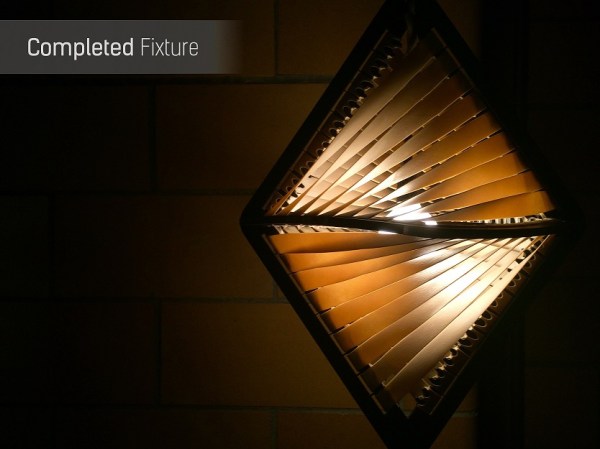
[Matt] was looking for a project for his senior industrial design studio at Wentworth Institute of Technology. He ended up designing a clever lamp that can be flat packed. [Matt] started by drawing out designs on paper. He really liked the idea of combining curves with straight lines, but he wanted to translate his two-dimensional drawings into a three-dimensional shape.

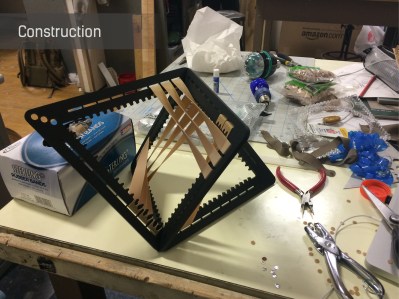
zOz0ys6 - ImgurHaving access to a laser cutter made the job much easier than it could have been and allowed [Matt] to go through many designs for the lamp frame. The two main pieces were cut from acrylic and include mounting pegs for the elastic bands. The two plastic pieces are designed to slot together, forming a sort of diamond shape.



The final version of the lamp required that the elastic bands had holes punched in them for mounting. The holes were placed over the small pegs to keep the bands in place. [Matt] used 3/4″ industrial elastic bands for this project. He then used a 120V 15W candelabra light bulb to illuminate the lamp. The final design is not only beautiful, but it can be flat packed and manufactured inexpensively.

If you want more inspiration for artistically designed lamps check out this one that uses the corrugation in cardboards as a shade pattern.

[via reddit]