Motorized Blinds Put Control At Your Fingertips

remote_controlled_motorized_blinds

While [Bremster] likes the view from his office window, he often needs to get up and adjust the blinds several times throughout the day in order to keep the glare from killing his eyes. Like any other enterprising hacker, he decided that constantly adjusting them was too repetitive, and that he could automate the process with electronics.

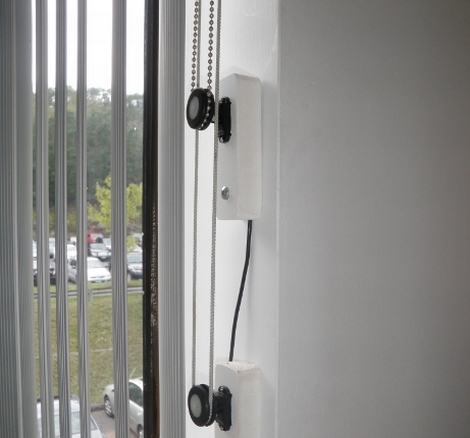
He thought that RC car servos would be a great choice to control the blinds, since they are cheap and the geared drive system offers a lot of torque at low speeds. After modifying the servos to enable continuous rotation, he set off to the hardware store in search of a way to mount them to the blinds’ looped cords.

After mounting some nylon spacers with rubber grommets on the servo arms, he installed them into a set of brackets he built and gave the blinds a spin. Now, he can easily control his blinds from the comfort of his desk with the simple flick of a switch – that’s the kind of laziness ingenuity we can respect!

Continue reading to see a quick video of his motorized blinds in action.

Continue reading “Motorized Blinds Put Control At Your Fingertips”

rfid_door_lock_tutorial

Easily Movable RFID Door Lock Is Great For Dorm Rooms

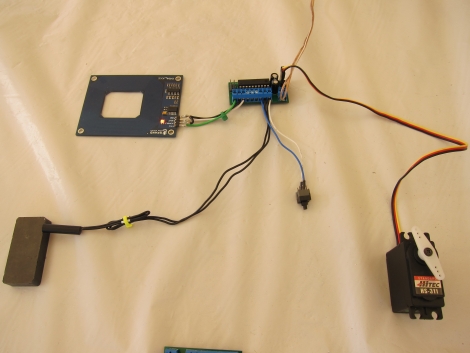
One of the first things that [Eric] hacked together when he got to college was an RFID door locking system. He found that he was often in a rush to get in and out of his dorm room, and that using a simple wireless key was a great way to streamline his days.

Over the years, he has refined his design, and while his original prototype was functional, it was a bit rough around the edges. In the video posted on his site, he thoroughly explains how his system was built, and shows off the revisions he has made over time. One key consideration when building this system was the fact that the installation had to be non-permanent. Since schools typically frown on physically altering your rooms, he found a non-intrusive means to mount his system in the way of zip ties and foam board.

His RFID door lock looks to work quite nicely, and we especially like the inclusion of the reed switch to ensure that the system knows if the door has been opened or not. If you have about half an hour to spare and are interested in building an RFID entry system of your own, be sure to check out [Eric’s] video below for all the details.

Continue reading “Easily Movable RFID Door Lock Is Great For Dorm Rooms”

Schäuble Jr Aims To Take Away Your Privacy!

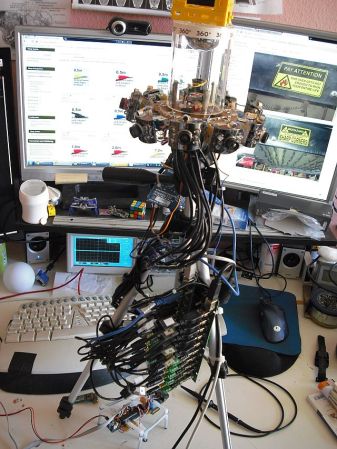
[Mnt] wrote in to tell us about this 360 degree array of cameras featured on [Codeninja]. This has to be one of the most impressive arrays of cameras and sound equipment that we’ve seen at Hack a day.

The array is capable of 360 degree x 140 degree panoramic views using the 9 cameras arranged in a circle around the base. Impressive in itself, these cameras are all capable of both pan and tilt rotation via and Arduino-controlled servo setup. It also has a native 360 degree camera mounted on top of everything for calibration purposes and IR-LED illumination capabilities.

On top of all of this, the camera array also features audio capability with a 9-microphone setup, presumably one for each camera. This, coupled with piezoelectric speakers should provide for echolocation capability. Although jokingly called the “Schäuble Jr.” after a German politician, we’re not sure of the true purpose for this “sensor array.” We can only hope that it will be used for good. A very impressive build, it will be interesting to see what comes of it.

Morphing Hexapod Has Us Drooling

morphex_morphing_hexabot

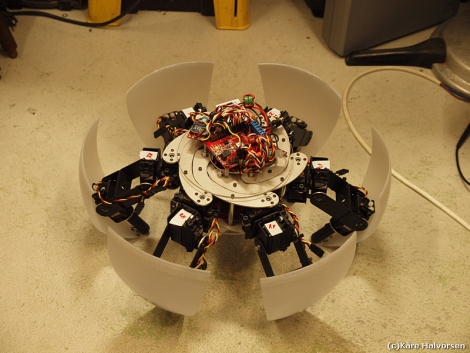
Hexapod robots seem to be a dime a dozen lately, but we think you will be hard pressed to not be wowed by [Zenta’s] latest creation. He’s built a bunch of hex and octopods before, but hasn’t tried building anything quite like this.

His MorpHex bot might look like your standard hexapod, but once it gets moving, you can see that it’s quite unique. Utilizing over 25 servos driven by a single ARC-32 controller, MorpHex moves in smooth, fluid-like motions, making it almost seem like it’s alive. The inner portion of the body can fan out, extending the overall length of the bot, though it’s more meant to allow the bot to morph into a ball and back, rather than increase its size.

In the teaser video below, you can see MorpHex in action, with its parts flowing together more like a jellyfish than any sort of land animal. While [Zenta] is continuing to work on MorpHex’s sphere-morphing capabilities, we think it would make for an awesome and creepy spiderbot!

[Thanks, weaz]

Continue reading “Morphing Hexapod Has Us Drooling”

Head-to-head Mountain Climbing From The Safety Of Your Game Room

Why risk frostbite and altitude sickness when you can marvel at the view from atop your own mountain climbing game?

[Jeff] built this delightful piece which you can see in action after the break. he combined several very simple ideas and he did it really well. The climbers are both mechanical. They grip the mountain’s face (which is covered with of carpet) with a tack pointed downward on the end of each limb. Their motion is provided by two tiny servos that make up the body of the climber. The two potentiometers in each controller directly affect the movement of the top and bottom limbs. The game plays music during the contest, and precisely detects a winner by sensing when an arm comes in contact with the metal snow cap at the summit.

Obviously weight was an issue during the design process. After some hemming and hawing [Jeff] decided to tether the climbers in order to avoid rolling a battery into each. But he overcame the issue with weighted cable management on the inside of the mountain.

Continue reading “Head-to-head Mountain Climbing From The Safety Of Your Game Room”

RC Car And Beagle Board Mate For A Versatile Robot Build

Here’s a rover project that has plenty of power (translated) to go places. This is true not only of its locomotive capability, but processing power as well.

The RC car used here (translated) is not overly expensive, but offers a lot of versatility. It’s got front and rear steering via two servo motors, as well as independent drive motors for each end. The frame also offers an advanced suspension system that lets the vehicle flex to keep as many wheels on the ground as possible. It’s a great find if you don’t want to start off your project bogged down in the hardware design.

On the control side of things a Beagle Board has been choosen. The demo after the break shows it controlling an added turret servo, as well as the drive mechanism controlled via a keyboard. These are driven through the embedded Ubuntu image running on the board. This should provide plenty of processing power to add obstacle avoidance and autonomy routines in future versions.

Continue reading “RC Car And Beagle Board Mate For A Versatile Robot Build”

Cypherbot Uses Older UC And Retro-controller

[PJ Allen] has been working on a little robot which he calls Cypherbot. The control circuitry is quite familiar; a Board of Education which features the Basic Stamp 2 microcontroller. This is an older and slower microprocessor, but it works quite well for this application since there’s no need for speed or heavy number crunching. The wheels of the bot are made out of plastic lids (we’re thinking peanut butter jars) with rubber bands for traction that are each driven by a servo motor. The third wheel is tiny and swivels as needed.

The front of the bot has a PING ultrasonic sensor mounted on a servo motor which lets the bot scan back and forth for a wider obstacle avoidance angle. In addition to the autonomous mode there’s an Xbee remote control. [PJ] picked up an Atari keyboard and is using that as the user input. Check out the little guy driving around the house in the video after the break.

Continue reading “Cypherbot Uses Older UC And Retro-controller”