DIY Animatronic Penguin Shakes And Grooves

animatronic_penguin

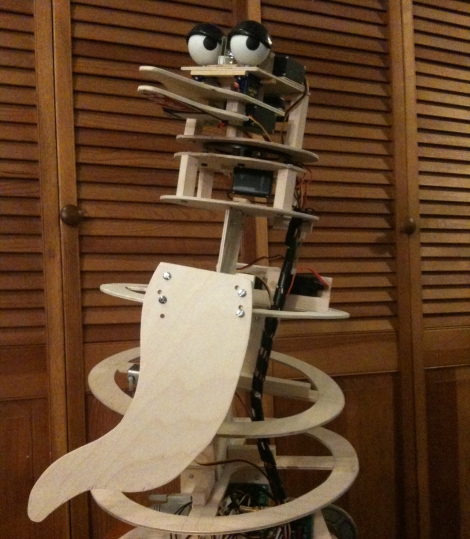
Instructables user [djsfantasi] wanted to build an animated holiday display using puppets as a means of raising money for a local arts program. After doing a bit of reading and research however, he decided that building animatronic characters for the display was not that far fetched an idea.

His first inclination was to build a penguin, allowing him to focus mostly on torso motion rather than having to articulate arms and legs as well. His goal was to enable his penguin to “dance” by shimmying and shaking as well as flapping his wings. Using plywood, four servos, along with some miscellaneous connecting rods and cables, he went to work.

The penguin is operated using a SSC-32 servo controller that features an ATmega168 MCU at its core. This allows him to control all of the servos independently, and also in concert, allowing for combined movements. The penguin’s mouth also functions, using a circuit that synchronizes its movements to an audio file.

While the robot is currently tethered to his computer via a serial cable, [djsfantasi] mentions that he is currently working on an iPhone app that will be able to control the robot wirelessly. All he needs to do now is build an animatronic Tom Servo then toss a Crow skin over this one, and he’ll be all set!

Keep reading to get a look at the penguin moving and grooving in the video below.

Continue reading “DIY Animatronic Penguin Shakes And Grooves”

Machine Pushes Cellphone Buttons From Anywhere In The World

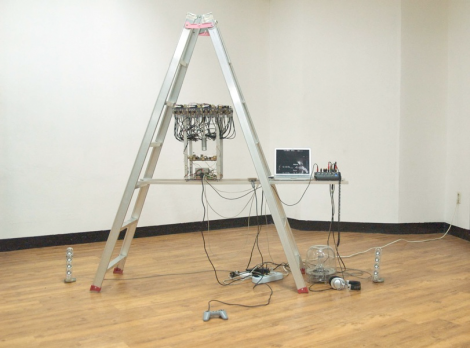
[Mok Young Bacq] works on the weekends for mobile game monitoring service. He has three cellphones that he uses for work, and although you would think this means he could work from anywhere in the world, the roaming charges are a killer. His solution was to build an incredibly intricate machine that can use three different cellphones (PDF) on his behalf.

Above you can see it perched underneath the apex of the ladder, but you’re definitely going to want to watch the video after the break. This interface method uses a camera to look at each phone. It’s hung pointing downward and moves like a pendulum to look at one of the three screens at a time. Each phone has one servo motor for each button, which uses a flexible cable as an actuator. Now he can take trips abroad, just checking in over the Internet for his two 17-hour weekend shifts (10am to 3am the next morning) working the phones.

This reminds us of the cellphone endurance tests. What happens when a button stops working?

Continue reading “Machine Pushes Cellphone Buttons From Anywhere In The World”

KiwiDrive HouseBot

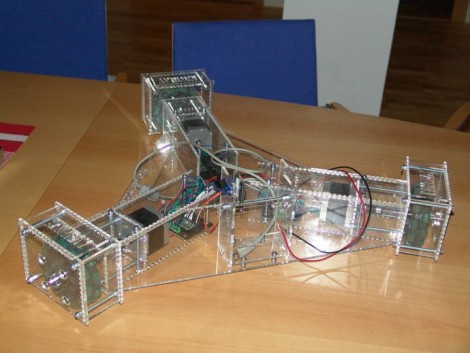
Forskningsavdelningen, a Swedish hackerspace, had a hackathon last weekend and the KiwiDrive HouseBot is one of the items that resulted from the group effort. They set a goal to use standard, easy to obtain parts, so that the robotic platform would be accessible for reproduction by individuals or at other hackerspaces. The three-limbed device rolls around on a triad of omni-directional wheels -which are probably the hardest part to source but you can always print your own. An Arduino Uno was used as the hardware interface, driving the three stepper motors for locomotion.

It’s not pictured above, but the fourth generation of the little guy also includes a webcam. The camera rides in the center of the body and is mounted on a servo. This makes it possible to turn the camera, meaning there’s no real front or back to this design. Future plans include adding an on-board computer (this is larger than it appears) and implementing emoticons on an 8×8 LED matrix, presumably so you can tell how the bot is feeling today.

[Thanks KiwiRay]

DIY Pick And Place Seems Easy To Build

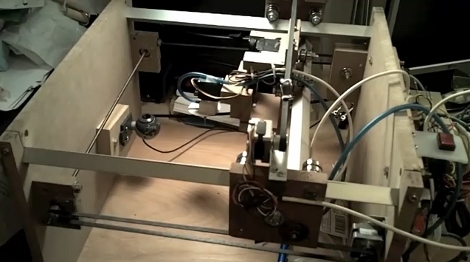
We’re not saying it’s a simple project, but the build methods that [Alan Sawula] used for this DIY pick and place are probably the easiest we’ve seen yet. As this is just a CNC machine, the methods he used would also work quite well for mills or other machines. Instead of using precision rods for the X and Y axes, he used square tubing. The tubing is oriented more like a diamond, with the ninety degree corners providing the travel surface. Two bearings with a shim between them provide a groove that rides along the corner, and since this is square and not just ‘L’ bracket, the sleds are secured both above and below the tube. Stepper motors provide the movement along X and Y, with a servo motor for Z and another one to rotate the medical grade needle that serves as the vacuum tip. Starting four minutes into the video you can see that this not only works, but it’s lightning fast!

Continue reading “DIY Pick And Place Seems Easy To Build”

Bluetooth Tomy Omnibot Hack


tomy_omnibot_hack

[DJ Sures] sent us his most recent hack, and it’s one that is sure to please those who enjoy a good dose of 80’s nostalgia. He located a Tomy Omnibot on eBay and snatched it up immediately. While he was waiting for it to arrive, he planned out what he would add to it once it showed up at his door. Once the robot was delivered, he cleaned it up, painted it, then got down to business.

The original robot had no ability to move its arms or head, so he immediately added servos to enable those actions. A wireless camera was inserted between the Omnibot’s eyes, and a wireless mic was mounted in his chest. He has also added some features found in his previous projects, such as voice recognition, visual recognition, voice synthesis, and the ability to remotely control the bot. He plans on adding an ultrasonic ping sensor and IR floor sensors in the near future. This is a great build so far, and it sounds like he has plenty more in store.

Be sure to stick around for a video of the robot in action, and if you are interested in some of [DJ Sures’] previous work, check these out as well.

Continue reading “Bluetooth Tomy Omnibot Hack”

Hacking Teddy Ruxpin

[DJ Sures] got his hands on a broken Teddy Ruxpin doll and decided to give it a new robotic life. You may want to ask the children to leave the room before viewing the video after the break. It starts right off with little Teddy having his throat slashed in order to get at the parts in the head. After retrofitting the eyes, mouth, neck, and arms with servos, Teddy gets a Bluetooth upgrade that lets you control his movements wirelessly. [DJ Sures] even has plans to get the little guy up and walking, far exceeding the original capabilities.

Continue reading “Hacking Teddy Ruxpin”

The Wandering Arduinobot

You almost have to love this Arduino based robot just because of the wheels and third leg support. Look closely, do you recognize them? Yep, they’re Capsela parts! That’s a blast from the past and we wonder why we don’t see the strange building toys of yore used in more hacks?

But we digress, this little bugger guy uses continuous rotation servos for locomotion. Perched atop the body is a third servo which scans an IR range finder back and forth to look out for obstacles in its path. The body itself is a Black and Decker rechargeable battery pack called Pocket Power which includes a USB port for a regulated 5V supply. One thing’s for sure, this little guy is fantastic at avoiding pizza and beer… you’ll just have to see for yourself after the break.

Continue reading “The Wandering Arduinobot”