Tricycle Robot Using Omni-wheels

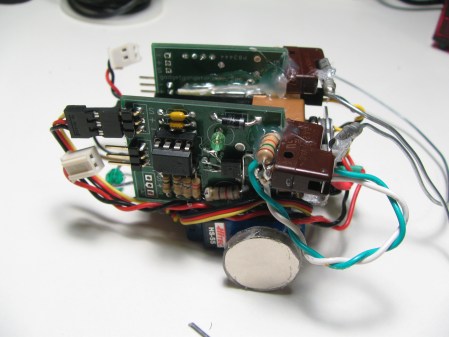
[Markus Gritsch] built this six-wheeled robot usingĀ omni-wheels. Two wheels are used on each axis in order to ensure perpendicular rotation is possible no matter where the axis rotation stops. The wheels have also been improved by dipping the elliptical components to give them a rubbery coating.

The robot gets its commands wirelessly from a separate controller unit. That controller, as well as the bot seen above, uses a Teensy microcontroller board. Two analog sticks take input from the operator and transmit commands using an inexpensive RF pair. The wheel movement is facilitated by three servo motors which may seem like an odd choice. But we think that it simplifies the electronic side of the build because you do not need an H-bridge to control a servo motors. It’s a bit loud, as you can hear in the video after the break, but it certainly works quite well.

One of the commenters on the thread above asks why [Markus] didn’t use mechanum wheels. These would have allowed him to use just one wheel on each axis but the omni-wheels were so inexpensive that he went this route instead.

Continue reading “Tricycle Robot Using Omni-wheels”

RoboTouch Adds Physical Game Controls To The IPad

robotouch

[ProtoDojo] wanted to play a racing game on his iPad, but he was not a big fan of using the touch interface for this particular title. Instead, he put together a pretty neat little hack that allows him to play games on his iPad using an old NES controller.

He built a set of custom conductive arms which he mounted on three micro servos. The servos were attached to the iPad screen using small suction cups in the locations where it expects to receive button presses. They are also wired to an Arduino that interprets button presses from the attached NES controller. When the Arduino senses that the D-pad or buttons have been pressed, it triggers the servos, which in turn press the virtual buttons on the screen.

In the video below, you can see that after adjusting the servo positions, the setup seems to work pretty well. You might expect to see some sort of lag with a setup like this, but we didn’t notice any. The [ProtoDojo] web site is currently down due to heavy traffic, but you should be able to find some more build details there, once it becomes functional again.

Continue reading “RoboTouch Adds Physical Game Controls To The IPad”

Tilt And Pivot Camera Base Uses Just Two Servos

[Caled] shows us how to build a tilt and pivot camera base. One of these can be quite handy for taking precisely aligned images that can later be stitched together into panoramic, or even spherical images. We have grand visions of being able to produce something along the lines of these stunning interactive images with hardware that is cheaper and easier to build than this other motorized rig.

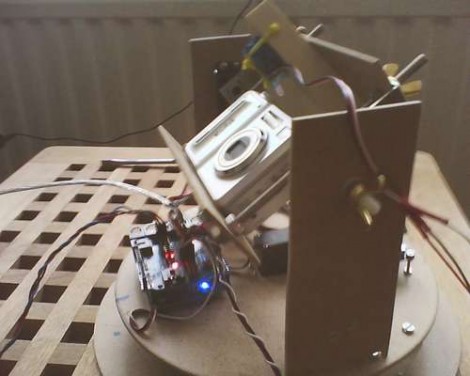
The design utilizes just two servo motors. In the image above you can just make out a pair of discs that serve as the base for the rig. In the center of the upper disc is the first servo, pointing downward, which rotates the camera. Two upright supports on either side of the point-and-shoot provide the framework for the tilt feature. The camera is mounted in a frame whose center is a threaded rod on the near side, and the second servo motor on the far side. An Arduino with a servo shield controls the movements along with a button pad and LCD screen as a user interface. The last step in the project log points to software options for combining the captured photos.

Controlling Fire With Your Mind (and Your Thumb)


[TechB] is using his mind to control fire. Well, what he’s really doing is using a Mindflex to control a lighter.

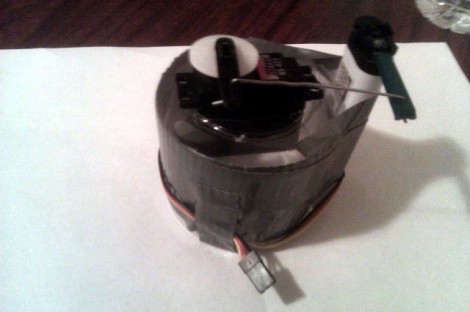
Many will remember the Mindflex from this shockingly awesome hack. But [TechB’s] approach follows in the footsteps of this Arduino interface for the device. He’s using the Arduino Brain Library to read data from the head-mounted EEG and sending commands to his own fire control system. Said system is composed of a cigarette lighter and a servo motor. The motor connects to the gas regulator on the lighter, opening it up when you concentrate and closing it when your mind wanders. The result is a higher flame to show more organized brain function. The only problem with the prototype is the burns you’ll get on your thumb from depressing the lighter’s valve while trying to get your thoughts in order.

Check out the video after the break to see this in action. [TechB] is looking a bit like the Borg at the beginning of the clip, making us wonder what other Mindflex hacks he’s already performed.

Continue reading “Controlling Fire With Your Mind (and Your Thumb)”

Jittering Hexapod Dances To The Strokes Of Your Bluetooth Keyboard

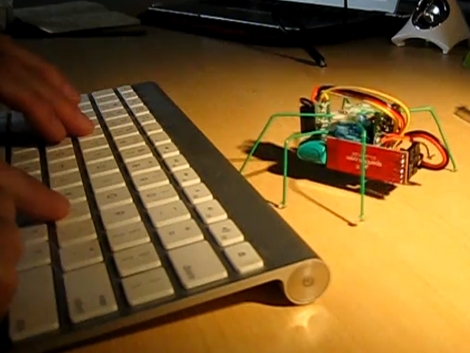
Here’s a small but functional hexapod that is controlled via Bluetooth. [Sigfpe] started with the hexapod kit sold by Polulu and added a BlueSMiRF modem to get the little guy’s communications up and running. But since the bot is merely three servos, a microcontroller board, sensors, and miscellaneous parts it’s an easy build for most electronic hobbyists.

Check out the video after the break to see the delightful dance it can perform at your bidding. When we first looked at the project we thought that the keyboard was directly paired with the bot for control, but a look at the code makes us think the computer is controlling it after processing keystrokes. Either way the BlueSMiRF should have no problem pairing with other Bluetooth devices so it’s just a matter of coding to get it taking commands from your device of choice. We’d love to see Android control but for the really hard-core code monkeys we think this should be voice controlled with a Bluetooth headset.

Continue reading “Jittering Hexapod Dances To The Strokes Of Your Bluetooth Keyboard”

A Trio Of Last-minute 555 Timer Projects

555_timer_secret_knock_circuit.jpg

[Bob] has been busy lately putting the finishing touches on three different projects that he plans on entering into the 555 Design Contest.

His first entry is a low-power H-bridge, which can be used to drive small servos. While he admits that it is a bit odd to build use a 555 timer to construct an H-bridge, they are cheap and plentiful enough to justify their use. Check out the video below to see the simple H-bridge controlling a servo.

[Bob’s] second entry is quite a bit more complex than his H-bridge. His secret knock detector listens for a pattern of knocks, triggering a relay if the proper cadence is detected. If a knock is heard, the first 555 timer starts, listening for another knock within a specific time range. If a knock is heard during this period, the next timer is triggered, and the process is repeated. Subsequent knocks must be timed correctly, or the circuit halts, waiting for a reset timer to expire before listening is resumed. It’s a bit hard to get the knocks just right, but that should be fixable with a few small tweaks.

The third entry he sent us is a project that is pretty common, though with a somewhat uncommon implementation. Class D amplifiers are often built as low-power headphone amps for personal audio applications. He liked the idea of a Class D amplifier, but wanted to build something with enough power to listen to his music in a small room. To accomplish this task, he looked over the internal block schematics of a 555 timer and constructed a pair of high-power 555 timers himself, using discrete components to mimic those usually found in the 555 package. His results were decent, though admittedly not of the highest quality, and could be tweaked a bit to provide better sound fidelity.

Continue reading to see videos of each project in action.

Continue reading “A Trio Of Last-minute 555 Timer Projects”

Analog Robotic Concepts

Everyone’s getting on board with the 555 timer projects. But [Tom] didn’t just come up with one project, he shared a slew of ideas related to analog robotics. They’re center around servo motor control. You can see in the video after the break he has a pleasing way of sharing a lot of details while also making an easy to view demonstration video. He’ll put up a schematic for about one second and then move on, saving those that don’t care about the details by not droning on.

The first schematic that flashes by is the main circuit for controlling the servo motor. The rest of the concepts build from this circuit, using light, sound, flex, and other sensors as inputs. For instance, the setup above is using a light sensor. When the ball blocks the light the servo moves that vertical rod hitting it out of the way. When it swings back the process repeats. It’s striking how lifelike the reactions are, reminding us of insect movements. But this is really just the tip of the iceberg as he’s got a lot of future video ideas that we can’t wait to see.

Continue reading “Analog Robotic Concepts”