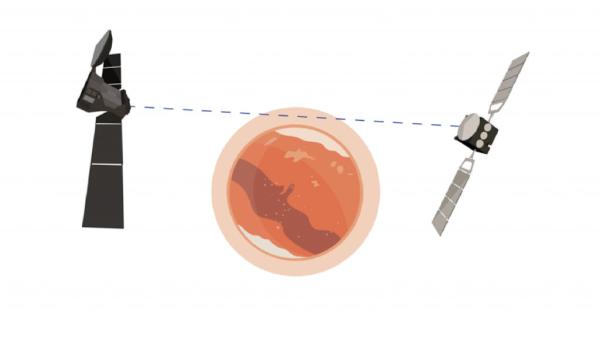
Two Mars Orbiters Chatted For Atmospheric Science

Mission extensions for interplanetary robot explorers are usually continuations of their primary mission. But sometimes the hardware already on board are put to novel uses. European Space Agency has started using radio equipment on board two Mars orbiters to probe the Martian atmosphere.

The scientific basis is straightforward: radio signals are affected by whatever they had traveled through. When transmitting data, such effects are noises to be minimized. But we can also leverage it for atmospheric science here on Earth. ESA applied the same concept at Mars: by transmitting a known signal from one Mars orbiter to another, changes in the received signal tells scientists something about the Martian atmosphere between them.

So the theory sounds good, but the engineering implementation took some work. Most radio equipment on board ESA’s orbiters were not designed to talk to each other. In fact they were deliberately different to minimize interference. However, both Mars Express and Trace Gas Orbiter were designed to act as data relays for surface probes, and not just the one they each carried to Mars. Thus their related radio gear were flexible enough to be adapted to this experiment.

These two machines launched over a decade apart. Yet they could now communicate with each other in Mars orbit using radios originally designed for talking to the surface. In the near future such chatter will probably be limited, as Trace Gas Orbiter is still in the middle of its primary mission. But this success lets ESA think about how much further to push the idea in the future. In the meantime Mars Express will continue its observation of Mars, doing things like giving us context on Perseverance rover landing.

Robot astronaut gazing at the moon

NASA’s New Moon Missions Are Happening Really Soon

NASA first landed a human on the moon back in 1969, and last achieved the feat in December 1972. In the intervening years, there have been few other missions to Earth’s primary natural satellite. A smattering of uncrewed craft have crashed into the surface, while a mere handful of missions have achieved a soft landing, with none successful from 1976 to 2013.

However, NASA aims to resume missions to the lunar surface, albeit in an uncrewed capacity at this stage. And you won’t have to wait very long, either. The world’s premier space agency aims to once again fly to the Moon beginning in February 2022.

Continue reading “NASA’s New Moon Missions Are Happening Really Soon”

30 Days Of Terror: The Logistics Of Launching The James Webb Space Telescope

Back during the 2019 Superconference in Pasadena, I had the chance to go to Northrop Grumman’s Redondo Beach campus to get a look at the James Webb Space Telescope. There is the high-bay class 10,000+ cleanroom in building M8, my wife and I along with fellow space nerd Tom Nardi got a chance to look upon what is likely the most expensive single object ever made. The $10 billion dollar space observatory was undergoing what we thought were its final tests before being packaged up and sent on its way to its forever home at the L2 Lagrange point.

Sadly, thanks to technical difficulties and the COVID-19 pandemic, it would be another two years before JWST was actually ready to ship — not a new story for the project, Mike Szczys toured the same facility back in 2015. But the good news is that it finally has shipped, taking the very, very slow first steps on its journey to space.

Both the terrestrial leg of the trip and the trip through 1.5 million kilometers of space are fraught with peril, of a different kind, of course, but still with plenty of chances for mission-impacting events. Here’s a look at what the priceless and long-awaited observatory will face along the way, and how its minders will endure the “30 days of terror” that lie ahead.

Continue reading “30 Days Of Terror: The Logistics Of Launching The James Webb Space Telescope”

Quick Reaction Saves ESA Space Telescope

Once launched, most spacecraft are out of reach of any upgrades or repairs. Mission critical problems must be solved with whatever’s still working on board, and sometimes there’s very little time. Recently ESA’s INTEGRAL team was confronted with a ruthlessly ticking three hour deadline to save the mission.

European Space Agency INTErnational Gamma-Ray Astrophysics Laboratory is one of many space telescopes currently in orbit. Launched in 2002, it has long surpassed its original designed lifespan of  two or three years, but nothing lasts forever. A failed reaction wheel caused the spacecraft to tumble out of control and its automatic emergency recovery procedures didn’t work. Later it was determined those procedures were dependent on the thrusters, which themselves failed in the summer of 2020. (Another mission-saving hack which the team had shared earlier.)

With solar panels no longer pointed at the sun, battery power became the critical constraint. Hampering this time-critical recovery effort was the fact that antenna on a tumbling spacecraft could only make intermittent radio contact. But there was enough control to shut down additional systems for a few more hours on battery, and enough telemetry so the team could understand what had happened. Control was regained using remaining reaction wheels.

INTEGRAL has since returned to work, but this won’t be the last crisis to face an aging space telescope. In the near future, its automatic emergency recovery procedures will be updated to reflect what the team has learned. Long term, ESA did their part to minimize space debris. Before the big heavy telescope lost its thrusters, it had already been guided onto a path which will reenter the atmosphere sometime around 2029. Between now and then, a very capable and fast-reacting operations team will keep INTEGRAL doing science for as long as possible.

Satellite image of hurrican Dorian

Hurricane Hunting From Outer Space

If you live in the right part of the world, you spend a lot of the year worried about hurricanes or — technically — tropical cyclones. These storms carry an amazing amount of power and can change your life. However, we are relatively spoiled these days compared to the past. It is hard to imagine, but there was a time when a hurricane’s arrival was something of a mystery. Sure, ships would report what they encountered, but finding exact data about a hurricane was a bit hit or miss. We often talk about space technology making life better. Weather forecasting — especially for tropical storms — is one place where money spent in space has made life much better on Earth.

The lack of data about storms can be fatal. The Great Galveston hurricane of 1900 took around 12,000 lives. It might have had a better outcome, but forecasters missed where the storm was heading, announcing that it would go from Cuba to Florida which was just totally wrong. Not that a forecaster couldn’t make a mistake today, but with aircraft and satellite coverage, you’d know very quickly that the prediction was wrong and you’d sound the alarm. In truth, the prediction models have become very good over the years, so the chances of this happening today are virtually nil in any event. But being able to precisely locate and track storms helps reduce the impact of the storm and also feeds data into the models that makes them even more accurate for the future.

Continue reading “Hurricane Hunting From Outer Space”

Review: Hands On With The Swarm Satellite Network Eval Kit

If you have devices out in the field, you probably want to connect with them. There was a time when that was hard to do, requiring telephone wires or specialized radio gear. Now cellular data is prevalent, but even cellular isn’t everywhere. If you have the cash, you can pay a number of satellite companies to carry your data, but that’s generally pricey and has its own challenges.

The age of satellite constellations is changing that. Of course everyone by now has heard of Starlink which is offering satellite internet via numerous satellites that are much smaller than traditional telecom satellites. But they’re not the only came in town.

A company called Swarm has put up a constellation of 1/4U cube satellites in low orbits. They offer a ground station that uses an omni antenna and a subscription access program for small amounts of data. They sent us a unit to review, and while I haven’t used the system in a real project yet, the kit was pretty impressive.

About Swarm

Swarm tile device
The Swarm Tile is made to mount on a PCB

The Swarm “tile” is a tiny radio that can talk bi-directionally with small satellites in low Earth orbit. The little unit is made to mount on a PCB, can control its power consumption, and talks to your system via a standard 3.3V UART connection. It does, however, require a small antenna and maybe even a smaller antenna for its GPS module. Small, in this case, is about a mid-size handy talkie antenna. There is a half-wave antenna that doesn’t need a ground plane and a shorter antenna that does need a ground plane.

Continue reading “Review: Hands On With The Swarm Satellite Network Eval Kit”

The Magnetosphere Has A Ton Of Energy. Can A Guitar Amp Company Tap Into It?

Researching a piece on vacuum tubes, we stumbled on something unexpected from Electro-Harmonix, best known for guitar amplifiers and audio tube manufacture. In a break from their core business, they plan to tap energy from the magnetosphere. This came as something of a surprise to their guitarist customers who were no doubt expecting a fancy new effects pedal, but it seems they’re serious.

The magnetosphere is the region of space surrounding the earth in which the earth’s magnetic field has most influence, and unlike the tidy pattern of magnetic field surrounding a bar magnet that you might have seen with iron filings at school, it’s distorted by the constant buffeting of the solar wind. This means that a significant quantity of potential energy is stored in its compression, and it’s this energy that Electro-Harmonix have their eye on.

Like Fox Mulder: we want to believe. Unfortunately the trouble with such ideas is readily visible with a quick web search; they attract a significant number of what one might charitably call cranks, and there is no shortage of unsubstantiated claims surrounding conspiracy theories, silenced genus inventors, and their mystery devices. Weird and wonderful descriptions and cryptic circuit diagrams abound, so separating the wheat if there is any from the inevitable chaff becomes a challenge. We respect that the Electro-Harmonix team are professional engineers who we hope are unlikely to become caught up in the weirder part of the Internet, but we’ll reserve our judgement until they provide more technical details of what they propose.

Header: NASA, Public domain.